
[论文解读] Demonstration of Robust and Efficient Quantum Property Learning with Shallow Shadows
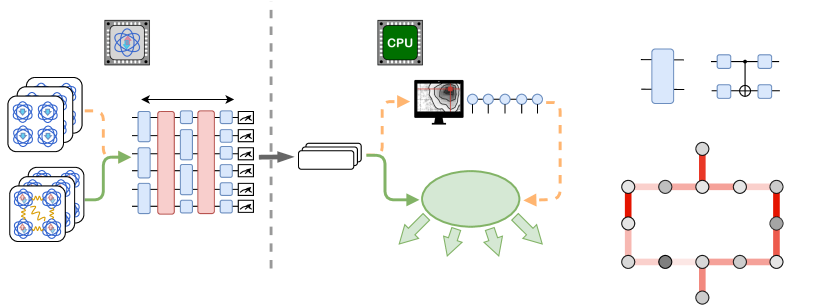
本文提出了一种抗噪声的浅层阴影协议(robust shallow shadows protocol),这是一种通过贝叶斯推断对浅层随机量子线路中的实验噪声进行建模与校正的噪声抑制型量子性质学习框架。该方法可在噪声超导硬件上实现对量子态性质(如保真度、纠缠熵和期望值)的精确估计,且样本复杂度低于标准的随机单量子比特测量方法。
Extracting information efficiently from quantum systems is a major component of quantum information processing tasks. Randomized measurements, or classical shadows, enable predicting many properties of arbitrary quantum states using few measurements. While random single-qubit measurements are experimentally friendly and suitable for learning low-weight Pauli observables, they perform poorly for nonlocal observables. Prepending a shallow random quantum circuit before measurements maintains this experimental friendliness, but also has favorable sample complexities for observables beyond low-weight Paulis, including high-weight Paulis and global low-rank properties such as fidelity. However, in realistic scenarios, quantum noise accumulated with each additional layer of the shallow circuit biases the results. To address these challenges, we propose the \emph{robust shallow shadows protocol}. Our protocol uses Bayesian inference to learn the experimentally relevant noise model and mitigate it in postprocessing. This mitigation introduces a bias-variance trade-off: correcting for noise-induced bias comes at the cost of a larger estimator variance. Despite this increased variance, as we demonstrate on a superconducting quantum processor, our protocol correctly recovers state properties such as expectation values, fidelity, and entanglement entropy, while maintaining a lower sample complexity compared to the random single qubit measurement scheme. We also theoretically analyze the effects of noise on sample complexity and show how the optimal choice of the shallow shadow depth varies with noise strength. This combined theoretical and experimental analysis positions the robust shallow shadow protocol as a scalable, robust, and sample-efficient protocol for characterizing quantum states on current quantum computing platforms.
研究动机与目标
- 填补浅层阴影在真实噪声条件下实验验证的空白。
- 克服浅层量子线路中噪声引入的量子性质估计偏差。
- 在保持低样本复杂度的同时,实现对保真度和纠缠熵等非局域与全局可观测量的鲁棒估计。
- 开发一种后处理框架,从校准数据中学习噪声模型,以校正测量偏差。
- 在真实127量子比特超导处理器(ibm_kyiv)上展示该协议的可扩展性与高效性。
提出的方法
- 在单量子比特测量前添加浅层随机量子线路,以实现对非局域与全局可观测量的高效学习。
- 利用贝叶斯推断,从在量子处理器上采集的实验校准数据中学习设备特定的噪声模型。
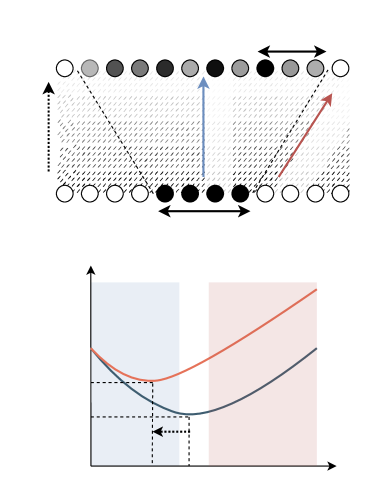
- 应用后处理缓解技术,校正估计量期望中的噪声诱导偏差,实现偏差与方差的平衡。
- 构建空间相关噪声模型,以捕捉多量子比特线路中的真实噪声效应。
- 利用经典阴影框架,实现从单个数据集“测量一次,学习多次”的性质估计。
- 理论分析量化了噪声对最优线路深度与样本复杂度的影响,为协议设计提供指导。
实验结果
研究问题
- RQ1浅层量子线路中的噪声在多大程度上影响使用经典阴影进行量子性质估计的准确性?
- RQ2在真实噪声条件下,浅层随机线路的最优深度是多少?其与噪声强度的关系如何?
- RQ3贝叶斯推断能否有效学习并缓解后处理中的设备特定噪声,从而恢复估计器的准确性?
- RQ4与单量子比特随机测量相比,稳健浅层阴影协议在多大程度上降低了样本复杂度?
- RQ5该协议能否在噪声近场量子硬件上可靠地恢复全局性质,如保真度与纠缠熵?
主要发现
- 该稳健浅层阴影协议在存在显著噪声的情况下,成功在127量子比特超导处理器(ibm_kyiv)上恢复了量子态性质,包括期望值、保真度与纠缠熵。
- 即使在真实噪声条件下,该协议的样本复杂度仍低于标准的单量子比特随机测量方案。
- 理论分析表明,随着噪声强度增加,最优浅层线路深度减小,且该权衡关系可被定量刻画。
- 贝叶斯噪声建模有效缓解了噪声引起的偏差,尽管导致估计器方差增加,但该方差在实验中可被有效管理。
- 蒙特卡洛模拟与对AKLT态和贝尔态的实验数据均表明,该协议在不同量子态与线路深度下均表现出一致的性能。
- 该协议能够准确估计低秩全局可观测量,如保真度与纠缠熵,而这些量在单量子比特随机测量中估计效果极差。
更好的研究,从现在开始
从阅读论文到最终审阅,大幅缩短您的研究时间。
无需绑定信用卡
本解读由 AI 生成,并经人工编辑审核。