
[论文解读] Density-matrix-renormalization-group-based downfolding of the three-band Hubbard model: the importance of density-assisted hopping
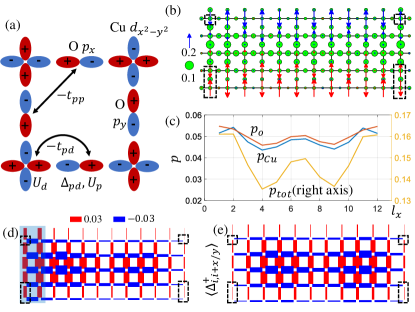
该论文使用 DMRG 计算得到的自然轨道将三带哈伯模型(埃梅里模型)降维为单带模型,揭示了一个显著的密度辅助跳跃项(t_n),该项在空穴掺杂的成对和迁移性方面对超越均场期望产生了显著影响。
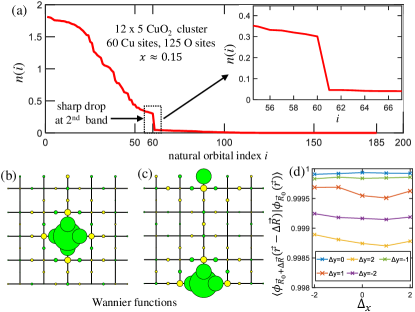
Typical Wannier-function downfolding starts with a mean-field or density functional set of bands to construct the Wannier functions. Here we carry out a controlled approach, using DMRG-computed natural orbital bands, to downfold the three-band Hubbard model to an effective single band model. A sharp drop-off in the natural orbital occupancy at the edge of the first band provides a clear justification for a single-band model. Constructing Wannier functions from the first band, we compute all possible two-particle terms and retain those with significant magnitude. The resulting single-band model includes two-site density-assisted hopping terms with $t_n \sim 0.6 t$. These terms lead to a reduction of the ratio $U/t_{ m eff}$, and are important in capturing the doping-asymmetric carrier mobility, as well as in enhancing the pairing in a single-band model for the hole-doped cuprates.
研究动机与目标
- 通过使用 DMRG 推导的自然轨道,将三带哈伯模型降维为单带模型的合理性。
- 在 Wannier 变换中识别并保留重要的两粒子项。
- 展示密度辅助跳跃项如何重新标定有效跳跃并影响配对。
- 证明这些项对捕捉掺杂不对称性和超导倾向至关重要。
- 评估均场处理对密度辅助跳跃项的局限性。
提出的方法
- 从三带哈伯模型的 DMRG 计算中获得自然轨道以识别占据的带带。
- 从第一自然带构建以铜为中心的 Wannier 函数并推导 Wannier 哈密顿量。
- 将三带哈密顿量转换到 Wannier 基底并截断为显著的一粒子和两粒子项。
- 基于大小准则保留密度辅助跳跃项 t_n 及其邻域项 t_n'、t_n''。
- 将降维得到的单带模型(含 t_n)与均场有效哈伯模型(t_eff)进行比较,以评估对迁移性和配对的影响。
- 在边缘场下评估超导相刚度以衡量配对倾向。
实验结果
研究问题
- RQ1单带模型能否准确再现铅铜酸盐的三带哈伯模型的关键特征?
- RQ2降维模型中密度辅助跳跃项的作用与量级为何?
- RQ3t_n 及相关项如何影响空穴掺杂的迁移性与配对,与均场 t_eff 相比有何不同?
- RQ4密度辅助跳跃是否在空洞掺杂系统中从定性上改变超导倾向?
- RQ5降维是否在不同的三带参数区间和系统规模下具有鲁棒性?
主要发现
- 第一带之后的自然轨道占据值急剧下降,为单带降维提供了合理性。
- 得到的 Wannier 单带模型包括相当规模的两站点密度辅助跳跃项 t_n ~ 0.6 t,以及相关的 t_n' 和 t_n'' 项。
- 密度辅助跳跃通过 t_eff = t + t_n ⟨n⟩ 降低有效 U/t 比,提升空穴的迁移性,促进配对。
- 对 t_n 的均场处理低估了空穴对的迁移性,无法捕捉在完整的 t-t_n-U 模型中观察到的增强配对。
- 边缘场测试显示在空洞掺杂情况下,t-t_n-U 模型的超导相刚度显著高于 t_eff-U 模型。
- 降维模型在空穴和电子掺杂下具有相似的 Wannier 几度重叠,表明降维受局部物理支配。
更好的研究,从现在开始
从阅读论文到最终审阅,大幅缩短您的研究时间。
无需绑定信用卡
本解读由 AI 生成,并经人工编辑审核。