
[论文解读] Depth-conditioned Dynamic Message Propagation for Monocular 3D Object Detection
本文提出DDMP-3D,一种基于图的算法,通过动态采样上下文感知节点,并利用深度条件化的多尺度滤波权重与关联矩阵,实现单目3D目标检测中的特征传播。该方法在KITTI基准上实现最先进性能,截至2020年11月16日,在单目3D检测赛道中排名第一,其关键在于引入了中心感知的深度编码任务,以缓解不准确的深度先验问题。
The objective of this paper is to learn context- and depth-aware feature representation to solve the problem of monocular 3D object detection. We make following contributions: (i) rather than appealing to the complicated pseudo-LiDAR based approach, we propose a depth-conditioned dynamic message propagation (DDMP) network to effectively integrate the multi-scale depth information with the image context;(ii) this is achieved by first adaptively sampling context-aware nodes in the image context and then dynamically predicting hybrid depth-dependent filter weights and affinity matrices for propagating information; (iii) by augmenting a center-aware depth encoding (CDE) task, our method successfully alleviates the inaccurate depth prior; (iv) we thoroughly demonstrate the effectiveness of our proposed approach and show state-of-the-art results among the monocular-based approaches on the KITTI benchmark dataset. Particularly, we rank $1^{st}$ in the highly competitive KITTI monocular 3D object detection track on the submission day (November 16th, 2020). Code and models are released at \url{https://github.com/fudan-zvg/DDMP}
研究动机与目标
- 为解决单目3D目标检测面临的尺度变化与单视角RGB图像中缺乏深度线索的问题。
- 克服伪LiDAR方法依赖不准确深度图并丢弃RGB图像语义信息的局限性。
- 通过动态、深度感知的方式融合多尺度深度特征与图像上下文,提升特征表示能力。
- 通过辅助的中心感知深度编码任务,减轻不准确深度先验对3D定位的影响。
- 在不依赖昂贵LiDAR传感器的前提下,实现单目3D目标检测的最先进性能。
提出的方法
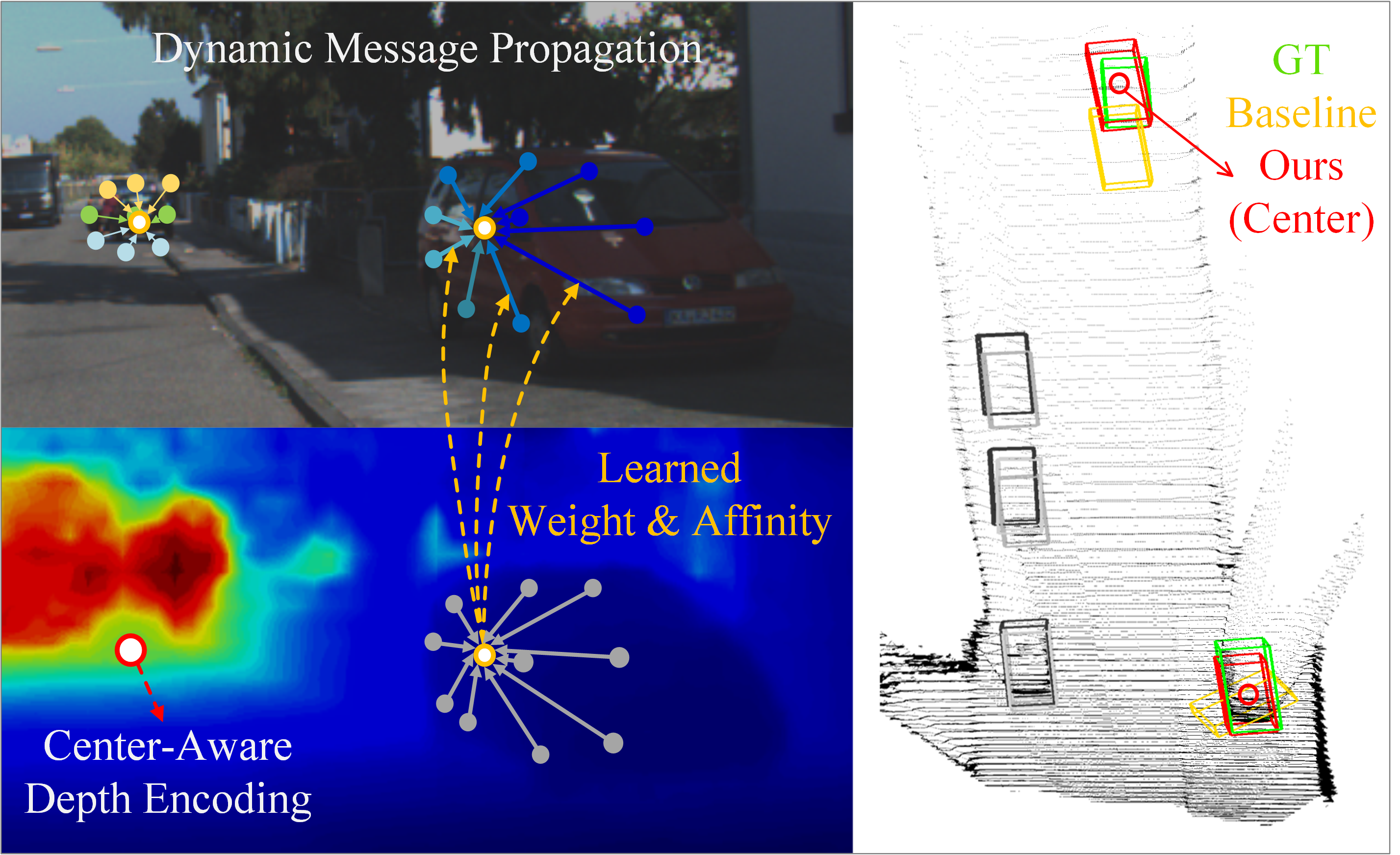
- 该方法采用基于图的建模方式,将每个特征图像素视为一个节点,从而实现对上下文相关邻近节点的动态采样。
- 提出深度条件化的动态消息传播机制,利用多尺度深度特征学习混合的、与深度相关的滤波权重与关联矩阵,实现特征传播。
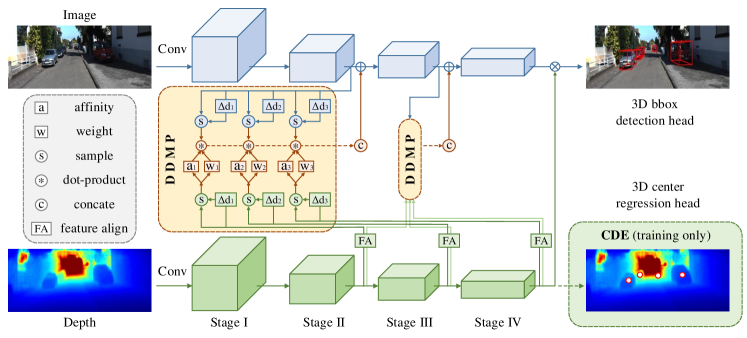
- 网络采用双分支结构:一个用于3D检测,另一个用于深度特征提取;DDMP模块在图像分支上运行,利用来自底部分支的深度特征。
- 引入中心感知深度编码(CDE)任务作为辅助损失,引导深度特征具备实例感知能力,从而提升定位精度。
- 模型采用端到端联合优化进行训练,推理阶段则移除CDE头。
- 使用多尺度深度特征以增强对不同物体尺度的感知能力,提升对透视失真的鲁棒性。
实验结果
研究问题
- RQ1基于多尺度深度特征的动态消息传播是否能提升单目3D检测中的上下文感知特征学习?
- RQ2与简单的特征融合或伪LiDAR方法相比,引入深度感知图传播对3D检测性能有何影响?
- RQ3中心感知深度编码任务在多大程度上能缓解不准确深度先验对3D定位的负面影响?
- RQ4所提方法是否能在不同深度估计网络(如单目与立体匹配估计器)上实现良好泛化?
- RQ5所提方法是否能在不依赖LiDAR数据的前提下,实现在KITTI基准上的最先进性能?
主要发现
- 所提DDMP-3D模型在KITTI 3D检测基准的'easy'子集上达到30.83%的平均精度(AP),并于2020年11月16日成为官方单目3D检测排行榜第一名。
- 消融实验表明,仅使用动态消息传播即可使'moderate'子集的AP从18.82%提升至22.36%,验证了图机制的有效性。
- 使用多尺度深度特征(Group III)相比单尺度深度特征带来0.48%的性能增益,证实了尺度感知深度感知的优势。
- 引入中心感知深度编码(CDE)任务后,'easy'子集的AP从28.12%提升至31.14%,表明定位精度获得显著提升。
- 该方法在'easy'和'moderate'子集上分别优于基线模型5.42%和6.50%,也优于D⁴LCN模型。
- 该模型在不同深度估计器(包括DORN和PSMNet)上均表现出一致的性能提升,表明对不同深度质量具有强泛化能力。
更好的研究,从现在开始
从阅读论文到最终审阅,大幅缩短您的研究时间。
无需绑定信用卡
本解读由 AI 生成,并经人工编辑审核。