
[论文解读] Deriving a genetic regulatory network from an optimization principle
本文通过在生物约束条件下优化最大位置信息,推导出果蝇原肠胚节基因调控网络。基于含噪声、扩散和调控反馈的随机空间模型,研究发现当资源分配和噪声最小时,最优网络会自然涌现,揭示了交叉调控和多种母源形态发生素在高保真度模式形成中的关键作用。
Many biological systems approach physical limits to their performance, motivating the idea that their behavior and underlying mechanisms could be determined by such optimality. Nevertheless, optimization as a predictive principle has only been applied in very simplified setups. Here, in contrast, we explore a mechanistically-detailed class of models for the gap gene network of the Drosophila embryo, and determine its 50+ parameters by optimizing the information that gene expression levels convey about nuclear positions, subject to physical constraints on the number of available molecules. Optimal networks recapitulate the architecture and spatial gene expression profiles of the real organism. Our framework makes precise the many tradeoffs involved in maximizing functional performance, and allows us to explore alternative networks to address the questions of necessity vs contingency. Multiple solutions to the optimization problem may be realized in closely related organisms.
研究动机与目标
- 确定基因调控网络在早期原肠胚发育中如何演化以最大化位置信息。
- 研究噪声、扩散和资源约束如何塑造最优基因调控架构。
- 评估原肠胚节基因数量和母源形态发生素输入如何影响胚胎模式形成的鲁棒性和精确度。
- 评估在生物约束下,交叉调控和反馈在实现高保真空间模式中的必要性。
提出的方法
- 使用包含蛋白质合成、降解、扩散和噪声的耦合随机微分方程,构建原肠胚节基因表达的空间-随机模型。
- 引入归一化的蛋白质拷贝数和噪声功率,以实现不同最大表达水平基因之间的比较。
- 基于Hill型动力学设计调控函数,模拟母源基因和原肠胚节基因输入对基因激活的响应。
- 采用多阶段优化流程,结合模拟退火与梯度下降,以最大化位置信息。
- 利用最优解码理论计算位置误差和信息量,并通过模式距离度量评估多样性与鲁棒性。
- 对调控强度施加约束,并探索基因数量或母源输入减少的场景,以测试网络鲁棒性与设计原则。
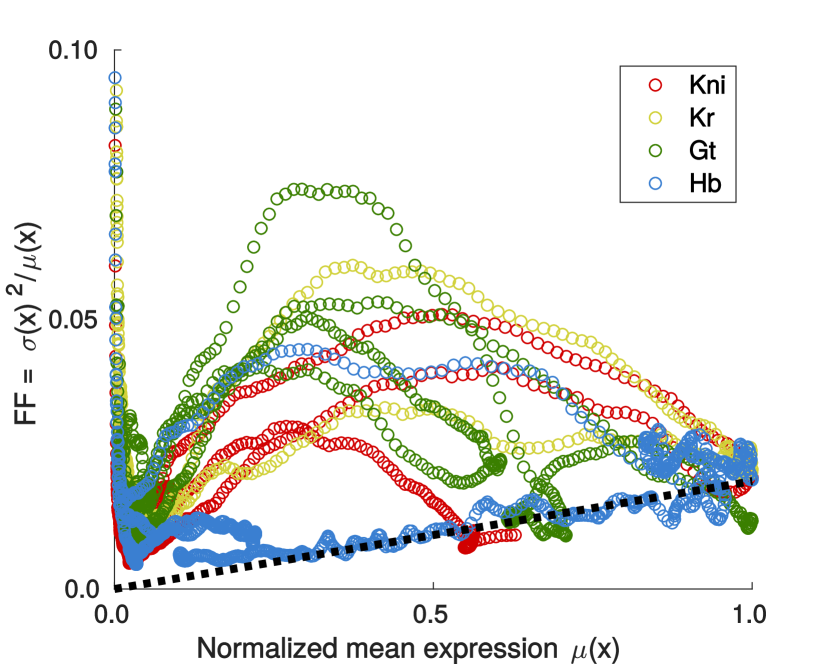
实验结果
研究问题
- RQ1在现实生物约束下,何种调控网络架构能最大化果蝇胚胎中的位置信息?
- RQ2噪声、扩散和资源分配如何塑造原肠胚节基因网络的最优结构?
- RQ3实现高保真度模式所需的最少原肠胚节基因数和母源形态发生素输入数是多少?
- RQ4若缺乏交叉调控或调控强度受限,对最优模式的鲁棒性和多样性有何影响?
- RQ5前馈调节在多大程度上可实现高位置信息?其与完整调控网络相比表现如何?
主要发现
- 最优网络在5个原肠胚节基因下实现最大位置信息4.84比特,对应28个可区分位置,从4个增至5个基因仅增加0.07比特。
- 包含3个母源形态发生素梯度(前极、后极、末端)可实现比仅使用单一梯度更高的位置信息,尤其在调控强度较低时更为显著。
- 交叉调控和自调控能显著补偿调控强度降低的影响,当H_max = 3时,仅前馈网络性能急剧下降。
- 仅有一个母源形态发生素输入时,最优模式变得不对称,资源集中于前极,凸显多输入对平衡模式形成的重要性。
- 3基因网络表现出局部位置缺陷,而4-和5基因网络则实现更高且更稳定的位置信息。
- 在仅前馈网络中,最优模式的多样性显著降低,尤其在H_max较低时,表明反馈对实现鲁棒且多样的解决方案至关重要。
更好的研究,从现在开始
从阅读论文到最终审阅,大幅缩短您的研究时间。
无需绑定信用卡
本解读由 AI 生成,并经人工编辑审核。