
[论文解读] Design principles for shift current photovoltaics
本文通过分析将光响应度与波函数依赖的矩阵元及能带结构相联系的有效能带边模型,确立了优化移位电流光伏器件的设计原则。研究识别出铁电聚合物和单层正交相单硫属化物(如GeS)为最佳候选材料,预测其光响应度可超过100 mA/W,表明移位电流器件在效率上具备超越传统太阳能电池的潜力。
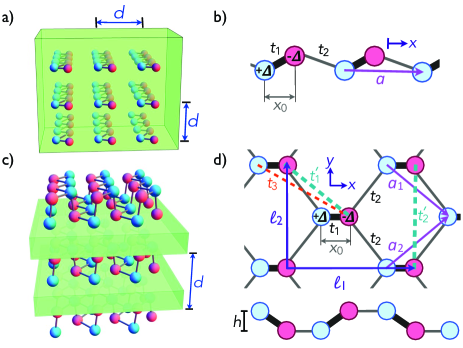
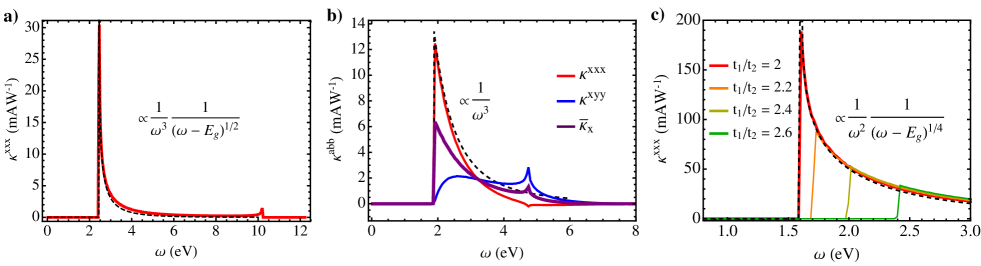
While the basic principles and limitations of conventional solar cells are well understood, relatively little attention has gone toward maximizing the potential efficiency of photovoltaic devices based on shift currents. In this work, we outline simple design principles for the optimization of shift currents for frequencies near the band gap, derived from the analysis of a general effective model. The use of a novel sum rule allows us to express the band edge shift current in terms of a few model parameters and to show it depends explicitly on wavefunctions via Berry connections in addition to standard band structure. We use our approach to identify two new classes of shift current photovoltaics, ferroelectric polymer films and single-layer orthorhombic monochalcogenides such as GeS. We introduce tight-binding models for these systems, and show that they exhibit the largest shift current responsivities at the band edge reported so far. Moreover, exploring the parameter space of these models we find photoresponsivities that can exceed $100$ mA/W. Our results show how the study of the shift current via effective models allows one to improve the possible efficiency of devices based on this mechanism and better grasp their potential to compete with conventional solar cells.
研究动机与目标
- 识别超越传统pn结限制的移位电流光伏效率最大化的一般设计原则。
- 解决在优化体光伏效应(BPVE)方面缺乏系统性理解的问题,而BPVE对电子波函数极为敏感。
- 构建一个最小有效模型,以捕捉能带边移位电流响应的本质物理机制。
- 将模型参数与实际的紧束缚模型关联,并预测具有优异光响应度的材料。
- 证明移位电流光伏器件可实现与传统太阳能电池相当或更优的性能。
提出的方法
- 作者推导出一种用于能带边移位电流的有效双能带模型,将其表达为联合态密度(JDOS)与波函数依赖的矩阵元的乘积。
- 识别出类狄拉克半金属能带色散为最大化移位电流前因子的最优条件,因其增强了波函数的非对称性。
- 通过同时拟合能带能量和规范不变的波函数量(特别是贝里曲率与量子度规)来拟合紧束缚模型,确保波函数结构的准确性。
- 通过将参数拟合至真实材料(如GeS)来验证模型,输入包括带隙、有效质量以及贝里曲率的导数等参数。
- 在有效模型中解析计算移位电流,在紧束缚框架中进行数值计算,从而实现参数空间的探索。
- 该方法可通过优化模型参数以在带隙附近最大化移位电流响应,实现对高响应度材料的预测。
实验结果
研究问题
- RQ1哪些能带结构特征可在不依赖材料特异性细节的前提下,最大化能带边的移位电流响应?
- RQ2如何系统地将波函数依赖的贡献整合进可预测的模型中?
- RQ3哪些材料类别展现出最优的能带结构与波函数非对称性组合,以实现高光响应度?
- RQ4能否通过基于从头算数据拟合的最小有效模型,准确预测真实材料中的移位电流?
- RQ5移位电流光伏器件的光响应度理论上限是多少?哪些材料接近该上限?
主要发现
- 铁电聚合物薄膜和单层正交相单硫属化物(如GeS)表现出迄今报道的最大能带边响应度。
- 移位电流响应强烈依赖于电子波函数的形状,而不仅取决于能带结构;类狄拉克半金属色散提供了最优条件。
- 通过将紧束缚模型拟合至从头算数据(包括贝里曲率与量子度规),模型准确再现了对移位电流至关重要的波函数依赖物理机制。
- 在优化参数区域,模型预测光响应度可超过100 mA/W,显著高于传统光伏器件的典型值。
- 具有低维、各向异性能带结构及强波函数非对称性的材料,是高性能移位电流光伏器件的理想候选。
- 本研究建立了一般性框架,基于波函数敏感的设计原则,用于识别和优化移位电流器件的材料。
更好的研究,从现在开始
从阅读论文到最终审阅,大幅缩短您的研究时间。
无需绑定信用卡
本解读由 AI 生成,并经人工编辑审核。