
[论文解读] Detection of Covid-19 From Chest X-ray Images Using Artificial Intelligence: An Early Review
本论文综述使用胸部X线影像检测COVID-19肺炎的AI方法,报道了若干深度学习模型及其在小数据集上的准确率。讨论将COVID-19肺炎与其他原因引起的肺炎在区分上的挑战。
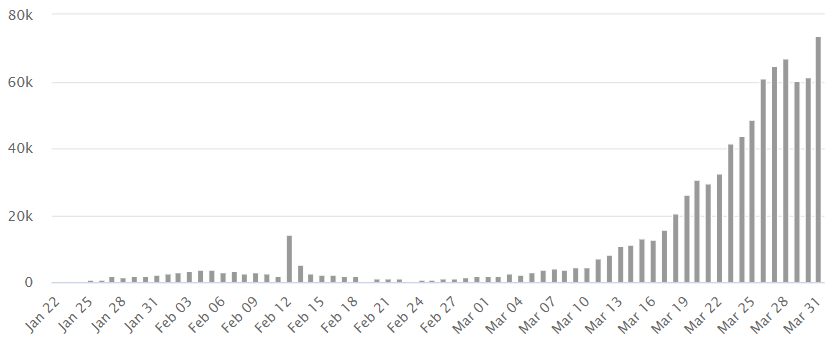
In 2019, the entire world is facing a situation of health emergency due to a newly emerged coronavirus (COVID-19). Almost 196 countries are affected by covid-19, while USA, Italy, China, Spain, Iran, and France have the maximum active cases of COVID-19. The issues, medical and healthcare departments are facing in delay of detecting the COVID-19. Several artificial intelligence based system are designed for the automatic detection of COVID-19 using chest x-rays. In this article we will discuss the different approaches used for the detection of COVID-19 and the challenges we are facing. It is mandatory to develop an automatic detection system to prevent the transfer of the virus through contact. Several deep learning architecture are deployed for the detection of COVID-19 such as ResNet, Inception, Googlenet etc. All these approaches are detecting the subjects suffering with pneumonia while its hard to decide whether the pneumonia is caused by COVID-19 or due to any other bacterial or fungal attack.
研究动机与目标
- 促进从胸部X线影像中实现COVID-19的自动化、非接触式检测,以帮助快速隔离和治疗。
- 总结用于X线数据中COVID-19检测的现有AI/深度学习方法(例如ResNet、Inception、GoogLeNet)。
- 突出挑战、数据局限性,以及需要更大规模、多类别的数据集以实现COVID-19与其他肺炎的可靠区分。
提出的方法
- 对基于AI的胸部X线影像COVID-19检测方法的文献综述。
- 整理小型数据集上报告的模型性能并在不同架构之间进行比较。
- 讨论挑战,如将COVID-19肺炎与其他肺炎区分开来以及数据稀缺问题。
实验结果
研究问题
- RQ1已经探索了哪些用于从胸部X线图像检测COVID-19的深度学习架构?
- RQ2这些方法的报告准确性和数据集大小是多少?它们揭示了哪些局限性?
- RQ3哪些挑战阻碍从X线图像实现可靠、临床级的COVID-19检测?
主要发现
- 多项研究在小数据集(50–728张图像)上报告了较高的准确率(约高达98%),使用的模型包括ResNet50、InceptionV3、VGG19等。
- 迁移学习和深层特征在有限数据上实现了显著的性能,应用广泛。
- 一个主要挑战是将COVID-19肺炎与其他肺炎的病因区分开来,因为许多模型专注于肺炎检测而非COVID-19特异性。
- 本文强调需要更大、更多样化的多类别胸部X线数据集,以提高泛化能力并实现COVID-19与其他肺炎的精确分类。
- 早期的AI方法在快速筛查方面显示出潜力,但高度依赖数据质量和带标签的COVID-19病例。
- 讨论将X线中的COVID-19检测置于CT基于AI方法和更广泛的AI驱动的疫情监测工具的语境中。
更好的研究,从现在开始
从阅读论文到最终审阅,大幅缩短您的研究时间。
无需绑定信用卡
本解读由 AI 生成,并经人工编辑审核。