
[论文解读] Detection of presence and number of persons by a Wi-Fi signal: a practical RSSI-based approach
本文提出了一种实用的基于RSSI的方法,仅使用Wi-Fi信号强度即可检测房间内人员的存在并计数,无需人员主动配合。通过分析RSSI时间序列的标准差,并在仅四个探测器的数据上应用机器学习(尤其是随机森林),该方法在人员计数上的预测准确率达到98%,使用五个探测器时准确率可达99%。
We present experimental results and theoretical methods for the precise determination of the presence and the number of persons in an observed area by using Wi-Fi signals. Our setup does not require active cooperation of persons present in the Wi-Fi field, and relies only on the Received Signal Strength Indicator (RSSI), which is read by the detectors. We first show that the standard deviation of the measured RSSI data can be used as a practical tool to establish the presence of a person (or more persons) with high precision, in particular when the signal source is inside the measurement room. For the more difficult problem of counting the number of persons, we have employed machine learning algorithms to analyze data collected on nine different detectors and up to nine people present in our experiment. We have achieved excellent results (prediction accuracy of $98 \%$ and above) for counting already with only few detectors utilized in the analysis. While generalizations to nontrivial indoor geometries (such as odd shapes, more rooms, and greater size) may be of interest in some applications, where additional care with respect to positioning od detectors can be needed (or even placing additional detectors), this approach may be useful due to its conceptual practicality and solid prediction results.
研究动机与目标
- 开发一种被动的、非协作的室内环境人员检测与计数方法,仅依赖Wi-Fi RSSI信号。
- 确定RSSI时间序列的标准差是否可作为人员存在的可靠指标。
- 评估机器学习算法在基于多探测器RSSI数据准确分类人员数量方面的性能。
- 确定实现高精度人员计数所需的最少探测器数量。
- 评估信号源位置(室内与室外)对检测与计数性能的影响。
提出的方法
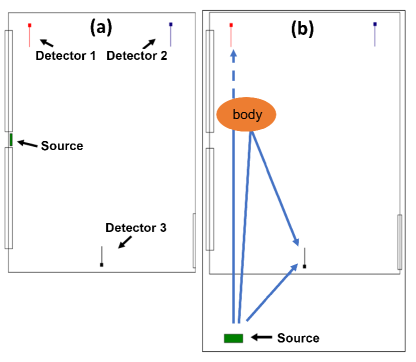
- 本研究使用九个固定探测器在室内环境中采集的RSSI测量值,以监测信号强度随时间的变化。
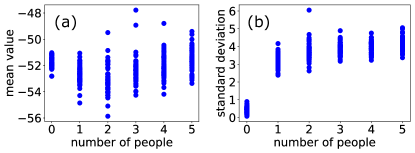
- 将RSSI时间序列的标准差作为关键特征,用于检测一人或多人的存在,因为当人员在场时该值会显著增加。
- 在人员计数方面,使用机器学习算法(包括K近邻、决策树和随机森林)对RSSI数据进行训练,以分类人员数量(1至9人)。
- 通过从1到9台探测器的配置,评估每种算法的预测准确率,以确定最小有效配置。
- 分析包括两种场景:Wi-Fi接入点位于室内和位于室外,以评估鲁棒性。
- 随机森林算法被选为性能最佳的模型,因其在不同探测器配置下均表现出高准确率和稳定性。
实验结果
研究问题
- RQ1RSSI时间序列的标准差能否在无需人员主动配合的情况下,可靠检测到房间内一人或多个人的存在?
- RQ2使用RSSI信号实现高精度人员计数所需的最少探测器数量是多少?
- RQ3Wi-Fi接入点的位置(室内与室外)如何影响检测与计数性能?
- RQ4基于RSSI数据训练的机器学习模型在多大程度上能准确分类房间内的人员数量?
- RQ5随着探测器数量的增加,预测准确率如何提升?是否在少量探测器后即趋于稳定?
主要发现
- RSSI时间序列的标准差是检测一人或多个人存在的高度有效特征,即使仅使用一台探测器也能实现高精度。
- 当Wi-Fi接入点位于房间内时,基于标准差的方法可实现对人员存在的准确二元检测。
- 在人员计数方面,机器学习模型在仅使用四台探测器的数据时即可实现98%的预测准确率,使用五台探测器时准确率提升至99%。
- 随机森林算法优于其他模型,在分类人员数量(1至9的奇数)方面达到99%的平均准确率。
- 预测准确率随探测器数量增加而提升,但在四至五台探测器后显著趋于稳定,表明最小配置即可实现优异性能。
- 即使信号源位于房间外,该方法仍具有效性,但当接入点位于室内时性能通常更优。
更好的研究,从现在开始
从阅读论文到最终审阅,大幅缩短您的研究时间。
无需绑定信用卡
本解读由 AI 生成,并经人工编辑审核。