
[论文解读] Differential voltage analysis for battery manufacturing process control
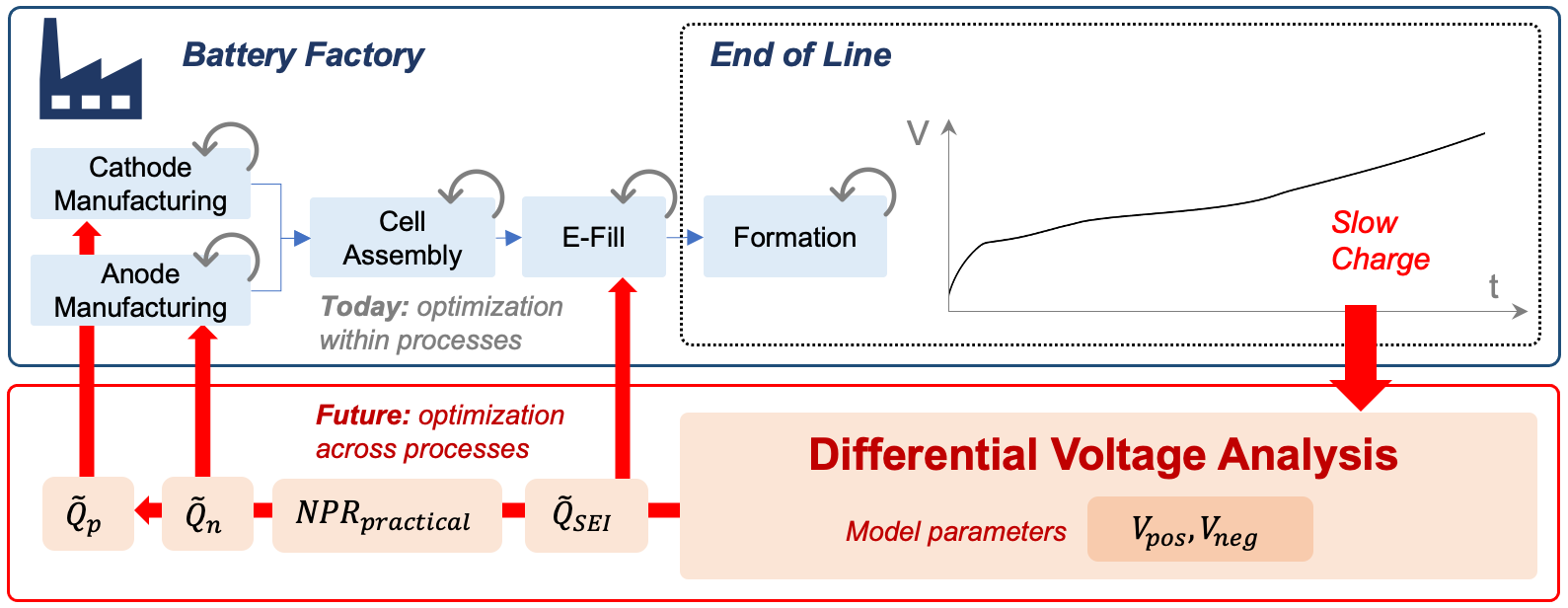
本文提出了一种用于电池生产线末端过程控制的自动化、可重复的微分电压分析(DVA)框架,利用全电池电压曲线提取可电化学解释的指标,如形成过程中消耗的锂量和实际负极与正极比。该方法通过形式化因‘不可及锂问题’导致的模型不确定性,改进了传统DVA,实现了非破坏性、可扩展的诊断,将制造变异与长期电池性能关联起来。
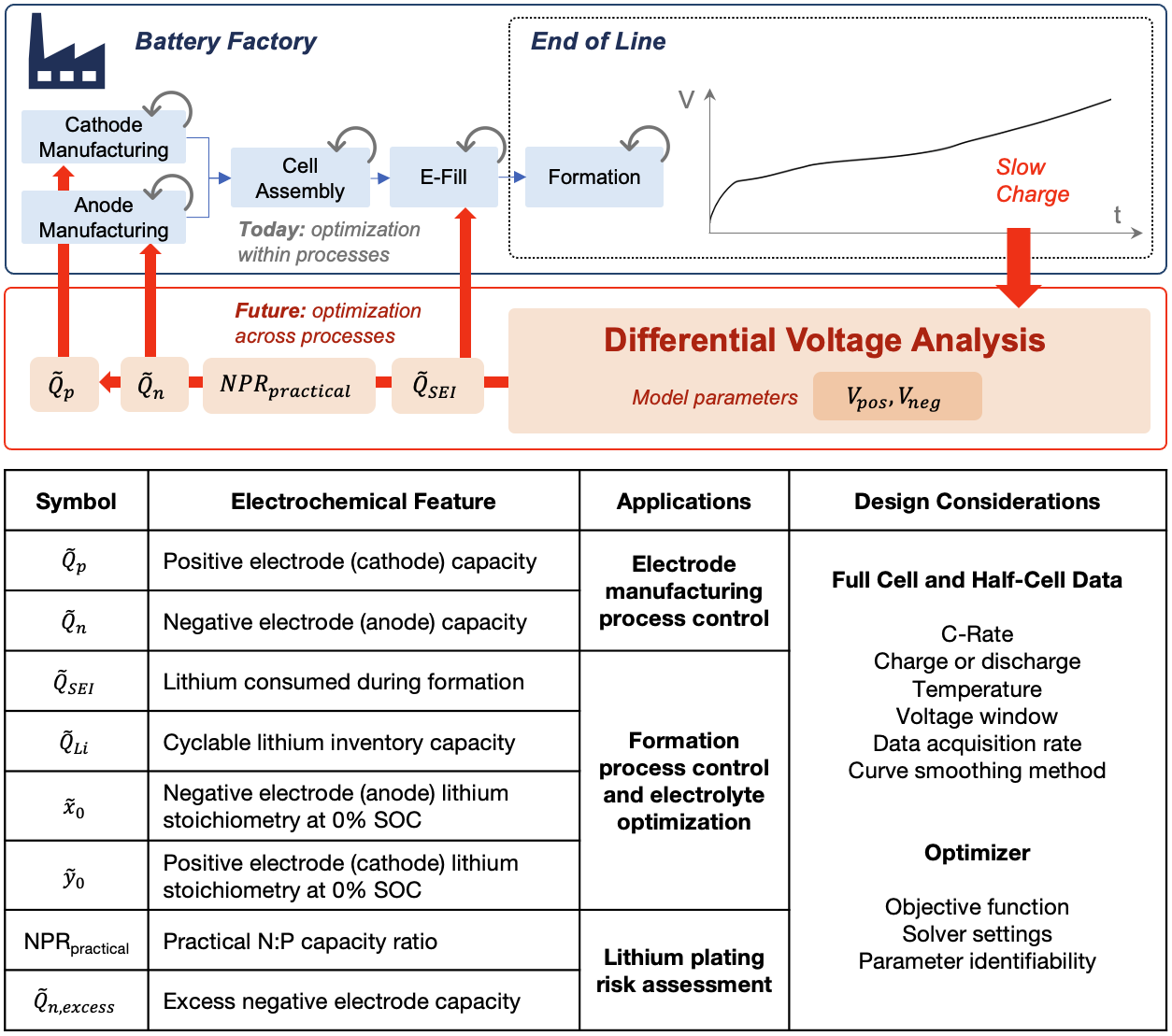
Voltage-based battery metrics are ubiquitous and essential in battery manufacturing diagnostics. They enable electrochemical "fingerprinting" of batteries at the end of the manufacturing line and are naturally scalable, since voltage data is already collected as part of the formation process which is the last step in battery manufacturing. Yet, despite their prevalence, interpretations of voltage-based metrics are often ambiguous and require expert judgment. In this work, we present a method for collecting and analyzing full cell near-equilibrium voltage curves for end-of-line manufacturing process control. The method builds on existing literature on differential voltage analysis (DVA or dV/dQ) by expanding the method formalism through the lens of reproducibility, interpretability, and automation. Our model revisions introduce several new derived metrics relevant to manufacturing process control, including lithium consumed during formation and the practical negative-to-positive ratio, which complement standard metrics such as positive and negative electrode capacities. To facilitate method reproducibility, we reformulate the model to account for the "inaccessible lithium problem" which quantifies the numerical differences between modeled versus true values for electrode capacities and stoichiometries. We finally outline key data collection considerations, including C-rate and charging direction for both full cell and half cell datasets, which may impact method reproducibility. This work highlights the opportunities for leveraging voltage-based electrochemical metrics for online battery manufacturing process control.
研究动机与目标
- 解决基于电压的指标在电池制造中解释时的模糊性和对专家的依赖性。
- 通过形式化模型不确定性,提高端末测试中微分电压分析(DVA)的可重复性和可解释性。
- 开发新的电化学特征(如形成过程中消耗的锂量和实际负极与正极比),以直接用于过程控制。
- 利用现有形成数据实现DVA的自动化,实现可扩展、实时的制造过程监控。
- 提供明确的数据采集指南(C率、电流方向、平滑处理),以确保模型输出的可重复性。
提出的方法
- 采用考虑‘不可及锂问题’的物理基础电化学模型重新表述DVA,以校正模型与真实电极容量和化学计量之间的差异。
- 引入非线性最小二乘优化框架,拟合全电池电压曲线,并估计关键参数:正极/负极容量、初始化学计量以及SEI形成过程中损失的锂量。
- 定义新的派生指标,包括可循环锂库存、实际负极与正极比(NP比)以及来自模型输出的过剩负极容量。
- 结合全电池和半电池电压数据,提高参数可识别性,降低模型预测的不确定性。
- 应用数据平滑和谨慎的C率选择,以最小化噪声引起的DVA特征变异。
- 在MATLAB和Python中实现该方法,支持端到端分析,开源代码和数据集已公开提供。
实验结果
研究问题
- RQ1如何形式化微分电压分析,以提高电池制造中的可重复性并减少对专家的依赖?
- RQ2从DVA中可以推导出哪些新的电化学特征,可直接用于过程控制和长期性能预测?
- RQ3数据采集协议(C率、电流方向、平滑处理)的差异如何影响DVA派生指标的可重复性?
- RQ4‘不可及锂问题’在多大程度上导致DVA参数估计产生偏差,如何进行校正?
- RQ5DVA能否在不进行破坏性测试的情况下检测出有意义的制造变异(如SEI形成差异或电极负载差异)?
主要发现
- 重新表述的DVA模型成功考虑了不可及锂问题,显著降低了电极容量和化学计量估计中的系统性误差。
- 该方法检测到两批电池在SEI形成过程中消耗的锂量存在三倍差异,揭示了无需破坏性分析的显著工艺变异。
- 在一批电池中,全电池容量的变异被归因于正极负载的变化,证明了该方法识别性能差异根本原因的能力。
- 实际负极与正极比和可循环锂库存成功得到估计,并显示出对制造偏差的高度敏感性。
- 数据采集参数(如C率和电流方向)显著影响模型输出的可重复性,较慢的C率和一致的充电方向可提高稳定性。
- 开源实现和公开提供的数据集支持结果复现,并可集成到工业过程控制流程中。
更好的研究,从现在开始
从阅读论文到最终审阅,大幅缩短您的研究时间。
无需绑定信用卡
本解读由 AI 生成,并经人工编辑审核。