
[论文解读] DiffHopp: A Graph Diffusion Model for Novel Drug Design via Scaffold Hopping
DiffHopp 是一种新颖的 E(3)-等变图扩散模型,专为药物设计中的骨架跃迁而设计,基于蛋白-配体复合物进行条件生成,可在保留药效团特征的同时生成新颖且多样的分子骨架。与通过图像修复(inpainting)使用的通用口袋条件扩散模型相比,其性能更优,尤其在结合强大的几何图神经网络以解决低连接性问题时表现更佳。
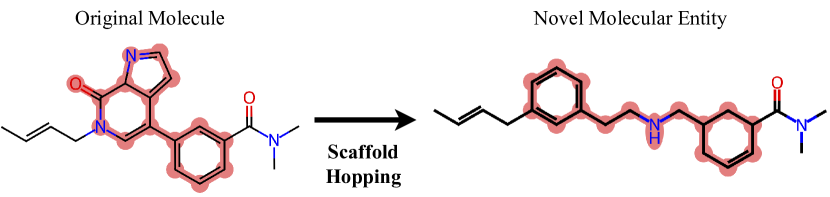
Scaffold hopping is a drug discovery strategy to generate new chemical entities by modifying the core structure, the \emph{scaffold}, of a known active compound. This approach preserves the essential molecular features of the original scaffold while introducing novel chemical elements or structural features to enhance potency, selectivity, or bioavailability. However, there is currently a lack of generative models specifically tailored for this task, especially in the pocket-conditioned context. In this work, we present DiffHopp, a conditional E(3)-equivariant graph diffusion model tailored for scaffold hopping given a known protein-ligand complex.
研究动机与目标
- 为解决结构基药物设计中缺乏专用于骨架跃迁的生成模型的问题。
- 改善蛋白质口袋中低连接性区域的分子生成,这是当前扩散模型的一个已知局限。
- 将骨架生成条件化于蛋白口袋和药效团特征,以确保功能团的保留。
- 评估专门针对骨架跃迁训练的模型是否优于通过图像修复方式使用的通用扩散模型。
提出的方法
- 使用蛋白-配体复合物的 3D 几何图表示,其中节点为原子,边为归一化的向量和距离。
- 采用基于 GVP(门控向量网络)的 E(3)-等变消息传递架构,以建模 3D 分子几何结构并强制实现旋转和平移不变性。
- 应用去噪扩散过程,逐步去噪一个被扰动的骨架,条件基于蛋白口袋和功能团。
- 引入一种残差 GNN 架构,结合注意力机制的边权重,以改善稀疏或低连接性区域的消息传递。
- 在 19,378 个 PDBBind 复合物上进行训练,使用 RDKit 提取 Murcko-Bemis 骨架,并以拓扑指纹进行评估。
- 通过图像修复方式复用通用口袋条件扩散模型(如 DiffSBDD)进行对比消融研究。
实验结果
研究问题
- RQ1是否专门针对骨架跃迁训练的扩散模型能优于通过图像修复设置使用的通用口袋条件扩散模型?
- RQ2使用更强大的几何图神经网络在多大程度上改善了蛋白质口袋低连接性区域的骨架生成?
- RQ3该模型在在保留药效团特征的前提下,能在多大程度上生成结构多样且具有类药物性质的骨架?
- RQ4与仅基于形状的条件相比,基于完整蛋白口袋的条件是否能生成更具生物学相关性的骨架跃迁?
主要发现
- DiffHopp 在骨架跃迁生成方面优于通过图像修复使用的通用口袋条件扩散模型(如 DiffSBDD),尤其在生成多样且类药物分子方面表现更优。
- 使用强大的几何 GNN 显著缓解了蛋白质口袋区域的低连接性问题,提升了稀疏区域的生成质量。
- UMAP 可视化显示,DiffHopp 即使在不同功能团条件下,也能生成涵盖多种化学类型的广泛骨架多样性。
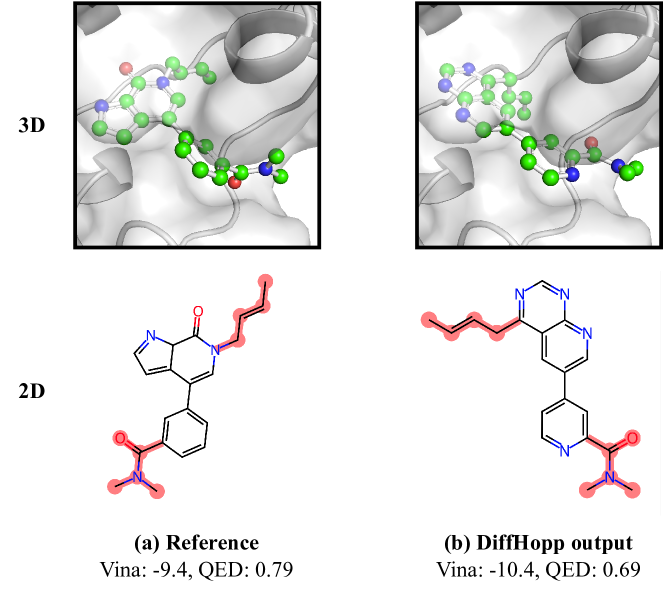
- 精选样本表明,生成的骨架通常比原始配体具有更好的 Vina 结合评分(例如 -8.5 vs. -8.0)和 QED 值(例如 0.69 vs. 0.65)。
- 尽管有所改进,部分生成的骨架仍存在不连通的情况,表明在拓扑一致性方面仍需进一步优化。
- 该模型在重新设计核心骨架的同时成功保留了药效团特征(以红色突出显示),证实了其骨架跃迁能力。
更好的研究,从现在开始
从阅读论文到最终审阅,大幅缩短您的研究时间。
无需绑定信用卡
本解读由 AI 生成,并经人工编辑审核。