
[论文解读] Diffusion Models for Counterfactual Explanations
本文提出DiME,一种新颖的方法,利用预训练的扩散模型在不微调的情况下生成图像分类器的反事实解释。通过使用分类器梯度引导扩散过程,DiME生成了真实、多样且扰动最小的反事实图像,在CelebA数据集上六项指标中的五项上超越了先前的最先进方法,同时引入了一项新指标——相关性差异(Correlation Difference),以更好地评估虚假相关性的检测能力。
Counterfactual explanations have shown promising results as a post-hoc framework to make image classifiers more explainable. In this paper, we propose DiME, a method allowing the generation of counterfactual images using the recent diffusion models. By leveraging the guided generative diffusion process, our proposed methodology shows how to use the gradients of the target classifier to generate counterfactual explanations of input instances. Further, we analyze current approaches to evaluate spurious correlations and extend the evaluation measurements by proposing a new metric: Correlation Difference. Our experimental validations show that the proposed algorithm surpasses previous State-of-the-Art results on 5 out of 6 metrics on CelebA.
研究动机与目标
- 开发一种后训练反事实解释方法,用于生成图像分类器决策的高保真、最小扰动且多样的扰动。
- 利用扩散模型的固有特性(如随机性与多层级潜在空间)来生成语义上有意义的反事实编辑。
- 通过引入新指标“相关性差异”来解决现有评估指标的局限性,以更好地检测反事实解释中细微的虚假相关性。
- 证明无条件扩散模型可在不重新训练或条件微调的情况下被有效重用于反事实解释。
提出的方法
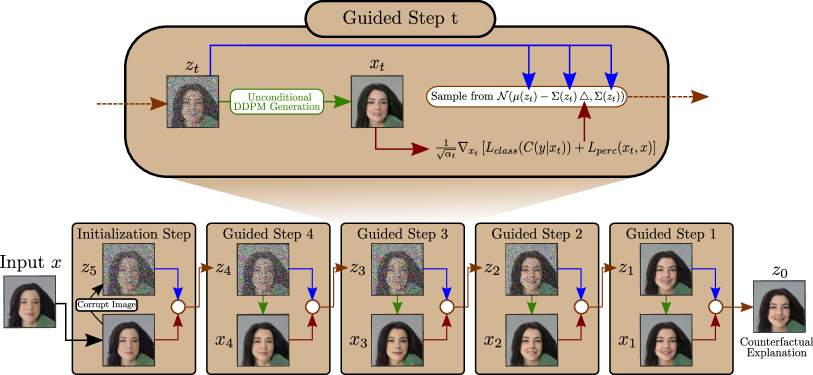
- DiME采用预训练的无条件去噪扩散概率模型(DDPM),通过利用目标分类器的梯度引导反向去噪过程,生成反事实图像。
- 该方法在多个去噪步骤中将分类器梯度应用于扩散模型的潜在空间,实现语义编辑,使模型预测发生改变,同时保持图像结构。
- 引入感知损失组件以提升图像保真度,确保生成的反事实图像保持真实且在感知上合理。
- 该方法避免对扩散模型进行重训练或基于反事实数据的条件微调,而是依赖于从单一预训练模型中进行梯度引导采样。
- 采用标准指标(FID、FVA、MNAC)和新指标“相关性差异”对方法进行评估,以衡量图像质量和虚假相关性检测能力。
- 通过消融研究分析噪声初始化水平和损失权重的影响,验证生成流程中设计选择的有效性。
实验结果
研究问题
- RQ1预训练的扩散模型是否可在不微调的情况下被有效重用于生成高质量、真实的反事实解释?
- RQ2使用分类器梯度引导的扩散过程与现有条件生成或对抗性方法相比,在反事实质量与多样性方面表现如何?
- RQ3当前指标如FID和MNAC在多大程度上能准确反映反事实解释检测虚假相关性的能力?
- RQ4新指标“相关性差异”是否能比现有方法更好地捕捉反事实解释中的细微虚假相关性?
主要发现
- DiME在CelebA数据集上六项指标中的五项达到最先进性能,其在‘微笑’属性上的FID、FVA和MNAC指标,以及在‘年轻’属性上的FID和MNAC指标均优于先前方法。
- 所提出的“相关性差异”指标表明,现有指标如MNAC可能因无法检测反事实中细微的虚假相关性而产生错误的正确性判断。
- 消融研究显示,未受干扰的DiME版本在保真度和忠实度方面显著优于基线的朴素和直接梯度引导方法,验证了所提引导去噪流程中改进步骤的重要性。
- 尽管计算成本较高——每个反事实图像需约1800次前向传播——DiME仍能生成多样且语义上合理的编辑,如改变面部表情或年龄外观,同时保持结构一致性。
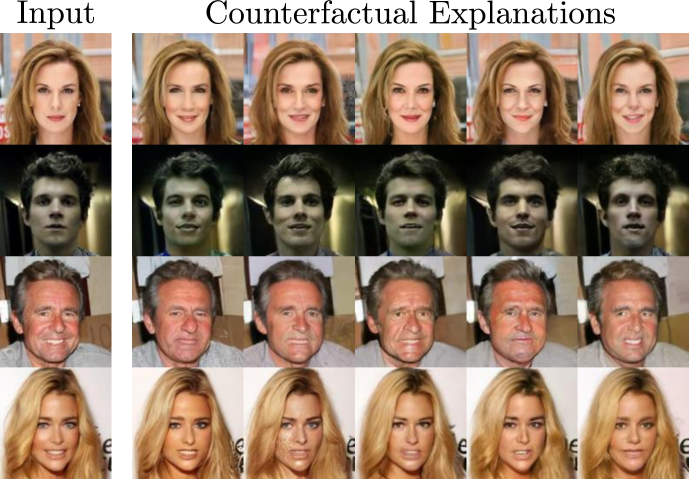
- 定性结果表明,DiME能产生感知上显著的变化,如改变微笑或年龄,同时保持原始身份和结构,即使在手部或吊坠等分布外元素上也表现良好。
- 无条件FID高于DiME,表明感知损失和梯度引导生成显著提升了图像质量,超越了无条件采样所能达到的效果。
更好的研究,从现在开始
从阅读论文到最终审阅,大幅缩短您的研究时间。
无需绑定信用卡
本解读由 AI 生成,并经人工编辑审核。