
[论文解读] Diffusion Models for High-Resolution Solar Forecasts
本论文使用基于分数的扩散模型将粗略的数值天气预报超分辨率为高分辨率的概率性太阳辐射预测,并在 Oahu 的日常前瞻云盖预测中得到验证。
Forecasting future weather and climate is inherently difficult. Machine learning offers new approaches to increase the accuracy and computational efficiency of forecasts, but current methods are unable to accurately model uncertainty in high-dimensional predictions. Score-based diffusion models offer a new approach to modeling probability distributions over many dependent variables, and in this work, we demonstrate how they provide probabilistic forecasts of weather and climate variables at unprecedented resolution, speed, and accuracy. We apply the technique to day-ahead solar irradiance forecasts by generating many samples from a diffusion model trained to super-resolve coarse-resolution numerical weather predictions to high-resolution weather satellite observations.
研究动机与目标
- 用扩散模型推动高维天气变量的概率预测的动机。
- 展示将粗略数值天气预测超分辨率提升到高分辨率卫星衍生云盖的能力。
- 量化 Oahu 的日前太阳预测的不确定性和准确性。
- 展示基于扩散的样本能够提供现实、具多样性且有用的预测分布。
提出的方法
- 两级级联扩散模型(64x64 然后 128x128),以 ERA5/GFS 大气变量为条件。
- 带大气条件注入的平坦向量的 U-Net 架构。
- 去噪分数匹配目标函数用于训练扩散模型。
- 从反向时间常微分方程进行采样以生成概率预测。
- 以基于 ERA5 和 GFS 的基线进行评估,使用卫星衍生云盖的 RMSE 进行对比。
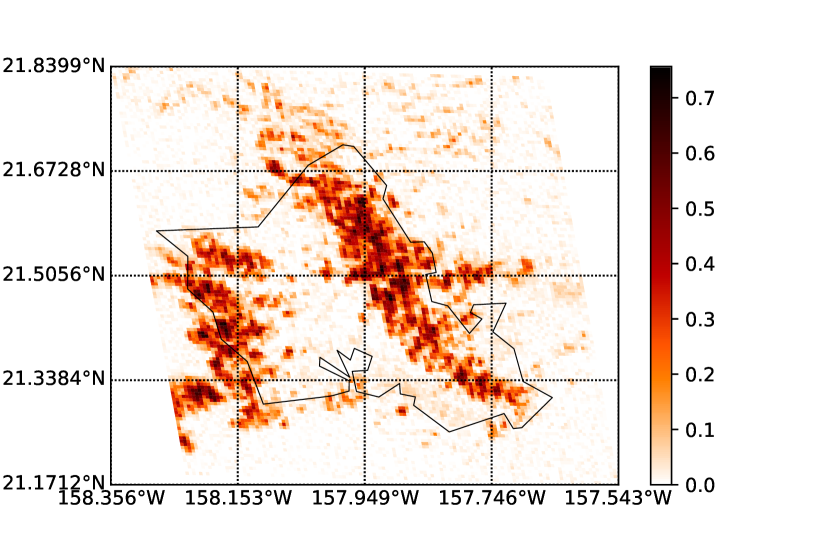
实验结果
研究问题
- RQ1基于分数的扩散模型是否能够为太阳相关变量提供完全概率化的高分辨率预测?
- RQ2对粗糙大气输出的超分辨率是否比基线下采样提高预测准确性?
- RQ3扩散模型的样本在多大程度上能准确捕捉不确定性和空间模式(如地形驱动的云)在 Oahu 的表现?
主要发现
| 预测 | 天气模型 | 扩散 | 保持性 | ERA5 | GFS | p 值 |
|---|---|---|---|---|---|---|
| 历史 | ERA5 | 0.207 ± 0.075 | 0.223 ± 0.090 | 0.362 ± 0.190 | — | <5×10^-4 |
| 未来(11am) | GFS | 0.198 ± 0.075 | 0.202 ± 0.089 | — | 0.358 ± 0.229 | 0.008 |
- 扩散模型在历史预测中比粗略 ERA5 基线具有更低的 RMSE(0.207 ± 0.075 对 0.362 ± 0.190,p < 5×10^-4)。
- 对于条件于 GFS 的未来 11 点预测,扩散建模的 RMSE 更低(0.198 ± 0.075)且低于粗糙 GFS 基线(0.358 ± 0.229,p = 0.008)。
- 增加扩散迭代次数能提升预测准确性;历史结果使用了 45+ 次样本。
- 样本具有现实性和多样性,样本均值提供的点估计优于输入的粗糙预测。
- 该方法能够实现快速的概率预测,适用于罕见事件的风险评估与电网管理。

更好的研究,从现在开始
从论文设计到论文写作,大幅缩短您的研究时间。
无需绑定信用卡
本解读由 AI 生成,并经人工编辑审核。