
[论文解读] Digital Twin-Assisted Cooperative Driving at Non-Signalized Intersections
本文提出了一种基于数字孪生的非信号灯交叉口协同驾驶系统,采用改进的先进先出(FIFO)时段预留机制、共识运动控制及基于模型的运动估计,使联网车辆能够无需停车通过交叉口。在使用真实旧金山交通数据的Unity仿真环境中,与信号灯控制交叉口相比,平均行程时间降低20%,能耗减少23.7%。
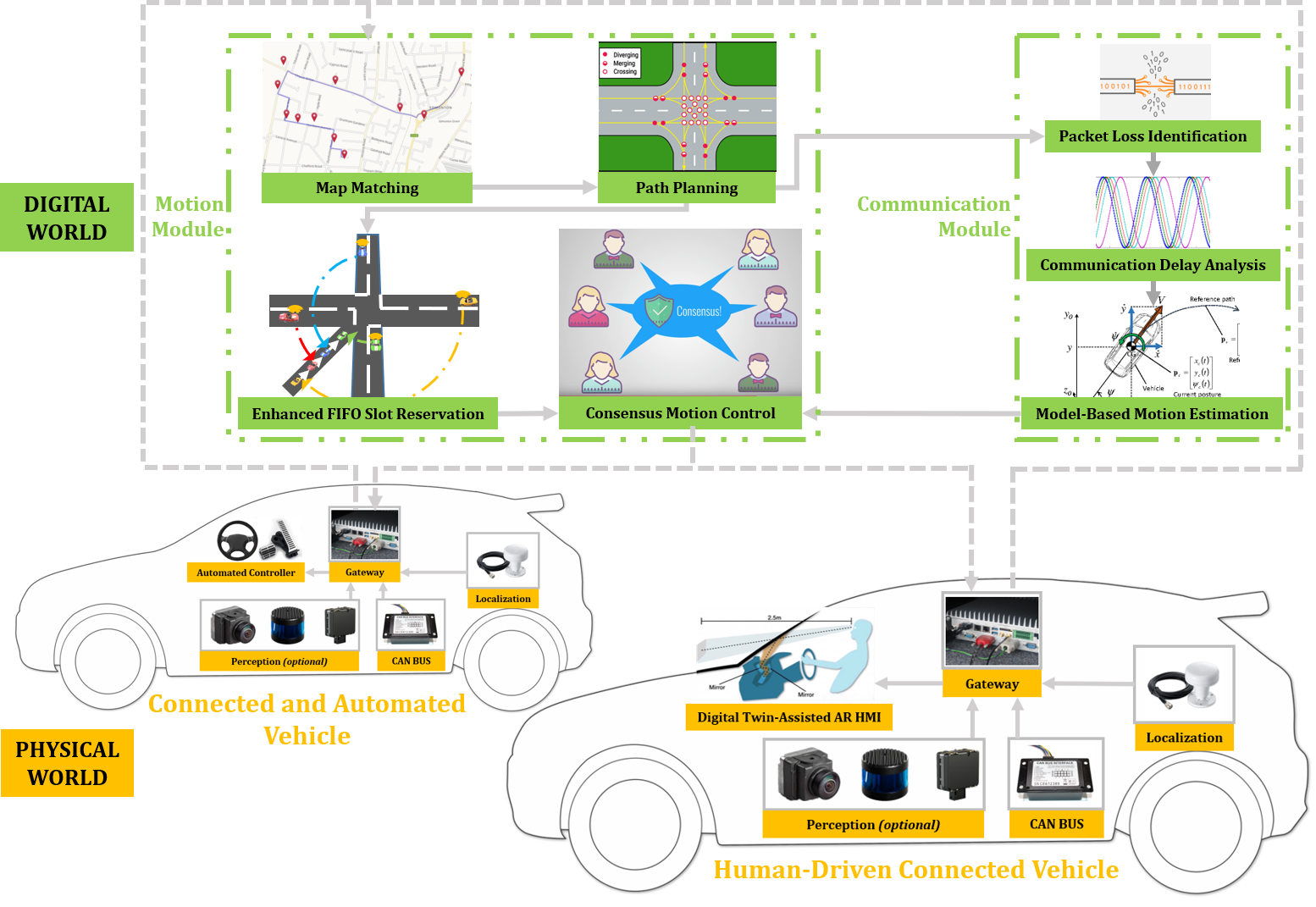
Digital Twin, as an emerging technology related to Cyber-Physical Systems (CPS) and Internet of Things (IoT), has attracted increasing attentions during the past decade. Conceptually, a Digital Twin is a digital replica of a physical entity in the real world, and this technology is leveraged in this study to design a cooperative driving system at non-signalized intersections, allowing connected vehicles to cooperate with each other to cross intersections without any full stops. Within the proposed Digital Twin framework, we developed an enhanced first-in-first-out (FIFO) slot reservation algorithm to schedule the sequence of crossing vehicles, a consensus motion control algorithm to calculate vehicles' referenced longitudinal motion, and a model-based motion estimation algorithm to tackle communication delay and packet loss. Additionally, an augmented reality (AR) human-machine-interface (HMI) is designed to provide the guidance to drivers to cooperate with other connected vehicles. Agent-based modeling and simulation of the proposed system is conducted in Unity game engine based on a real-world map in San Francisco, and the human-in-the-loop (HITL) simulation results prove the benefits of the proposed algorithms with 20% reduction in travel time and 23.7% reduction in energy consumption, respectively, when compared with traditional signalized intersections.
研究动机与目标
- 设计一种基于数字孪生技术的非信号灯交叉口协同驾驶系统,实现车辆无需完全停车通过。
- 通过鲁棒的运动估计方法,应对V2X联网车辆协同中的通信延迟与数据包丢失问题。
- 通过用智能、车辆协同的通行机制替代传统交通信号灯,提升交通效率与安全性。
- 集成增强现实(AR)人机界面(HMI),指导驾驶员执行协同通行行为。
- 在基于真实世界交通数据的、具备真实驾驶员参与的仿真环境中,评估系统性能。
提出的方法
- 开发了一种改进的先进先出(FIFO)时段预留算法,用于在数字孪生环境中调度车辆的通行序列。
- 实现了共识运动控制算法,为协同车辆生成同步的纵向参考轨迹。
- 提出了一种基于模型的运动估计算法,通过预测状态估计补偿V2X通信延迟与数据包丢失的影响。
- 设计了基于AR的HMI,通过视觉提示指导驾驶员何时以及如何通行,提升驾驶员对协同动作的配合度。
- 在Unity游戏引擎中,基于旧金山真实地图进行基于代理的仿真,以模拟混合交通与交叉口动态。
- 集成人机协同(HITL)仿真,评估系统在真实驾驶条件下的可用性与性能表现。
实验结果
研究问题
- RQ1基于数字孪生的系统能否有效协调非信号灯交叉口的联网车辆,实现无需完全停车的通行?
- RQ2基于模型的运动估计算法如何减轻通信延迟与数据包丢失对车辆协同的影响?
- RQ3在不同预测频率下,运动估计算法的预测精度与计算负载之间存在何种权衡?
- RQ4与传统信号灯控制交叉口相比,所提出的系统在行程时间与能耗方面降低了多少?
- RQ5AR HMI在人机协同场景中,对驾驶员协同与系统性能的支持效果如何?
主要发现
- 在HITL仿真中,所提系统相比传统信号灯控制交叉口,平均行程时间降低了20%。
- 在相同对比条件下,能耗降低了23.7%,表明系统具有显著的能效优势。
- 当采用0.01秒预测步长(100 Hz频率)时,基于模型的运动估计算法位置估计误差小于0.2米。
- 当预测步长为1秒(1 Hz)时,出现严重数据包丢失,估计误差上升至5.8米,凸显对更新频率的敏感性。
- 0.01秒预测步长导致仿真帧率降至6 FPS,表明计算负载较高;而1秒预测步长可维持超过19 FPS。
- 本研究识别出运动估计精度与计算成本之间存在关键权衡,未来工作需进一步优化。

更好的研究,从现在开始
从阅读论文到最终审阅,大幅缩短您的研究时间。
无需绑定信用卡
本解读由 AI 生成,并经人工编辑审核。