
[论文解读] Dilated Convolution based CSI Feedback Compression for Massive MIMO Systems
该论文提出DCRNet,一种基于深度学习的FDD大规模MIMO系统CSI反馈压缩框架,采用空洞卷积在不增加卷积核大小的情况下扩展感受野。该方法在显著降低FLOPs(相比CsiNet最高降低26%)的同时实现了最先进的重建性能,使其在低复杂度用户设备上具有高度效率。
Although the frequency-division duplex (FDD) massive multiple-input multiple-output (MIMO) system can offer high spectral and energy efficiency, it requires to feedback the downlink channel state information (CSI) from users to the base station (BS), in order to fulfill the precoding design at the BS. However, the large dimension of CSI matrices in the massive MIMO system makes the CSI feedback very challenging, and it is urgent to compress the feedback CSI. To this end, this paper proposes a novel dilated convolution based CSI feedback network, namely DCRNet. Specifically, the dilated convolutions are used to enhance the receptive field (RF) of the proposed DCRNet without increasing the convolution size. Moreover, advanced encoder and decoder blocks are designed to improve the reconstruction performance and reduce computational complexity as well. Numerical results are presented to show the superiority of the proposed DCRNet over the conventional networks. In particular, the proposed DCRNet can achieve almost the state-of-the-arts (SOTA) performance with much lower floating point operations (FLOPs). The open source code and checkpoint of this work are available at https://github.com/recusant7/DCRNet.
研究动机与目标
- 解决FDD大规模MIMO系统中由于CSI矩阵维度大而导致的高计算和反馈开销问题。
- 克服传统压缩感知方法的局限性,如对CSI稀疏性的依赖以及迭代处理带来的高延迟。
- 改进现有基于深度学习的CSI压缩网络(如CsiNet)中存在的感受野有限和计算复杂度高的问题。
- 设计一种轻量化但高性能的网络,以在实际用户设备资源约束下实现高效CSI反馈。
提出的方法
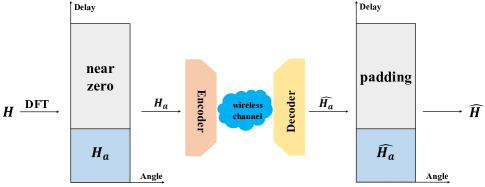
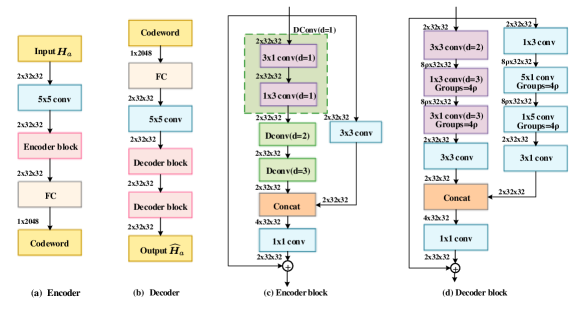
- 在编码器和解码器模块中均采用空洞卷积,以在不增加卷积核大小或参数量的情况下扩展感受野。
- 集成先进的编码器和解码器模块,以在最小化计算复杂度的同时提升重建精度。
- 通过DFT将CSI矩阵转换到角域-延迟域,以利用稀疏性并改善压缩性,再进行深度学习处理。
- 采用带有空洞卷积的深度自编码器架构,学习CSI矩阵的紧凑表示,以实现高效反馈。
- 通过宽度扩展比(ρ)优化网络宽度,以在性能与FLOPs之间取得平衡,支持在低复杂度设备上部署。
- 端到端训练网络,以最小化重建CSI矩阵与原始CSI矩阵之间的NMSE。
实验结果
研究问题
- RQ1空洞卷积是否能在不增加模型复杂度的前提下,有效扩展CSI反馈网络的感受野?
- RQ2所提出的DCRNet在重建精度和计算效率方面与SOTA网络(如CsiNet和ACRNet)相比如何?
- RQ3在高压缩率(如1/16、1/32)下,网络在降低FLOPs的同时能将性能保持在多高程度?
- RQ4在编码器和解码器中同时使用空洞卷积是否优于仅在编码器中使用或完全不使用?
- RQ5所提出的网络是否能在多种传播环境(室内/室外)下实现接近SOTA的性能,同时显著降低FLOPs?
主要发现
- DCRNet-1×在1/4压缩率下实现了SOTA的NMSE性能,相比CsiNet降低26%的FLOPs,相比CRNet降低21%,相比ACRNet-1×降低12%。
- 在室内条件下,DCRNet-1×优于所有基线模型,以极低的计算成本实现了SOTA性能。
- 在1/16压缩率下,DCRNet-10×的NMSE为-14.18 dB,与最佳性能的ACRNet-10×相差仅0.7 dB,但FLOPs显著更低。
- DCRNet-8×在NMSE为-13.52 dB的同时仅消耗6.69M FLOPs,性能和效率均优于DS-NLCsiNet(NMSE:-12.93 dB,FLOPs:4.98M)。
- 消融实验表明,在编码器和解码器中均使用空洞卷积可获得最佳重建性能(在1/16压缩率下,室内NMSE为-11.74 dB,室外为-5.60 dB),优于基线和DCRNet-M1。
- 该网络在室内和室外场景下均保持强劲性能,展现出对不同传播环境的鲁棒性和适应性。
更好的研究,从现在开始
从阅读论文到最终审阅,大幅缩短您的研究时间。
无需绑定信用卡
本解读由 AI 生成,并经人工编辑审核。