
[论文解读] Direct observation of Floquet-Bloch states in monolayer graphene
本文报告了在单层石墨烯中,使用时域与角分辨光电子能谱(trARPES)配中红外泵浦,直接获得能量-动量分辨的 Floquet-Bloch 态观测,并显示复制带,其偏振依赖性揭示 Floquet–Volkov 耦合。
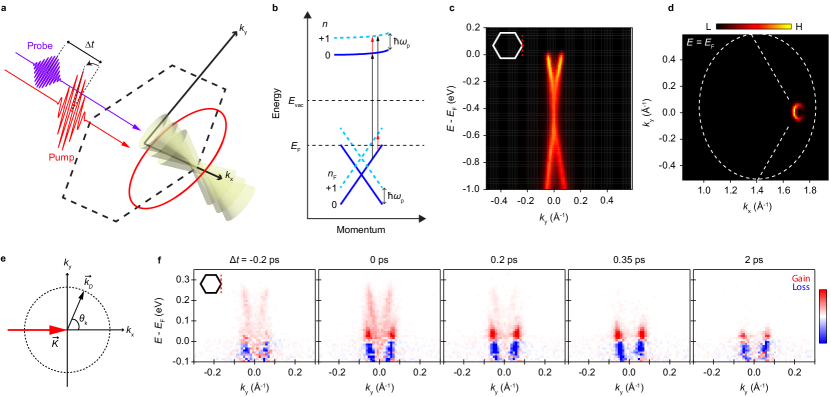
Floquet engineering is a novel method of manipulating quantum phases of matter via periodic driving [1, 2]. It has successfully been utilized in different platforms ranging from photonic systems [3] to optical lattice of ultracold atoms [4, 5]. In solids, light can be used as the periodic drive via coherent light-matter interaction. This leads to hybridization of Bloch electrons with photons resulting in replica bands known as Floquet-Bloch states. After the direct observation of Floquet-Bloch states in a topological insulator [6], their manifestations have been seen in a number of other experiments [7-14]. By engineering the electronic band structure using Floquet-Bloch states, various exotic phase transitions have been predicted [15-22] to occur. To realize these phases, it is necessary to better understand the nature of Floquet-Bloch states in different materials. However, direct energy and momentum resolved observation of these states is still limited to only few material systems [6, 10, 14, 23, 24]. Here, we report direct observation of Floquet-Bloch states in monolayer epitaxial graphene which was the first proposed material platform [15] for Floquet engineering. By using time- and angle-resolved photoemission spectroscopy (trARPES) with mid-infrared (mid-IR) pump excitation, we detected replicas of the Dirac cone. Pump polarization dependence of these replica bands unequivocally shows that they originate from the scattering between Floquet-Bloch states and photon-dressed free-electron-like photoemission final states, called Volkov states. Beyond graphene, our method can potentially be used to directly observe Floquet-Bloch states in other systems paving the way for Floquet engineering in a wide range of quantum materials.
研究动机与目标
- Motivate Floquet engineering as a route to manipulate quantum phases in solids and specifically in graphene.
- Demonstrate direct energy-momentum resolved observation of Floquet-Bloch states in monolayer graphene.
- Differentiate Floquet-Bloch contributions from Volkov final-state effects through pump polarization dependence.
- Develop and apply a simple analytical model to interpret replica-band evolution under polarization rotation.
提出的方法
- Use time- and angle-resolved photoemission spectroscopy (trARPES) with a mid-infrared pump (246 meV) and 26.4 eV probe to observe replica Dirac cones in graphene.
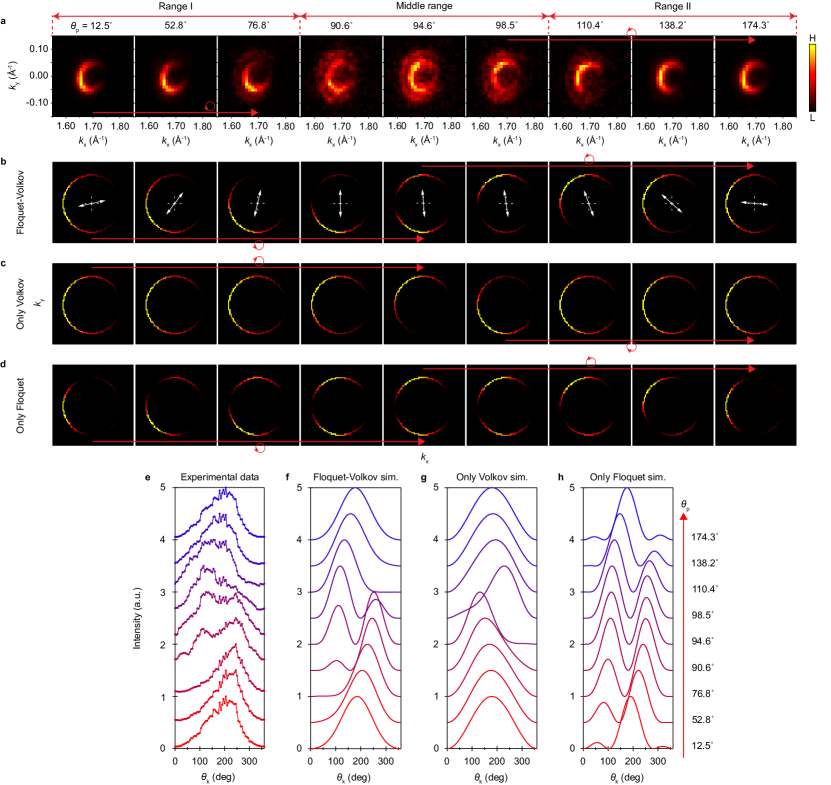
- Record ARPES spectra as pump polarization is rotated to track the evolution of replica bands in k-space.
- Compare experimental polarization-dependent replica-band evolution with simulations based on three scenarios: Floquet–Volkov coupling, only Volkov states, and only Floquet states.
- Employ a scattering-matrix formalism where the replica intensity P1 scales with |M|^2 |γ|^2, and γ encodes Floquet and Volkov interaction parameters (α, β).
- Incorporate pump incidence angle and in-plane vector potential to model γ and the resulting replica-band dynamics (Equation for γ and related terms).
- Use an analytical model inspired by prior work to distinguish Floquet-Bloch contributions from Volkov effects.
实验结果
研究问题
- RQ1Can Floquet-Bloch states be directly observed in monolayer graphene using trARPES with mid-IR pumping?
- RQ2Do the observed replica bands arise from Floquet-Bloch states, Volkov states, or their coupling, as evidenced by pump-polarization dependence?
- RQ3How does the polarization of the pump influence the evolution of replica bands, and what does this imply about Floquet–Volkov interactions?
主要发现
- Replica Dirac-cone replicas appear in graphene after mid-IR pump excitation, indicative of photon-dressed states.
- The evolution of replica bands with pump-polarization rotation cannot be explained by Volkov states alone and is consistent with Floquet–Volkov scattering.
- A Floquet-Bloch and Volkov coupling model reproduces the observed polarization-dependent arc rotation and coexistence of two arcs, matching experimental trends.
- A purely Floquet or purely Volkov scenario fails to capture the full evolution of replica bands across polarization angles.
- The results provide direct evidence for Floquet-Bloch states in graphene and offer a framework extendable to other materials for Floquet engineering.
更好的研究,从现在开始
从论文设计到论文写作,大幅缩短您的研究时间。
无需绑定信用卡
本解读由 AI 生成,并经人工编辑审核。