
[论文解读] Discovery of the local counterpart of disc galaxies at z > 4: The oldest thin disc of the Milky Way using Gaia-RVS
本研究利用高精度的Gaia-RVS数据与StarHorse恒星年龄模型,发现了银河系中最古老的薄盘,其形成时间早于宇宙大爆炸后10亿年。研究证实,处于冷、薄盘轨道上的金属贫乏恒星绝大多数年龄超过130亿年,其垂直速度弥散度(σ_Vz)约为20–25 km s⁻¹,与詹姆斯·韦伯太空望远镜(JWST)和阿塔卡马大型毫米波/亚毫米波阵列(ALMA)观测到的高红移盘星系一致,表明银河系盘在早期即已形成,并经历了持续的由内而外的生长过程。
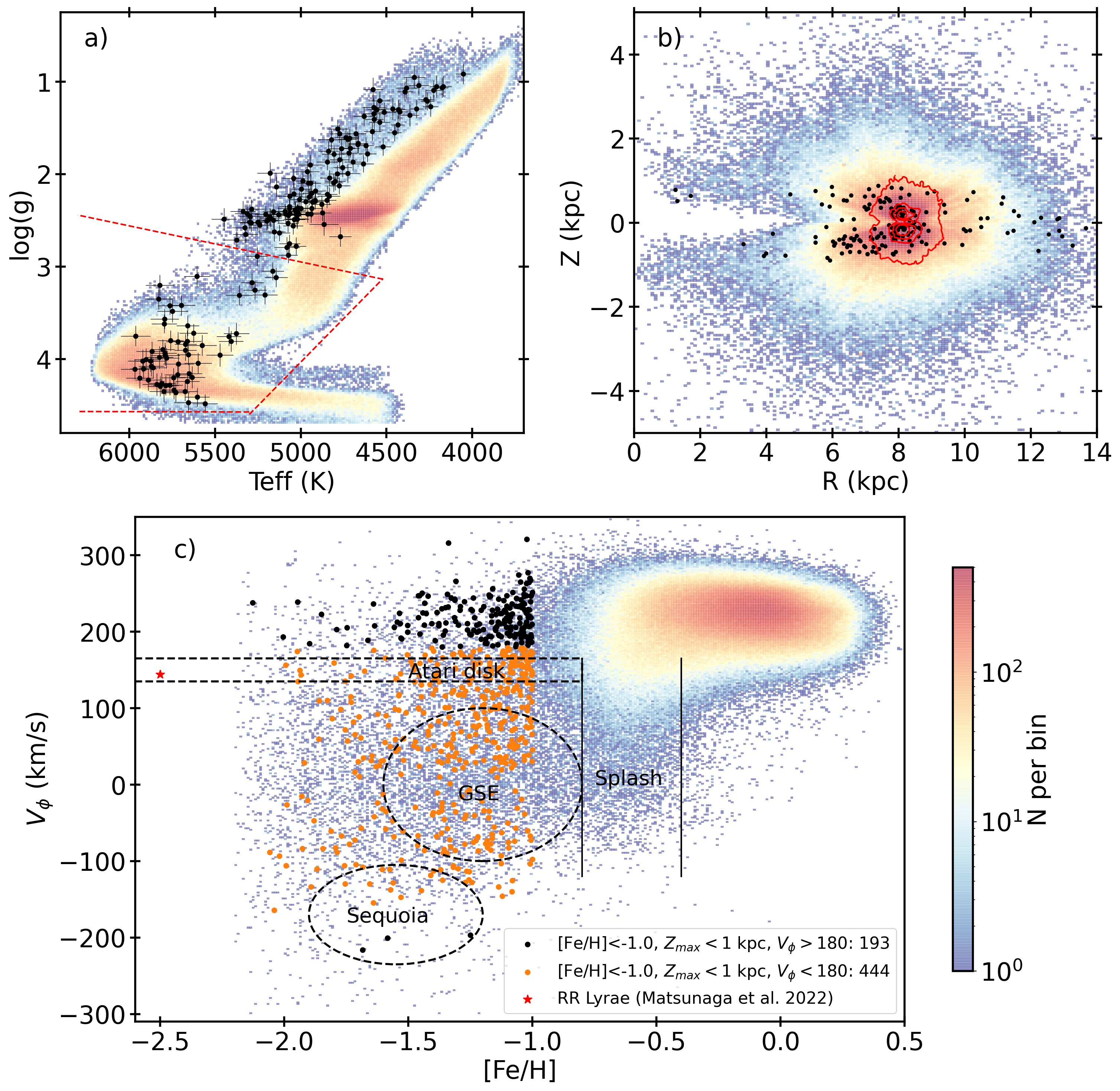
JWST has recently detected numerous disc galaxies at high-redshifts and there have been observations of cold disc galaxies at z > 4 with ALMA. In the Milky Way, recent studies find metal-poor stars in cold disc orbits, suggesting an ancient disc. We investigated a sample of 565,606 stars from the hybrid-CNN analysis of the Gaia-DR3 RVS stars. The sample contains 8,500 stars with [Fe/H]<-1. For a subset of ~200,000 MSTO and subgiant stars we computed distances and ages using the StarHorse code with a mean precision of 1% and 12%, respectively. First, we confirm the existence of metal-poor stars in thin disc orbits - over 50% are older than 13 Gyr. Second, we report the discovery of the oldest thin disc of the Milky Way(MW), which extends across a wide range of metallicities, from metal-poor to super-solar stars. The metal-poor stars in disc orbits manifest as a readily visible tail of the metallicity distribution. The high-[α/Fe] thick disc exhibits a vertical velocity dispersion of 35 km/s, while the thin disc shows 10 to 15 km/s lower at similar ages. Our old thin disc $σ_{V_z}$ appears similar to those estimated for the high-z disc galaxies. Third, we extend the [Y/Mg] chemical clock to the oldest ages and estimate a slope of -0.038 dex/Gyr. Finally, we confirm our discovery by showing that the splash includes high- and low-[α/Fe] populations that are both old and extends to super-solar [Fe/H]. We find about 6 to 10% of the old thin disc was heated to thick disc orbits with the youngest splashed stars being 9 to 10 Gyrs. We conclude the MW thin disc forms <1 billion years from Big Bang, building up inside-out, preceding earlier estimates by about 4-5 billion years. Considering a massive merger event such as the GSE, a Splash is expected - we find a portion of the old thin disc is heated to thick disc velocities and the Splash extends to super-solar [Fe/H] regimes.
研究动机与目标
- 解决银河系薄盘的形成 epoch,挑战早期估计的约80–90亿年前的结论。
- 确定处于冷盘轨道中的金属贫乏恒星是否属于古老薄盘,还是星系晕/子结构的一部分。
- 研究重大并合事件(如Gaia-Enceladus)在将恒星从薄盘动力学状态加热至厚盘动力学状态中的作用。
- 通过[ Y/Mg ]化学钟验证最古老年龄区间的恒星年龄估计。
- 绘制古老薄盘的完整金属丰度范围,包括超太阳系金属丰度。
提出的方法
- 利用Gaia DR3 RVS中的202,384颗主序转折点及亚巨星支恒星,其具有六维相空间和高质量恒星参数。
- 应用StarHorse代码,结合测光与光谱数据,分别以1%和12%的精度推导距离与年龄。
- 将GALAH巡天的化学丰度数据与Gaia-RVS数据结合,计算[α/Fe]与[Fe/H],用于运动学与化学动力学分析。
- 使用[ Y/Mg ]丰度比作为化学钟验证年龄估计,发现其斜率为−0.038 dex Gyr⁻¹。
- 分析垂直速度弥散度(σ_Vz),以区分薄盘(低σ_Vz)与厚盘(高σ_Vz)星族。
- 追踪Splash星族在年龄与金属丰度上的分布,识别由并合事件加热至厚盘轨道的恒星。
实验结果
研究问题
- RQ1银河系薄盘形成于何时?其是否早于GSE并合事件?
- RQ2处于冷盘轨道中的金属贫乏恒星是否属于原始薄盘,还是星系晕/子结构的一部分?
- RQ3古老薄盘的垂直速度弥散度是多少?与高红移盘星系相比如何?
- RQ4GSE并合事件在多大程度上将古老薄盘加热至厚盘动力学状态?
- RQ5Splash星族是否延伸至超太阳系金属丰度?这对早期盘形成意味着什么?
主要发现
- 银河系薄盘形成于大爆炸后不足10亿年,比以往估计提前了40–50亿年。
- 超过50%处于薄盘轨道的金属贫乏恒星(Z_max < 1 kpc,V_φ > 180 km s⁻¹)年龄超过130亿年,证实其古老起源。
- 古老薄盘的垂直速度弥散度(σ_Vz)为20–25 km s⁻¹,比高[α/Fe]厚盘(σ_Vz ≈ 35 km s⁻¹)低10–15 km s⁻¹。
- [ Y/Mg ]化学钟被拓展至最古老年龄区间,测得斜率为−0.038 dex Gyr⁻¹,验证了StarHorse年龄估计的可靠性。
- 约6–10%的古老薄盘被加热至厚盘动力学状态,且在该速度范围内未发现较年轻的低[α/Fe]恒星,表明加热过程发生于90–100亿年前之前。
- Splash星族包含年龄≥90亿年的高[α/Fe]与低[α/Fe]恒星,并延伸至超太阳系[Fe/H] ≈ 0.25,表明冷盘中存在早期且持续的恒星形成。
![Figure 2 : Toomre diagrams ( $\sqrt{V^{2}_{R}+V^{2}_{\phi}}$ vs. $V_{\phi}$ ) for the age sample stars in bins of age and [ Fe / H ] . The plots are color-coded by logarithm of stellar density. Older to younger ages from top to bottom and metal-poor to metal-rich [ Fe / H ] from left to right. The a](https://ar5iv.labs.arxiv.org/html/2402.00561/assets/plots/mp_sample_age_toomre_age_mh_bins_1.png)
更好的研究,从现在开始
从阅读论文到最终审阅,大幅缩短您的研究时间。
无需绑定信用卡
本解读由 AI 生成,并经人工编辑审核。