
[论文解读] Discovery of the missing intermediate-mass helium stars stripped in binaries
该论文通过大、小麦哲伦云中过量的紫外辐射,识别出长期寻求的中等质量氦星(2–8 M⊙)群体,这些恒星因双星相互作用而剥离了氢包层。25个系统具有高温(60–100 kK)、高表面重力(log g ≈ 5)以及径向速度变化,证实了它们的存在,并填补了大质量恒星演化模型中的关键空白。
The theory of binary evolution predicts that many massive stars should lose their hydrogen-rich envelopes via interaction with a companion -- revealing hot helium stars with masses of $\sim$2--8M$_{\odot}$. However, only one candidate system had been identified, leaving a large discrepancy between theory and observation. Here, we present a new sample of stars -- identified via excess ultraviolet emission -- whose luminosities, colors, and spectral morphologies are consistent with predictions for the missing population. We detect radial velocity variations indicative of binary motion and measure high temperatures ($T_{ m eff}\sim60-100$kK), high surface gravities ($\log(g)\sim5$) and depleted surface hydrogen mass fractions ($X_{ m{H,surf}}\lesssim0.3$), which match expectations for stars with initial masses between 8--25 M$_{\odot}$ that have been stripped via binary interaction. These systems fill the helium star mass gap between subdwarfs and Wolf-Rayet stars, and are thought to be of large astrophysical significance as ionizing sources, progenitors of stripped-envelope supernovae and merging double neutron stars.
研究动机与目标
- 解决双星演化理论与观测之间的长期矛盾,该矛盾预测了大量通过双星相互作用剥离的中等质量氦星(2–8 M⊙),但此前仅发现一个候选体。
- 克服观测偏见,这些恒星常被明亮的主序星伴星掩盖,且表现出微弱的恒星风特征。
- 提出一种新检测方法,利用紫外-光学颜色-星等图中的过量紫外辐射,以分离出具有剥离氦核心的双星系统。
- 确认初始质量为 8–25 M⊙ 的大质量恒星在经历双星剥离后形成了一类群体,填补了低质量亚矮星与高质量沃尔夫-拉叶星之间的空白。
- 确立这些恒星在天体物理学上的重要性,作为剥离包层超新星和合并双中子星的前身体,同时也是硬电离光子的重要来源。
提出的方法
- 利用斯威夫特-紫外光学望远镜(Swift-UVOT)对大、小麦哲伦云(LMC/SMC)进行深度紫外测光,覆盖约 39 deg² 的区域,使用三个紫外滤镜(1928–2600 Å),空间分辨率为 2.5″。
- 采用正向建模方法,结合 The Tractor 算法,在已知恒星位置(来自大、小麦哲伦云光度巡天)上执行强制 PSF 测光,提升密集场中的源提取效率。
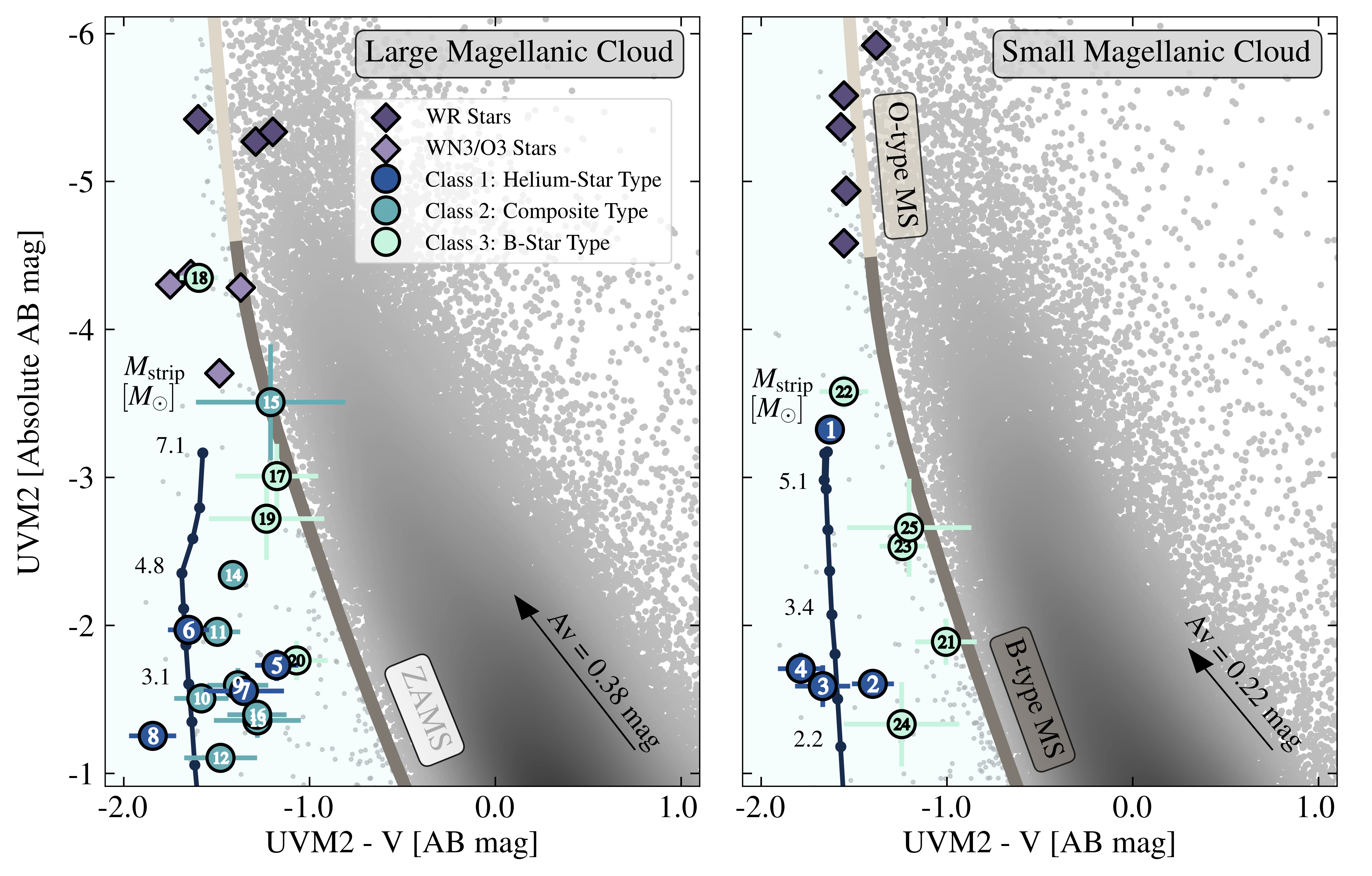
- 通过在紫外-光学颜色-星等图中的位置识别候选系统——位于中等光度下主序蓝侧(−1 mag > M_UV > −4 mag),这是具有中等质量氦星的双星系统的特征。
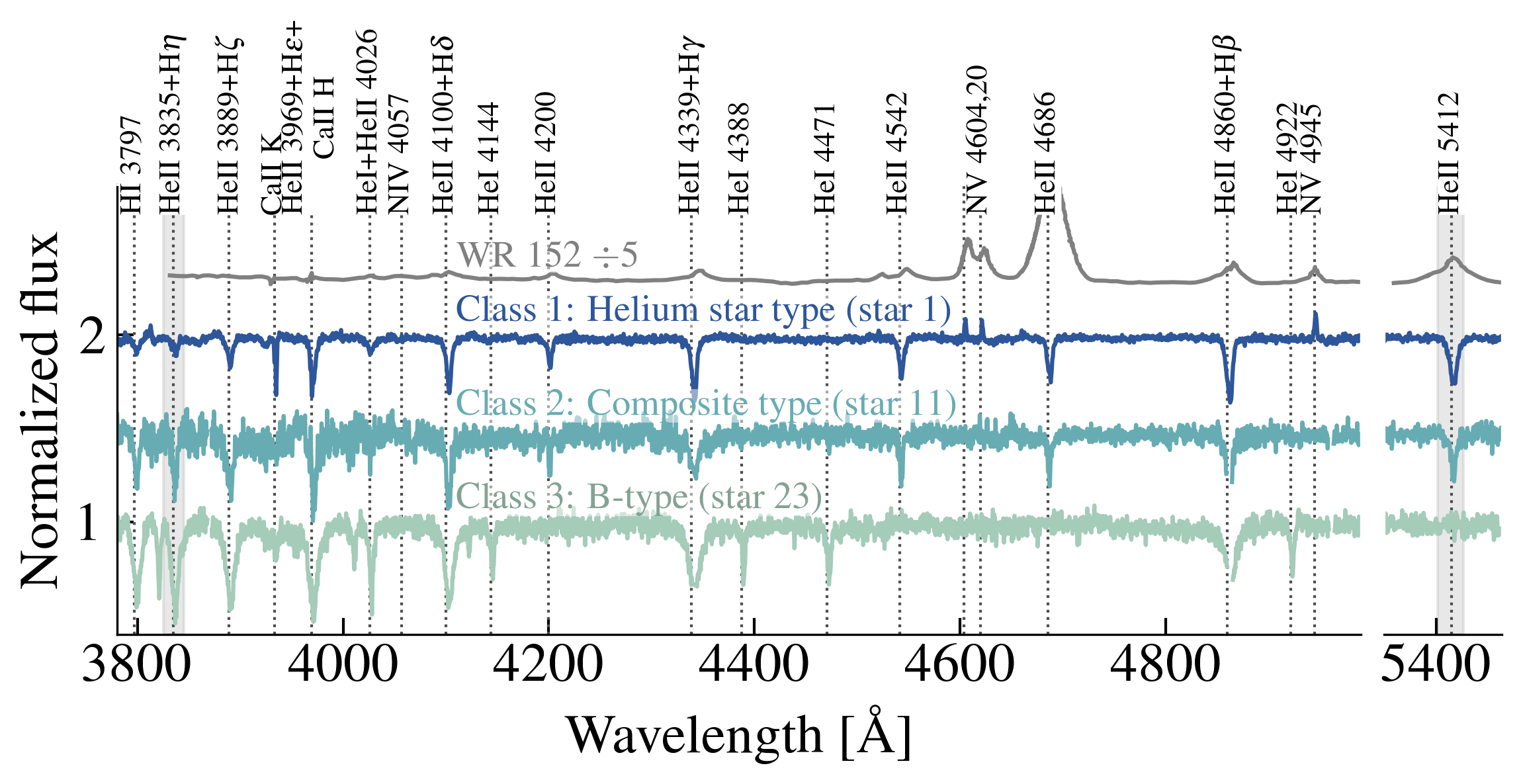
- 利用 6.5 米麦哲伦-巴德望远镜上的 MagE 光谱仪,对每个系统获取 1 至 30 次光谱观测,测量径向速度并确认双星运动。
- 利用 Gaia DR3 天体测量数据(视差和自行)验证径向速度的一致性与三维运动学,排除前景污染源。
- 合成剥离恒星+主序星双星系统的理论光谱,预测紫外-光学颜色,指导搜索工作。
实验结果
研究问题
- RQ1为何理论上预测普遍存在的、通过双星相互作用剥离的中等质量氦星(2–8 M⊙)群体长期未被探测到?
- RQ2紫外-光学颜色-星等图中的过量紫外辐射是否可作为可靠诊断工具,用于识别包含中等质量氦星的双星系统?
- RQ3径向速度变化与与大、小麦哲伦云恒星一致的运动学特性,是否能确认候选系统的双星性质和距离?
- RQ4这些候选恒星的物理参数(温度、重力、表面成分)为何与初始质量为 8–25 M⊙ 的恒星经双星剥离后的预测相符?
- RQ5这些恒星在关键天体物理过程中的贡献程度如何,包括电离光子产生、剥离包层超新星形成以及双中子星的形成?
主要发现
- 该研究识别出 25 个候选系统,其过量紫外辐射、光度、颜色和光谱形态均与通过双星相互作用剥离的中等质量氦星(2–8 M⊙)一致。
- 所有 16 个具有多阶段光谱观测的系统均表现出径向速度变化,证实其为双星系统并具有轨道运动。
- 测得有效温度为 60–100 kK,表面重力为 log g ≈ 5,与高温、致密的氦核心一致。
- 表面氢质量分数显著耗尽(X_H,surf ≲ 0.3),证实氦核心占主导地位,并通过双星相互作用发生剥离。
- 利用 Gaia DR3 的运动学分析表明,23 个候选系统中的 25 个具有与 LMC 和 SMC 中 O/B 型星一致的三维运动,支持其属于大、小麦哲伦云。
- 该发现填补了低质量亚矮星(≲1.5 M⊙)与高质量沃尔夫-拉叶星(≳8 M⊙)之间的关键质量空白,解决了大质量恒星演化模型中长期存在的矛盾。
更好的研究,从现在开始
从阅读论文到最终审阅,大幅缩短您的研究时间。
无需绑定信用卡
本解读由 AI 生成,并经人工编辑审核。