
[论文解读] Disk settling and dynamical heating: histories of Milky Way-mass stellar disks across cosmic time in the FIRE simulations
本研究利用FIRE-2宇宙学模拟分析银河系质量恒星盘的动力学演化,区分了宇宙学演化过程中的盘面稳定化(disk settling)与形成后的动力学加热。研究揭示了三个恒星形成时期:湍流的预盘阶段(σ_form在约80亿年前达到峰值)、早期盘阶段(高速度弥散度)和晚期盘阶段(冷形成)。关键发现是,对于年龄小于约100亿年的恒星,当前的速度弥散度主要在形成时继承,而形成后的加热主要增加了年轻恒星的径向弥散度。
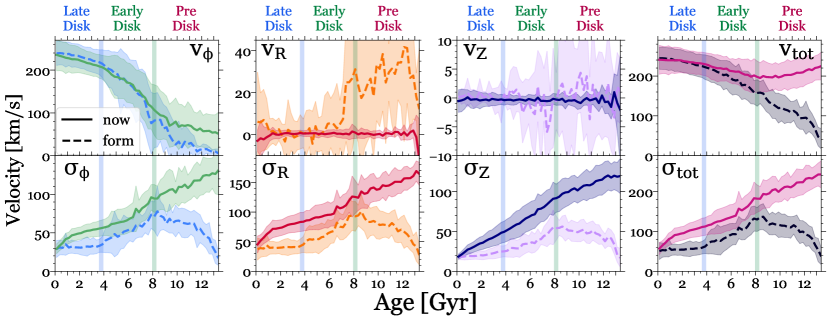
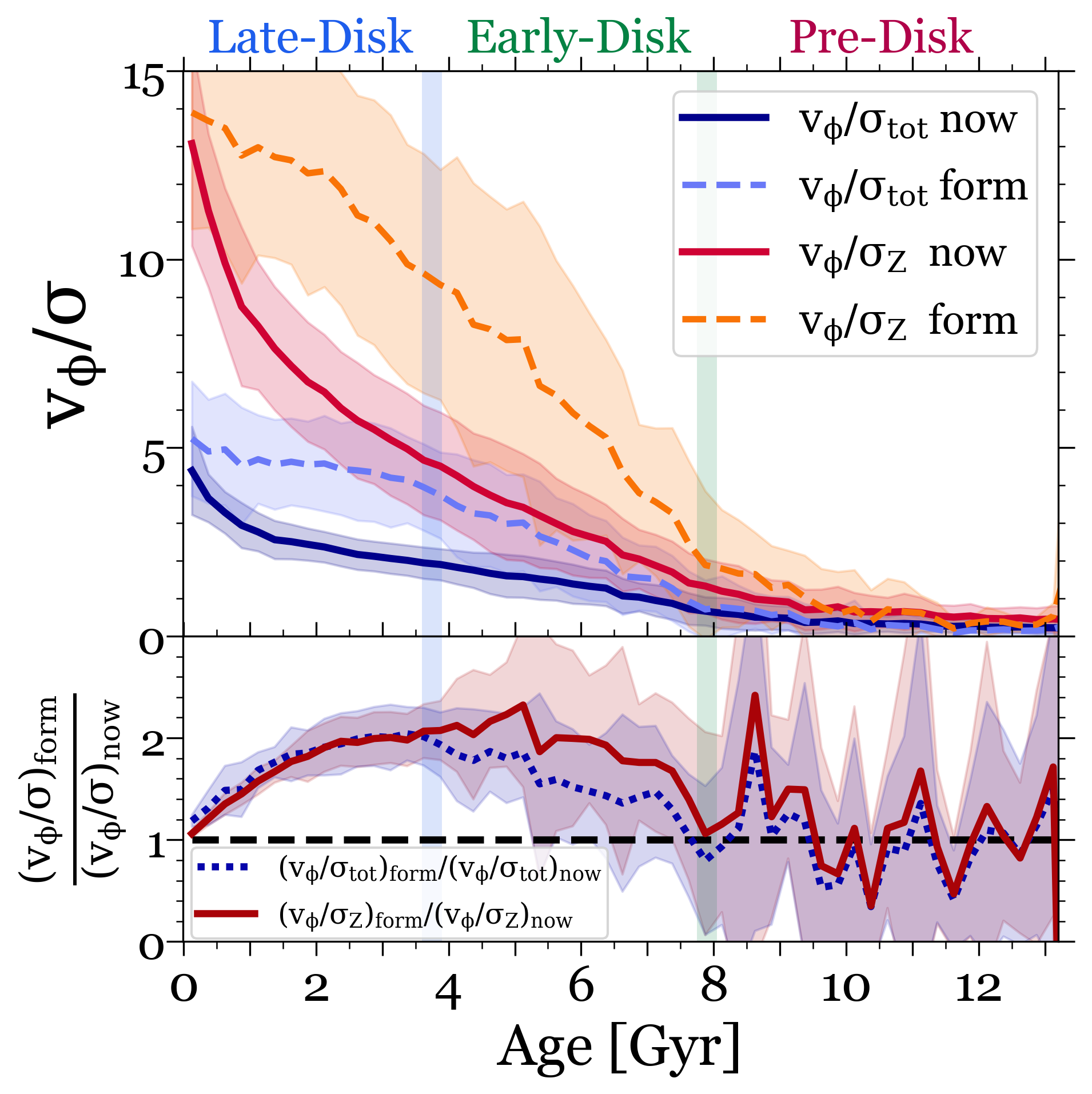
We study the kinematics of stars both at their formation and today within 14 Milky Way (MW)-mass galaxies from the FIRE-2 cosmological zoom-in simulations. We quantify the relative importance of cosmological disk settling and post-formation dynamical heating. We identify three eras: a Pre-Disk Era (typically >8 Gyr ago), when stars formed on dispersion-dominated orbits; an Early-Disk Era (~ 8 - 4 Gyr ago), when stars started to form on rotation-dominated orbits but with high velocity dispersion, sigma_form; and a Late-Disk Era (< 4 Gyr ago), when stars formed with low sigma_form. sigma_form increased with time during the Pre-Disk Era, peaking ~ 8 Gyr ago, then decreased throughout the Early-Disk Era as the disk settled and remained low throughout the Late-Disk Era. By contrast, the velocity dispersion measured today, sigma_now, increases monotonically with age because of stronger post-formation heating for Pre-Disk stars. Importantly, most of sigma_now was in place at formation, not added post-formation, for stars younger than ~ 10 Gyr. We compare the evolution of the three velocity components: at all times, sigma_R,form > sigma_phi,form > sigma_Z,form. Post-formation heating primarily increased sigma_R at ages < 4 Gyr but acted nearly isotropically for older stars. The kinematics of young stars in FIRE-2 broadly agree with the range observed across the MW, M31, M33, and PHANGS-MUSE galaxies. The lookback time that the disk began to settle correlates with its dynamical state today: earlier-settling galaxies currently form colder disks. Including stellar cosmic-ray feedback does not significantly change disk rotational support at fixed stellar mass.
研究动机与目标
- 区分宇宙学盘面稳定化与形成后动力学加热对银河系质量恒星盘动力学的贡献。
- 量化在高分辨率模拟中,恒星形成时的速度弥散度(σ_form)与当前速度弥散度(σ_now)随宇宙时间的演化。
- 将模拟的恒星动力学与银河系、M31、M33及PHANGS-MUSE星系的观测结果进行比较,以评估模拟的真实性。
- 探究早期盘面稳定化是否与当前更冷的盘相关,以及恒星宇宙射线反馈是否改变旋转支持。
- 确定观测到的盘动力学特性是主要由初始条件决定,还是由后期动力学过程(尤其是对古老贫金属恒星)主导。
提出的方法
- 利用14个包含恒星形成、反馈及宇宙学演化的完整物理过程的银河系质量星系高分辨率FIRE-2宇宙学聚焦模拟。
- 追踪恒星从形成至今的演化,测量其形成时的速度弥散度(σ_form)与当前弥散度(σ_now),以分离形成后加热的影响。
- 基于轨道动力学与弥散度演化,将恒星形成划分为三个时期:预盘期(≥80亿年前)、早期盘期(80–40亿年前)与晚期盘期(≤40亿年前)。
- 分别分析三个速度分量(径向、方位向、垂直向),以评估加热的各向异性:形成时满足σ_R,form > σ_φ,form > σ_Z,form。
- 通过比较σ_now与σ_form量化形成后加热效应,发现古老恒星加热趋于各向同性,而年轻恒星则呈现径向偏向的加热。
- 将模拟的动力学特性与观测星系(MW、M31、M33、PHANGS-MUSE)进行比较,并测试在模拟中引入恒星宇宙射线反馈对旋转支持的影响。
实验结果
研究问题
- RQ1在银河系质量星系中,形成时的速度弥散度(σ_form)如何随宇宙时间演化?其变化由什么驱动?
- RQ2当前恒星速度弥散度(σ_now)在多大程度上由初始条件(σ_form)决定,而非形成后的动力学加热?
- RQ3在不同时期形成的恒星——预盘期、早期盘期与晚期盘期——其σ_form与σ_now的动力学特性如何比较?
- RQ4盘面稳定化的时间是否与当前盘的冷度(低σ_now)相关?这种相关性在模拟中是否稳健?
- RQ5银河系中古老贫金属恒星的观测动力学行为,主要源于初始形成条件,还是后期并合与非对称性引起的角动量转移?
主要发现
- 形成时的速度弥散度(σ_form)在约80亿年前的预盘期达到峰值,随后随着盘面稳定化而下降,晚期盘期的σ_form保持较低水平。
- 对于年龄小于约100亿年的恒星,当前速度弥散度(σ_now)的大部分已在形成时确立,表明形成后加热对其动力学贡献甚微。
- 形成后加热随年龄单调增加σ_now,主要影响年龄≤40亿年的恒星的径向弥散度(σ_R),但对更老恒星则近乎各向同性加热。
- 形成时,速度弥散度满足顺序σ_R,form > σ_φ,form > σ_Z,form,表明湍流星际介质中初始条件具有各向异性。
- 早期完成稳定化的星系,其当前盘面更冷,显示出早期盘面稳定化与低当前σ_now之间存在强烈相关性。
- 在模拟中引入恒星宇宙射线反馈并未显著改变固定恒星质量下盘的旋转支持,表明其并非盘动力学的主导因素。
更好的研究,从现在开始
从阅读论文到最终审阅,大幅缩短您的研究时间。
无需绑定信用卡
本解读由 AI 生成,并经人工编辑审核。