
[论文解读] Distributed Multi-agent Interaction Generation with Imagined Potential Games
本文提出一种基于想象潜能博弈(IPG)的分布式多智能体交互生成框架,实现无需通信的协作导航。每个智能体通过想象其他智能体的行为,独立求解协作博弈,并使用iLQR进行轨迹优化;该方法在狭窄走廊和T型路口等密集障碍物环境中实现了高成功率和高效、逼真的交互。
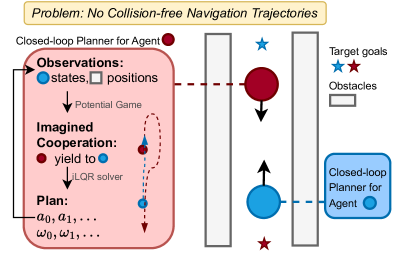
Interactive behavior modeling of multiple agents is an essential challenge in simulation, especially in scenarios when agents need to avoid collisions and cooperate at the same time. Humans can interact with others without explicit communication and navigate in scenarios when cooperation is required. In this work, we aim to model human interactions in this realistic setting, where each agent acts based on its observation and does not communicate with others. We propose a framework based on distributed potential games, where each agent imagines a cooperative game with other agents and solves the game using its estimation of their behavior. We utilize iLQR to solve the games and closed-loop simulate the interactions. We demonstrate the benefits of utilizing distributed imagined games in our framework through various simulation experiments. We show the high success rate, the increased navigation efficiency, and the ability to generate rich and realistic interactions with interpretable parameters. Illustrative examples are available at https://sites.google.com/berkeley.edu/distributed-interaction.
研究动机与目标
- 在无需显式通信的情况下,建模密集障碍物环境中的类人多智能体协作交互。
- 解决分布式规划中因无法直接协调而导致的死锁问题。
- 在需要相互避让的场景(如狭窄通道和T型路口)中,提升成功率和导航效率。
- 通过调整安全距离和代价权重等参数,生成多样化、可解释且逼真的交互行为。
- 实现与异构智能体(包括非协作或非IPG控制器)的鲁棒交互,用于评估社交导航算法。
提出的方法
- 每个智能体与其他智能体构建想象潜能博弈,将协作视为共享优化问题。
- 框架使用迭代线性二次调节器(iLQR)求解协作博弈并生成开环规划。
- 通过滚动时域控制的闭环仿真,使智能体能够基于实时观测自适应调整规划。
- 优化过程包含与障碍物的碰撞避免、针对智能体的观测范围和盲区建模,以实现逼真的感知。
- 智能体通过共享博弈结构估计其他智能体的行为,实现在无通信情况下的协调避让。
- 通过安全距离和代价权重等参数调节行为,实现多样化且可解释的交互模式。
实验结果
研究问题
- RQ1无通信的分布式框架能否在密集环境中生成逼真且协作的多智能体交互?
- RQ2与原始分布式规划相比,想象潜能博弈规划在成功率和导航效率方面有何提升?
- RQ3通过参数调节,IPG在多大程度上能生成多样化且可解释的交互行为?
- RQ4IPG智能体能否与非IPG智能体(包括非协作或恒定速度预测器)实现鲁棒交互?
- RQ5在闭环仿真中,该框架如何从开环死锁状态中恢复?
主要发现
- 与原始分布式智能体相比,IPG框架在狭窄通道和T型路口场景中显著提升了成功率。
- 闭环仿真使智能体能够从相互矛盾的开环规划中收敛,通过自适应预测修正实现死锁恢复。
- IPG智能体即使在对方智能体初始不可见的情况下,也能生成类人的行为,如在路口处避让和等待。
- 调整安全距离和代价权重可生成多样化、可解释的行为,包括更保守或更灵活的导航策略。
- IPG智能体能成功与异构智能体(包括恒定速度预测器和非协作智能体)交互,展现出良好的鲁棒性。
- 该框架可通过可调交互参数的IPG智能体,有效评估社交导航算法。

更好的研究,从现在开始
从阅读论文到最终审阅,大幅缩短您的研究时间。
无需绑定信用卡
本解读由 AI 生成,并经人工编辑审核。