
[论文解读] Distribution Grid Line Outage Identification with Unknown Pattern and Performance Guarantee
本文提出了一种鲁棒的、数据驱动的方法,仅使用电压幅值即可实现配电网线路停运的识别,无需相位角或潮流数据。通过采用带有Bregman散度约束的投影梯度下降法,该方法在物理和统计约束下实现了对未知停运后配电网参数的学习,并具备收敛性保证,从而在无需预先了解停运模式的情况下,实现实时检测与定位。
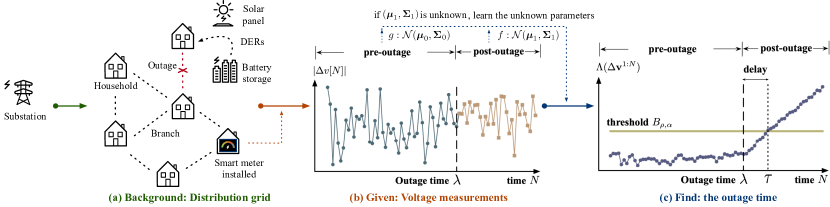
Line outage identification in distribution grids is essential for sustainable grid operation. In this work, we propose a practical yet robust detection approach that utilizes only readily available voltage magnitudes, eliminating the need for costly phase angles or power flow data. Given the sensor data, many existing detection methods based on change-point detection require prior knowledge of outage patterns, which are unknown for real-world outage scenarios. To remove this impractical requirement, we propose a data-driven method to learn the parameters of the post-outage distribution through gradient descent. However, directly using gradient descent presents feasibility issues. To address this, we modify our approach by adding a Bregman divergence constraint to control the trajectory of the parameter updates, which eliminates the feasibility problems. As timely operation is the key nowadays, we prove that the optimal parameters can be learned with convergence guarantees via leveraging the statistical and physical properties of voltage data. We evaluate our approach using many representative distribution grids and real load profiles with 17 outage configurations. The results show that we can detect and localize the outage in a timely manner with only voltage magnitudes and without assuming a prior knowledge of outage patterns.
研究动机与目标
- 解决在停运后模式未知且缺乏先验知识的情况下,配电网中线路停运识别的挑战。
- 开发一种仅依赖于易于获取的电压幅值测量数据的方法,避免对昂贵的相量或潮流数据的依赖。
- 通过在物理和统计约束下提供参数学习的理论收敛保证,确保操作的及时性。
- 通过Bregman散度约束消除基于梯度下降的参数估计中的可行性问题。
- 实现在现实配电网中准确、快速地检测与定位停运,且假设条件极少。
提出的方法
- 提出一种投影梯度下降框架,用于从未知的停运后配电网参数中学习,基于电压幅值数据。
- 引入Bregman散度约束,以在参数更新过程中保持可行性,防止梯度下降发散。
- 利用电压数据的统计与物理特性,确保学习过程的收敛性与稳定性。
- 通过优化技术加速算法,使执行时间减少超过75%,且精度损失极小。
- 采用基于学习到的停运后分布的改变点检测框架,避免对停运模式先验知识的依赖。
- 通过限制凸性和有界梯度范数,证明了理论收敛性,确保迭代过程中的次优性界。
实验结果
研究问题
- RQ1是否可以仅使用电压幅值测量数据,在不了解停运模式先验知识的情况下,准确检测并定位线路停运?
- RQ2在配电网中学习未知的停运后分布时,如何使梯度下降方法具备可行性与稳定性?
- RQ3在停运检测的参数学习过程中,可以为收敛性和性能提供哪些理论保证?
- RQ4所提出的方法是否能在保持高检测精度的同时实现实时运行,适用于真实配电网场景?
- RQ5Bregman散度约束如何提升参数估计过程的可行性与鲁棒性?
主要发现
- 所提方法仅使用电压幅值即可检测并定位线路停运,无需相位角或潮流数据。
- Bregman散度约束成功防止了梯度下降中的可行性问题,实现了稳定的参数学习。
- 理论收敛性得到保证,次优性随迭代次数E以O(1/√E)的速率递减。
- 通过加速技术,算法执行时间减少超过75%,实现了及时运行。
- 在包含17种停运配置的代表性配电网上的实证评估结果表明,该方法在多样化场景中均表现出高精度与强鲁棒性。
- 即使在环网结构和含分布式电源的网络中,该方法仍保持高性能,而传统“最后一口气”信号在此类场景中会失效。
更好的研究,从现在开始
从阅读论文到最终审阅,大幅缩短您的研究时间。
无需绑定信用卡
本解读由 AI 生成,并经人工编辑审核。