
[论文解读] Does Circuit Analysis Interpretability Scale? Evidence from Multiple Choice Capabilities in Chinchilla
本文研究了电路分析技术在700亿参数的Chinchilla语言模型上的可扩展性,重点关注MMLU基准中的多选题问答任务。通过逻辑归因、注意力可视化和激活修补技术,作者识别出关注正确答案标签(A、B、C或D)的“正确字母”注意力头,将其压缩至低秩子空间而未造成性能损失,并发现查询和键子空间编码了一般性的“枚举中的第N项”特征,尽管该解释在更广泛分布上仅部分成立。
\emph{Circuit analysis} is a promising technique for understanding the internal mechanisms of language models. However, existing analyses are done in small models far from the state of the art. To address this, we present a case study of circuit analysis in the 70B Chinchilla model, aiming to test the scalability of circuit analysis. In particular, we study multiple-choice question answering, and investigate Chinchilla's capability to identify the correct answer \emph{label} given knowledge of the correct answer \emph{text}. We find that the existing techniques of logit attribution, attention pattern visualization, and activation patching naturally scale to Chinchilla, allowing us to identify and categorize a small set of `output nodes' (attention heads and MLPs). We further study the `correct letter' category of attention heads aiming to understand the semantics of their features, with mixed results. For normal multiple-choice question answers, we significantly compress the query, key and value subspaces of the head without loss of performance when operating on the answer labels for multiple-choice questions, and we show that the query and key subspaces represent an `Nth item in an enumeration' feature to at least some extent. However, when we attempt to use this explanation to understand the heads' behaviour on a more general distribution including randomized answer labels, we find that it is only a partial explanation, suggesting there is more to learn about the operation of `correct letter' heads on multiple choice question answering.
研究动机与目标
- 测试既有的电路分析技术——逻辑归因、注意力可视化和激活修补——是否能有效扩展至类似Chinchilla(700亿参数)的大规模语言模型。
- 识别并分类在多选题中负责选择正确答案标签的具体注意力头和MLP。
- 研究“正确字母”头的功能语义是否能泛化到MMLU分布之外,特别是当答案标签被随机化时。
- 使用降维(SVD)提取注意力头查询、键和值投影中的可解释子空间,并验证其语义一致性。
- 通过在扰动输入上测试,评估电路解释的鲁棒性和完整性,识别当前可解释性方法在大规模模型中的局限性。
提出的方法
- 应用逻辑归因和注意力模式可视化,定位Chinchilla模型中对MMLU中正确答案标签选择有贡献的注意力头。
- 使用激活修补技术,验证所识别头对最终输出logits的因果贡献。
- 采用奇异值分解(SVD),识别“正确字母”头在查询、键和值投影中捕捉MMLU输入变化的三维子空间。
- 在保持MMLU基准性能不变的前提下,将这些头的查询、键和值子空间压缩为低秩表示。
- 通过在变异提示(包括随机化答案标签)上探测其行为,评估所识别子空间的语义可解释性。
- 对比低秩压缩头与原始头的性能,以验证在原始MMLU分布上无准确率损失。
实验结果
研究问题
- RQ1标准电路分析技术(如逻辑归因和激活修补)是否能成功应用于像Chinchilla这样的700亿参数语言模型?
- RQ2Chinchilla中的“正确字母”注意力头在不同输入分布(包括随机化答案标签)下是否表现出一致且可解释的行为?
- RQ3“正确字母”头的查询、键和值子空间中编码了哪些特征?它们是否反映了如“枚举中的第N项”这类可泛化的模式?
- RQ4所识别的低秩子空间表示在MMLU测试集之外的更广泛分布上,能在多大程度上解释头的行为?
- RQ5当应用于大规模模型时,当前可解释性工具的鲁棒性和完整性如何?在真实的大参数场景下会暴露出哪些局限性?
主要发现
- 逻辑归因、注意力可视化和激活修补等技术成功扩展至700亿参数的Chinchilla模型,使研究者能够识别出参与多选题答案选择的“正确字母”注意力头和MLP。
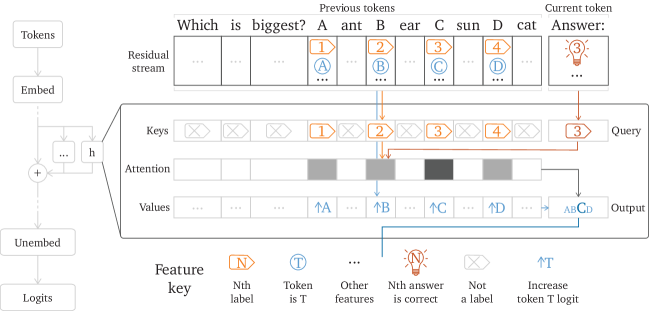
- “正确字母”头可在查询、键和值投影中被压缩为低秩子空间,且在MMLU基准上性能无损失,表明其结构具有简洁性。
- 这些头的查询和键子空间编码了一般性的“枚举中的第N项”特征,表明它们能检测正确答案在选项列表中的位置。
- 值子空间主要编码答案标记的身份(例如,'A'、'B'、'C'、'D'),使头能够提升相应logits。
- 所识别的“第N项”特征仅能部分解释头在随机化或分布外输入上的行为,表明该机制无法被此解释完全捕捉。
- 结果凸显了当前可解释性方法在大规模模型中的局限性,表明即使在标准基准上表现良好,解释仍可能具有噪声、不完整或依赖上下文。
更好的研究,从现在开始
从阅读论文到最终审阅,大幅缩短您的研究时间。
无需绑定信用卡
本解读由 AI 生成,并经人工编辑审核。