
[论文解读] Double Half-Heusler Alloys X$_2$Ni$_2$InSb (X= Zr/Hf) with promising Thermoelectric Performance: Role of varying structural phases
本研究采用从头算计算方法,系统研究了Zr/Hf基双半赫斯勒合金X₂Ni₂InSb(X = Zr/Hf)在四角相、立方相及固溶体相中的热电性能,结果表明四角相因具有较低的晶格热导率和较高的电子输运性能,展现出更优的热电性能。Zr₂Ni₂InSb在900 K时n型掺杂下达到峰值ZT值2.46,显示出作为高效热电材料的强劲潜力。
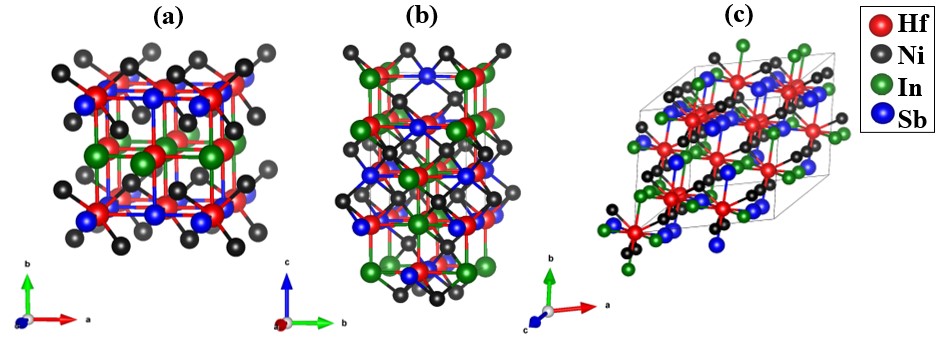
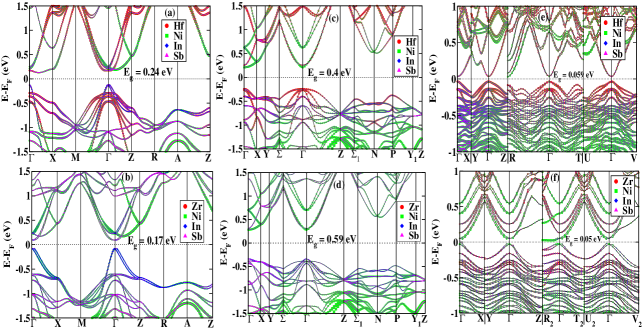
Double half-heusler alloys are the new class of compounds which can be seen as transmuted version of two single half-heusler with higher flexibility of tuning their properties. Here, we report a detailed study of thermoelectric (TE) properties of two double half-heusler (HH) alloys X$_2$Ni$_2$InSb (X=Hf/Zr), using first-principles calculation. These alloys exhibit a rich phase diagram with the possibility of tetragonal, cubic and solid solution phase at different temperature range. As such, a comparative study of TE properties of all these phases is performed. The ordered phases show quite favorable electronic transport as compared to the disordered ones in both compounds. Lattice thermal conductivity of double HH alloys is lower than their ternary counter-part, making them most promising for TE application. Simulated band gap, obtained using hybrid functional, of ordered phases of Hf$_2$Ni$_2$InSb and Zr$_2$Ni$_2$InSb lie in the range 0.24-0.4 eV and 0.17-0.59 eV respectively, while for disordered phase, it is 0.05- 0.06 eV. Hf$_2$Ni$_2$InSb shows a reasonably high ZT value of $\sim$ 2.19, while Zr$_2$Ni$_2$InSb yields 2.46 at high temperature for n-type conduction in tetragonal phase. The ZT value for p-type conduction is also quite promising ($\sim$ 1.35 and $\sim$ 2.19 for Hf- and Zr-based compounds). In both the compounds, electronic transport (Seebeck and electrical conductivity) plays the dominant role for the high ZT-value. Keeping in mind the promising TE performance, we propose immediate attention from experimentalists to synthesize and cross validate our findings for these new candidate materials.
研究动机与目标
- 研究双半赫斯勒合金X₂Ni₂InSb(X = Zr/Hf)在多种结构相中的热电性能。
- 评估结构相(四角相、立方相、固溶体相)对电子与热输运性能的调控作用。
- 识别最优结构相与掺杂浓度,以最大化热电优值(ZT)。
- 对比Zr基与Hf基化合物的性能,评估其在实验合成中的潜力。
提出的方法
- 采用含HSE06杂化泛函的密度泛函理论(DFT)精确计算带隙。
- 利用BoltzTraP2代码计算电子输运性质(塞贝克系数、电导率、功率因子)。
- 通过Wiedemann-Franz定律与声子群速度分析计算晶格热导率(κL)。
- 采用刚性带近似模拟载流子浓度对ZT的影响。
- 进行结构弛豫与声子色 dispersion 计算,以评估相稳定性与非谐性。
- 引入自旋-轨道耦合以考虑重Sb原子引起的能带分裂。
实验结果
研究问题
- RQ1X₂Ni₂InSb(X = Zr/Hf)在四角相、立方相及固溶体相中的热电性能如何变化?
- RQ2晶格热导率在决定双半赫斯勒合金ZT性能中起到何种作用?
- RQ3电子输运(塞贝克系数与功率因子)如何贡献于这些材料中高ZT值的形成?
- RQ4在Zr₂Ni₂InSb与Hf₂Ni₂InSb中,哪种相与掺杂浓度可使n型与p型传导的ZT达到最高?
- RQ5自旋-轨道耦合在多大程度上影响电子能带结构与热电响应?
主要发现
- Zr₂Ni₂InSb的四角相在900 K时n型传导下达到峰值ZT值2.46,为所有研究相与组分中的最高值。
- Hf₂Ni₂InSb在四角相中n型传导下ZT值达2.19,同样表现出优异性能。
- 四角相具有最低的晶格热导率(κL),这是提升ZT的关键因素,尽管其功率因子相近。
- 对于p型传导,Zr₂Ni₂InSb的四角相在900 K时ZT达2.19,而Hf₂Ni₂InSb为1.35。
- 采用HSE06泛函计算,有序四角相Zr₂Ni₂InSb的带隙范围为0.17至0.59 eV,表明其具有有利的半导体行为。
- 电子输运主导了高ZT值的形成,n型Zr₂Ni₂InSb在四角相中功率因子最高可达29.7 mWm⁻¹K⁻²。
更好的研究,从现在开始
从阅读论文到最终审阅,大幅缩短您的研究时间。
无需绑定信用卡
本解读由 AI 生成,并经人工编辑审核。