
[论文解读] DreamPose: Fashion Image-to-Video Synthesis via Stable Diffusion
DreamPose 是一种基于扩散模型的方法,通过在 Stable Diffusion 中引入姿态和图像条件控制,从单张静态图像和人体姿态序列生成逼真的时尚视频。它通过双分支 CLIP-VAE 编码器、五帧姿态条件控制以及对 UNet 和 VAE 解码器进行主体特定微调,实现了在时间一致性、外观保真度和运动真实感方面的最先进性能。
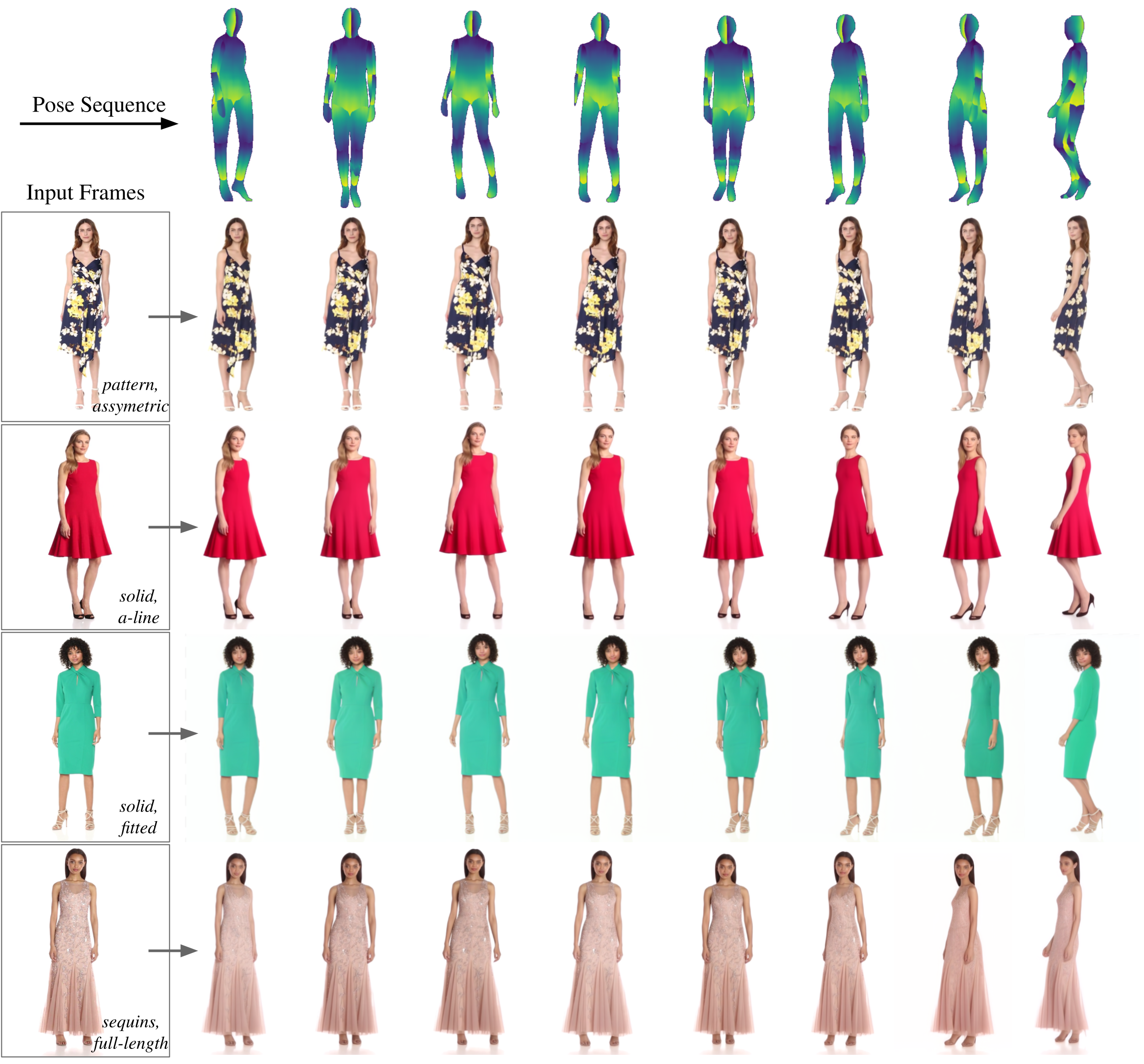
We present DreamPose, a diffusion-based method for generating animated fashion videos from still images. Given an image and a sequence of human body poses, our method synthesizes a video containing both human and fabric motion. To achieve this, we transform a pretrained text-to-image model (Stable Diffusion) into a pose-and-image guided video synthesis model, using a novel fine-tuning strategy, a set of architectural changes to support the added conditioning signals, and techniques to encourage temporal consistency. We fine-tune on a collection of fashion videos from the UBC Fashion dataset. We evaluate our method on a variety of clothing styles and poses, and demonstrate that our method produces state-of-the-art results on fashion video animation.Video results are available on our project page.
研究动机与目标
- 解决尽管时尚摄影普遍存在的背景下,真实且时间一致的时尚视频仍然稀缺的问题。
- 仅使用单张输入图像和姿态序列,实现对人类动作和布料动态的精确控制,同时保持高保真度图像动画。
- 克服现有视频扩散模型的局限性,如时间一致性差以及仅依赖文本条件控制的问题。
- 通过将姿态和图像条件整合到预训练扩散模型中,提升时尚视频合成中的外观保真度和运动平滑度。
- 在无需大量数据或复杂多阶段网络的情况下,实现主体特定的动画生成。
提出的方法
- 采用新颖的两阶段策略微调预训练的文生图 Stable Diffusion 模型:首先在 UBC Fashion 数据集上进行微调,随后在单张输入图像上进行主体特定微调。
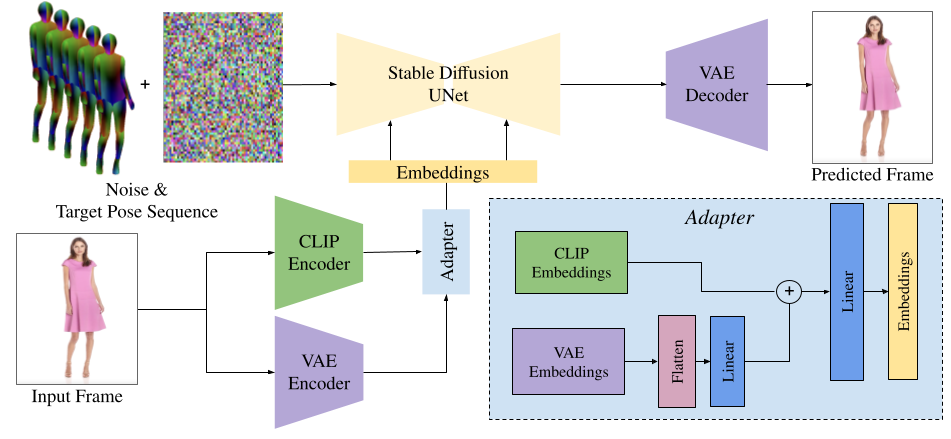
- 将 CLIP 文本编码器替换为双分支 CLIP-VAE 图像编码器与适配模块,以联合建模并重塑图像嵌入与潜在嵌入,从而提升外观保真度。
- 通过以目标帧为中心的五个连续姿态序列对去噪 U-Net 进行条件控制,增强时间一致性。
- 提出一种新型架构,通过修改注意力机制和输入注入路径,同时支持图像和姿态条件控制。
- 对 UNet、适配模块和 VAE 解码器进行主体特定微调,以在帧间保持身份和纹理细节。
- 在每个去噪步骤中,将姿态表示与输入噪声拼接,引入噪声注入机制。
实验结果
研究问题
- RQ1预训练的图像扩散模型能否被有效适配,以从单张图像和姿态序列生成高质量、逼真的时尚视频?
- RQ2与单帧姿态条件控制相比,使用多帧连续姿态条件控制在提升时间一致性方面有何优势?
- RQ3对 UNet 和 VAE 解码器进行主体特定微调,在多大程度上提升了外观保真度并减少了闪烁现象?
- RQ4与标准 CLIP 图像编码器相比,双 CLIP-VAE 编码器在保留衣物和身份的精细细节方面表现如何?
- RQ5该方法的失败模式是什么?是否可通过改进姿态估计或引入额外监督来缓解?
主要发现
- 完整版 DreamPose 模型在所有指标上均表现最佳:L1 (0.019),SSIM (0.900),VGG (0.207),LPIPS (0.056),优于消融实验变体。
- 仅使用 CLIP 图像编码器的消融实验(Ours_CLIP)表现出显著的外观退化,表明双 CLIP-VAE 编码器对细节保留至关重要。
- 对 VAE 解码器进行主体特定微调显著提升了图像锐度并减少了过拟合,如 Ours_No-VAE-FT 相较于 Ours_CLIP 的指标改善所示。
- 仅使用一帧姿态(Ours_1-pose)导致闪烁和运动不稳,尽管定量指标相近,凸显多帧姿态上下文的重要性。
- 对一帧姿态变体应用时间平滑处理(Ours_smooth)导致性能急剧下降,表明运动伪影更应通过架构设计而非后处理解决。
- 失败案例包括肢体与衣物融合、幻觉特征出现以及背面姿态下的方向错位,表明姿态估计和几何推理仍存在局限。
更好的研究,从现在开始
从阅读论文到最终审阅,大幅缩短您的研究时间。
无需绑定信用卡
本解读由 AI 生成,并经人工编辑审核。