
[论文解读] Dust modeling of the combined ALMA and SPHERE datasets of HD163296. Is HD163296 really a Meeus group II disk?
本研究结合ALMA(毫米波连续谱)与SPHERE(偏振散射光)数据,对HD 163296的尘埃分布进行建模,发现其外盘表面缺乏小颗粒尘埃,从而解释了其处于中间位置的SED特征。两种机制——增强的尘埃沉降或小颗粒耗竭——可解释100 AU以外区域缺乏散射光的原因,表明HD 163296更类似于I组原行星盘,而非传统分类中的II组源。
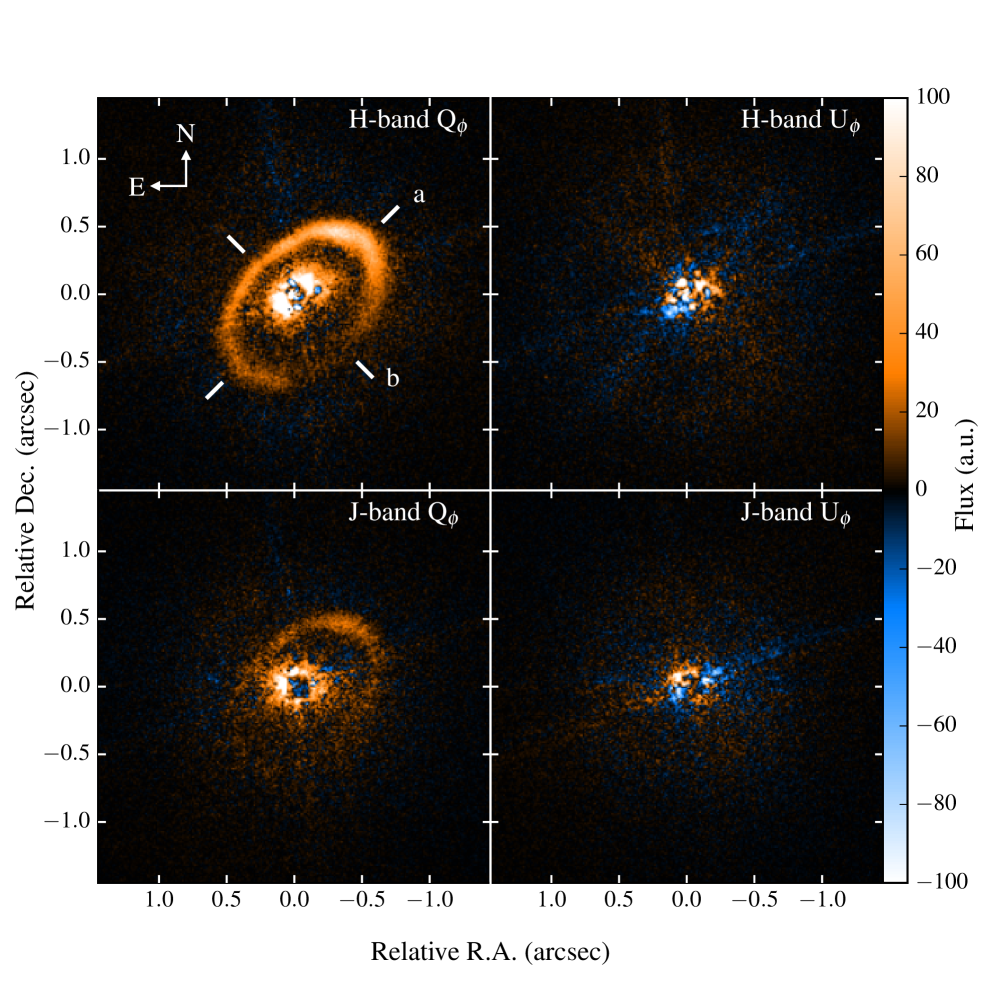
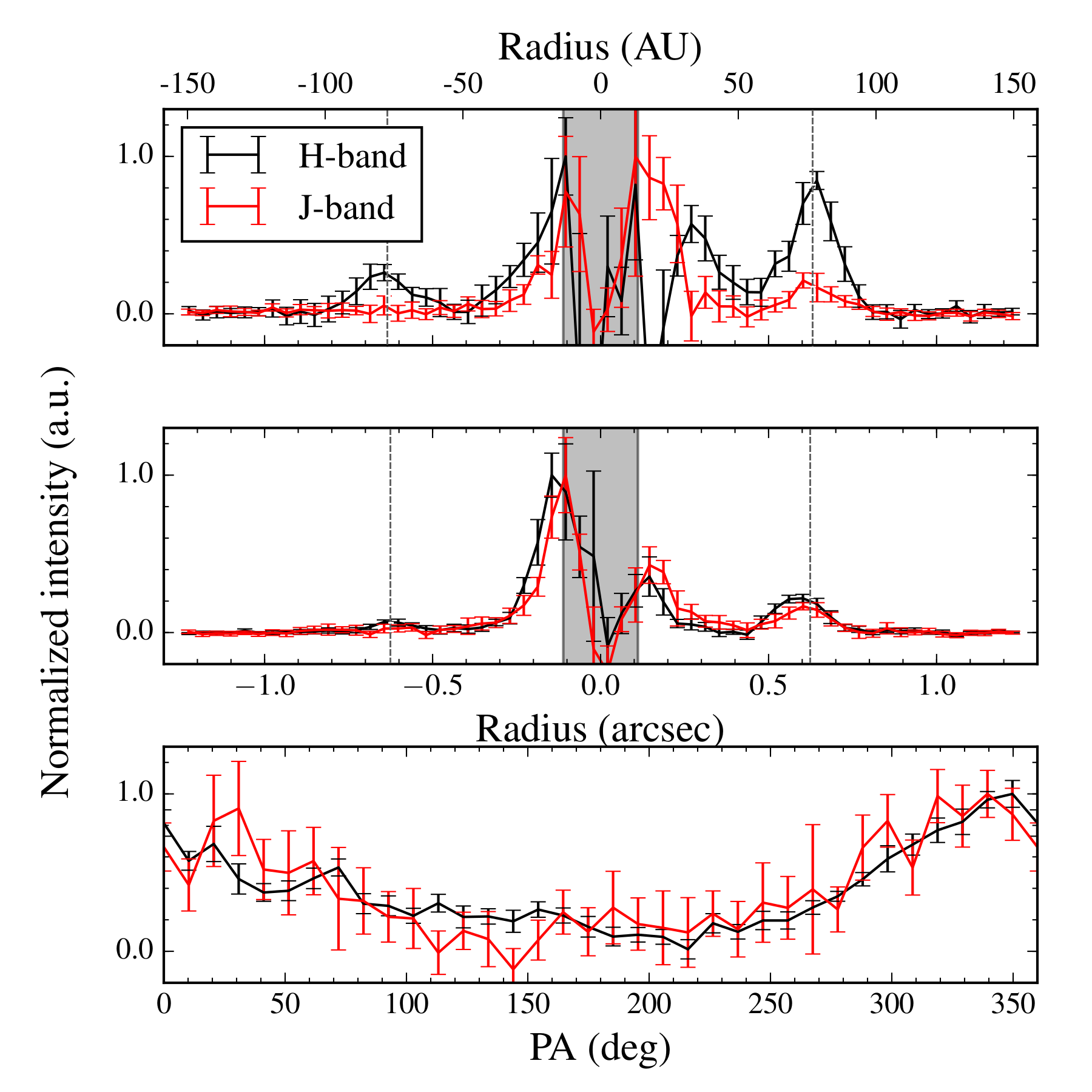
Context. Multi-wavelength observations are indispensable in studying disk geometry and dust evolution processes in protoplanetary disks. Aims. We aimed to construct a 3-dimensional model of HD 163296 capable of reproducing simultaneously new observations of the disk surface in scattered light with the SPHERE instrument and thermal emission continuum observations of the disk midplane with ALMA. We want to determine why the SED of HD 163296 is intermediary between the otherwise well-separated group I and group II Herbig stars. Methods. The disk was modelled using the Monte Carlo radiative transfer code MCMax3D. The radial dust surface density profile was modelled after the ALMA observations, while the polarized scattered light observations were used to constrain the inclination of the inner disk component and turbulence and grain growth in the outer disk. Results. While three rings are observed in the disk midplane in millimeter thermal emission at $\sim$80, 124 and 200 AU, only the innermost of these is observed in polarized scattered light, indicating a lack of small dust grains on the surface of the outer disk. We provide two models capable of explaining this difference. The first model uses increased settling in the outer disk as a mechanism to bring the small dust grains on the surface of the disk closer to the midplane, and into the shadow cast by the first ring. The second model uses depletion of the smallest dust grains in the outer disk as a mechanism for decreasing the optical depth at optical and NIR wavelengths. In the region outside the fragmentation-dominated regime, such depletion is expected from state-of-the-art dust evolution models. We studied the effect of creating an artificial inner cavity in our models, and conclude that HD 163296 might be a precursor to typical group I sources.
研究动机与目标
- 调和HD 163296的中间SED与其被归类为Meeus II组源之间的矛盾。
- 利用ALMA与SPHERE的多波长观测数据,对HD 163296的三维尘埃分布进行建模。
- 确定外盘(100 AU以外)缺乏散射光的原因是否源于尘埃沉降或颗粒耗竭。
- 评估HD 163296是否为典型I组金牛T型Ae/Be星的前体。
- 评估盘面几何结构、湍流及颗粒生长过程在塑造观测到的SED与形态中的作用。
提出的方法
- 使用蒙特卡罗辐射转移代码MCMax3D模拟HD 163296中的三维尘埃分布与辐射转移过程。
- 将径向尘埃面密度分布拟合至ALMA 1.3 mm连续谱数据,识别出位于~80、124和200 AU处的三个环。
- 利用SPHERE IRDIS的偏振散射光数据约束内盘的倾角与湍流。
- 探讨两种尘埃演化机制:外盘中尘埃沉降增强(α ~ 1×10⁻⁵)与外盘中小于3 µm颗粒的耗竭。
- 通过人工内腔模拟测试过渡盘行为。
- 通过内盘与外盘组件间约1.3°–3°的倾角错位,验证模型对观测亮度不对称性的拟合效果。
实验结果
研究问题
- RQ1为何HD 163296的SED位于I组与II组金牛T型Ae/Be星之间,尽管其被归类为II组?
- RQ2为何SPHERE图像中在100 AU以外区域未检测到散射光,尽管ALMA数据中存在尘埃环?
- RQ3增强的尘埃沉降或小颗粒耗竭是否能解释外盘区域表面缺乏小颗粒尘埃?
- RQ4HD 163296是否为向I组源演化的过渡天体?其观测特征如何支持这一观点?
- RQ5盘面几何结构与颗粒演化过程如何共同塑造HD 163296在多波长下的外观?
主要发现
- 外盘表面缺乏小颗粒尘埃,其证据为:尽管存在毫米波明亮的尘埃环,但在100 AU以外区域未检测到散射光。
- 外盘中α ~ 1×10⁻⁵的尘埃沉降情景可解释第一环遮蔽小颗粒,从而降低其散射贡献。
- 外盘中完全耗竭小于3 µm颗粒的模型可产生相似的观测效应,与当前最先进的尘埃演化模型一致。
- HD 163296的FIR余晖几乎由解析的内盘与第一尘埃环共同贡献,而非来自一个大而明亮的外盘。
- 缺乏强烈照亮的内壁,且内盘与第一环之间存在间隙,表明HD 163296是I组源的前体。
- SPHERE图像中的亮度不对称性可通过内盘与外盘组件间的小倾角错位(~1.3°–3°)结合偏振与相函数效应良好再现。
更好的研究,从现在开始
从阅读论文到最终审阅,大幅缩短您的研究时间。
无需绑定信用卡
本解读由 AI 生成,并经人工编辑审核。