
[论文解读] DYffusion: A Dynamics-informed Diffusion Model for Spatiotemporal Forecasting
DYffusion 引入一种基于动力学信息的扩散框架,用于对概率性时空预测,通过将一个时间条件的插值器与预测器耦合,实现高维动力学中的高效多步预测和连续时间采样。它在 SST、Navier-Stokes 流动和弹簧网格数据集上实现具有竞争力的精度并提高效率,同时相比标准扩散模型降低内存和步数要求。
While diffusion models can successfully generate data and make predictions, they are predominantly designed for static images. We propose an approach for efficiently training diffusion models for probabilistic spatiotemporal forecasting, where generating stable and accurate rollout forecasts remains challenging, Our method, DYffusion, leverages the temporal dynamics in the data, directly coupling it with the diffusion steps in the model. We train a stochastic, time-conditioned interpolator and a forecaster network that mimic the forward and reverse processes of standard diffusion models, respectively. DYffusion naturally facilitates multi-step and long-range forecasting, allowing for highly flexible, continuous-time sampling trajectories and the ability to trade-off performance with accelerated sampling at inference time. In addition, the dynamics-informed diffusion process in DYffusion imposes a strong inductive bias and significantly improves computational efficiency compared to traditional Gaussian noise-based diffusion models. Our approach performs competitively on probabilistic forecasting of complex dynamics in sea surface temperatures, Navier-Stokes flows, and spring mesh systems.
研究动机与目标
- 用扩散模型推动对复杂动力学的概率性时空预测。
- 提出一种将时间插值与预测耦合的基于动力学信息的扩散框架。
- 在提高内存效率和采样灵活性的前提下实现远期预测。
- 通过将模型与隐式动力系统解连接提供理论洞见。
- 在海表温度、Navier-Stokes 流动和弹簧网格系统上进行实证验证。
提出的方法
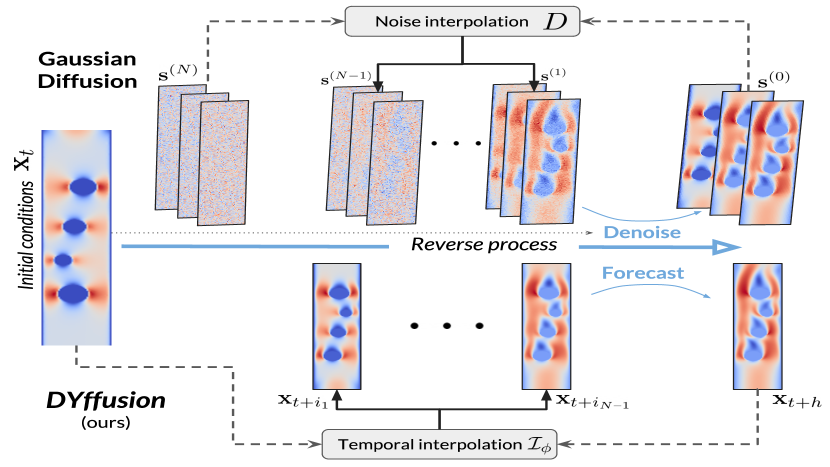
- 用时间条件插值器 I_phi 将标准扩散前向去噪替代为时间插值前向过程。
- 训练预测器网络 F_theta,基于在 x_t 与 x_{t+h} 之间的插值来预测 x_{t+h}。
- 两阶段训练:(1) 训练插值器以预测中间时间步;(2) 冻结 I_phi,使用推断随机性训练预测器以在多个 i_n 步上预测 x_{t+h}。
- 使用扩 diffusion-式的时间表,其中 n 为插值时间步 i_n 的索引,从而实现连续时间采样。
实验结果
研究问题
- RQ1基于动力学信息的扩散过程是否能在高维时空数据的概率预测上优于标准高斯扩散?
- RQ2将时间插值与预测耦合是否在保持或提高准确度的同时减少内存占用和采样步数?
- RQ3在复杂动力学数据集(SST、Navier-Stokes、Spring Mesh)上,DYffusion 在概率指标和效率方面的表现如何?
- RQ4是否能够有效且有益地生成连续时间采样轨迹用于长程预测?
主要发现
- 相较于基线,DYffusion 在 SST 和 Navier-Stokes 上实现了具有竞争力的 CRPS 和 MSE,由于扩散步数较少,采样速度快于 MCVD。
- DYffusion 在长距离预测方面表现突出,在 Spring Mesh 的长轨迹上优于基线,尤其是在分布之外的情况。
- 该方法在时间步长 h 下保持恒定的内存占用,与需要为多步时间步分配更大内存的多步预测基线不同。
- 通过跳过中间扩散步骤的时间表可以加速采样,在准确性和速度之间进行权衡。
- 定性结果显示,DYffusion 相较于强基线在 Navier-Stokes 轨迹中更好地保留了细尺度动力学。
- 理论视角将 DYffusion 与隐式动力系统求解器联系起来,类似于冷采样中的欧拉方法。

更好的研究,从现在开始
从论文设计到论文写作,大幅缩短您的研究时间。
无需绑定信用卡
本解读由 AI 生成,并经人工编辑审核。