
[论文解读] Dynamical Tests of a Deep-Learning Weather Prediction Model
本研究通过四项经典动力学实验——热带加热、中纬度气旋生成、地转调整及飓风发展——评估了Pangu-weather深度学习模型,表明其能够产生物理上合理的信号传播与结构演变。该模型展现出关键的大气动力学特征,如Matsuno–Gill响应、中纬度波辐射以及依赖湿度的飓风增强,表明其编码了超越单纯模式匹配的真实物理机制。
Global deep-learning weather prediction models have recently been shown to produce forecasts that rival those from physics-based models run at operational centers. It is unclear whether these models have encoded atmospheric dynamics, or simply pattern matching that produces the smallest forecast error. Answering this question is crucial to establishing the utility of these models as tools for basic science. Here we subject one such model, Pangu-weather, to a set of four classical dynamical experiments that do not resemble the model training data. Localized perturbations to the model output and the initial conditions are added to steady time-averaged conditions, to assess the propagation speed and structural evolution of signals away from the local source. Perturbing the model physics by adding a steady tropical heat source results in a classical Matsuno--Gill response near the heating, and planetary waves that radiate into the extratropics. A localized disturbance on the winter-averaged North Pacific jet stream produces realistic extratropical cyclones and fronts, including the spontaneous emergence of polar lows. Perturbing the 500hPa height field alone yields adjustment from a state of rest to one of wind--pressure balance over ~6 hours. Localized subtropical low pressure systems produce Atlantic hurricanes, provided the initial amplitude exceeds about 5 hPa, and setting the initial humidity to zero eliminates hurricane development. We conclude that the model encodes realistic physics in all experiments, and suggest it can be used as a tool for rapidly testing ideas before using expensive physics-based models.
研究动机与目标
- 评估类似Pangu-weather的深度学习天气模型是否编码了真实大气动力学,而非仅模仿训练数据中的模式。
- 检验模型是否能在训练分布之外重现对局部扰动的已知物理响应。
- 评估模型作为大气动力学中快速科学假说检验工具的实用性。
- 确定模型行为在理想化实验中是否与理论和观测预期在定性上一致。
- 探索深度学习模型在昂贵物理基模型运行之前,加速气象学基础研究的潜力。
提出的方法
- 使用气候学平均的初始条件进行四项理想化动力学实验,以避免与训练数据直接重叠。
- 对初始条件或模型输出施加局部扰动,包括持续的热带加热、急流扰动、500 hPa高度异常以及地表低压系统。
- 利用Pangu-weather模型的1小时、3小时、6小时和24小时预报头,模拟随时间的演变,借助其基于ERA5再分析数据训练的视觉Transformer架构。
- 将信号传播速度、结构演变及响应模式(如波辐射、气旋生成、平衡调整)与理论预期进行分析。
- 进行敏感性测试,例如将初始水汽设为零,以评估水汽依赖关系如湿对流的条件依赖性。
- 将定性结果与既有的大气理论和观测进行比较,而不与物理基模型进行直接定量基准对比。
实验结果
研究问题
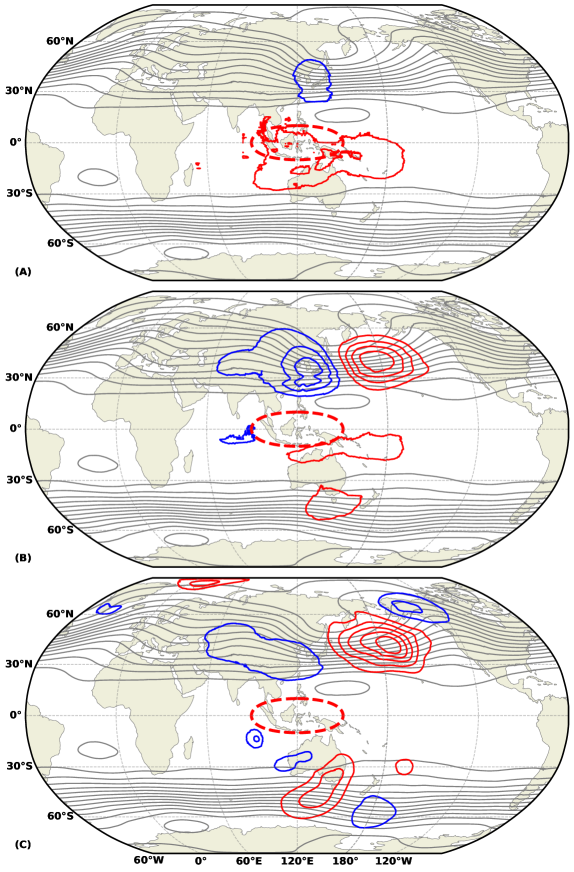
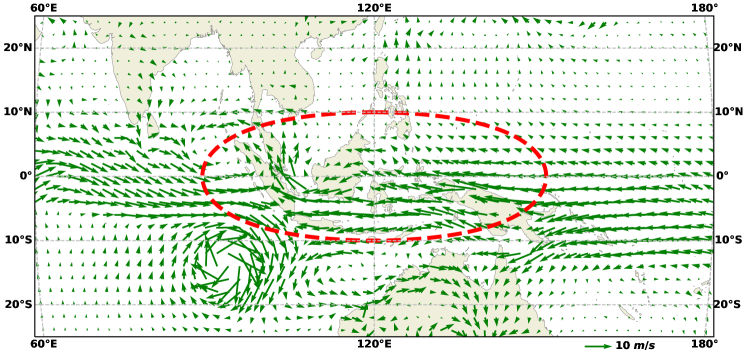
- RQ1当施加持续热带加热时,Pangu-weather模型是否会产生物理上合理的Matsuno–Gill响应?
- RQ2模型能否从冬季平均急流上的局部扰动中生成中纬度气旋和极地低压?
- RQ3当以不平衡的500 hPa高度异常初始化时,模型是否表现出地转调整?
- RQ4模型是否能根据初始涡旋振幅和水汽含量重现已知的热带气旋生成阈值?
- RQ5模型对局部扰动的响应是否在定性上与已知大气动力学和观测行为一致?
主要发现
- 持续热带加热在热带区域产生Matsuno–Gill响应,并激发向中高纬度传播的行星波,与线性波理论一致。
- 在冬季平均北太平洋急流上施加局部扰动后,自发生成中纬度气旋和极地低压,表明其表现出真实的斜压不稳定。
- 初始500 hPa高度异常在约6小时内触发向地转平衡的调整,其中非辐合流逐渐转变为旋转流。
- 大西洋飓风仅在初始地表低压振幅超过约5 hPa时形成,且当初始水汽设为零时发展过程即停止。
- 模型对扰动的响应展现出信号传播与结构演变,其特征在多个时间尺度上与已知大气动力学定性一致。
- 模型行为表明其编码了超越模式匹配的物理约束,其能从局部输入重现复杂非线性大气响应,证明了这一点。
更好的研究,从现在开始
从阅读论文到最终审阅,大幅缩短您的研究时间。
无需绑定信用卡
本解读由 AI 生成,并经人工编辑审核。