
[论文解读] Dynamics of Long-lived Axion Domain Walls and Its Cosmological Implications
本文通过3D晶格模拟研究了带有偏置项的长寿命轴子域壁(DWs),揭示了轴子辐射导致的能量损失主导了域壁演化。研究构建了一个速度依赖的单标度(VOS)模型来描述域壁动力学,并得出了与以往研究显著不同的轴子暗物质丰度修正预测,对轴子理论物理和宇宙学约束具有重要意义。
We perform an updated analysis on a long-lived axion domain wall (DW) network. By simulating the axion field on a 3D lattice and fitting an analytical model for the DW evolution, we identify the leading energy loss mechanisms of the DWs and compute the spectrum of axions emitted from the network. The contribution from the DWs to axion dark matter (DM) density is derived, with viable parameter space given. The application to both QCD axions and general axion-like particles (ALPs) are considered. Due to the new approaches taken, while our results bear consistency with earlier literature, notable discrepancies are also revealed, such as the prediction for DM abundance, which may have a profound impact on axion phenomenology at large.
研究动机与目标
- 理解早期宇宙中长寿命轴子域壁(DWs)的动力学,特别是其能量损失机制和轴子发射过程。
- 解决先前文献中关于具有N_DW > 1的模型下轴子暗物质(DM)遗迹丰度的争议。
- 开发并校准一个适用于亚稳态DW演化的速度依赖单标度(VOS)模型,将其应用范围从宇宙弦和稳定DW扩展至新情境。
- 为QCD轴子和轴子样粒子(ALPs)在宇宙学约束下的轴子DM产生提供更新的预测。
- 阐明域壁亚结构和辐射谱在决定最终轴子遗迹密度和观测特征中的作用。
提出的方法
- 在辐射主导的宇宙中,对轴子场进行3D有限温度场论晶格模拟,网格尺寸为1536³。
- 在轴子势能中引入一个微小偏置项ε,以模拟在大爆炸核合成(BBN)前衰变的亚稳态DWs。
- 精确求解轴子场运动方程,避免了先前研究中使用的近似方法(例如3D希格斯DW模拟中的PRS近似)。
- 通过时间分辨的快照和轴子能量密度谱分析,识别主要的辐射机制和DW亚结构演化。
- 将模拟数据拟合至解析模型,包括引入速度依赖参数的改进型VOS模型,以描述DW网络的标度行为和衰变过程。
- 使用高斯拟合函数建模轴子能量密度组分(ρ₂, ρ₃),并从DW面积和速度的时间演化中推导能量损失率。
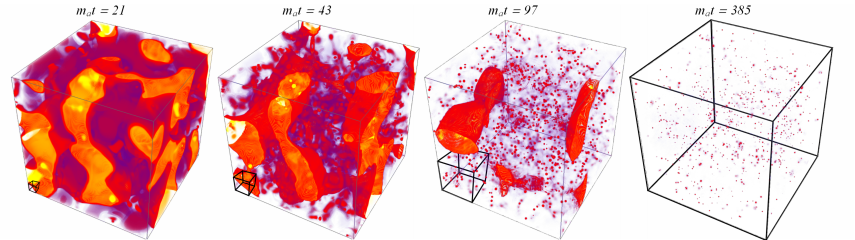
实验结果
研究问题
- RQ1长寿命轴子域壁衰变的主要能量损失机制是什么?
- RQ2从DW网络发射的轴子谱如何依赖于偏置参数ε和DW演化动力学?
- RQ3扩展至包含速度依赖性的VOS模型在多大程度上能准确描述亚稳态DW网络的标度和衰变阶段?
- RQ4从DW衰变产生的轴子暗物质遗迹密度的修正预测是什么?与先前估计相比有何差异?
- RQ5DW衰变时间对轴子模型可行参数空间施加了何种约束,特别是在BBN和CMB观测的背景下?
主要发现
- 长寿命轴子域壁的主要能量损失机制是轴子辐射,而非引力波发射或弦介导衰变。
- 模拟显示,DW表面曲率随时间逐渐变平,表明系统已进入标度行为阶段,网络以自相似方式演化。
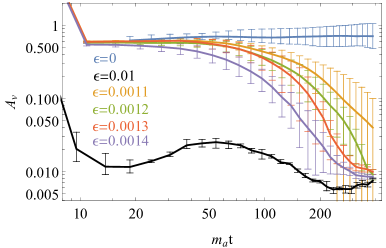
- 成功将VOS模型扩展为包含速度依赖性,平均DW速度⟨γv⟩在标度阶段趋于恒定,与A_v ≈ 0.009 ± 0.0012一致。
- 轴子能量密度谱显示出对应于不同辐射组分的显著峰,其中第三组分(ρ₃)在晚期占主导地位,且与能量损失模型拟合良好。
- 从DW衰变预测的轴子暗物质丰度满足Ω_a^DW ∝ ε^(-1/2)(小ε时),但归一化值显著低于以往2D模拟结果,表明为更保守的修正估计。
- DW在BBN前衰变的参数空间受到约束:ε ≲ 0.005可确保有足够时间进入标度阶段,而较大ε则导致过早坍缩,无法完成标度过程。
更好的研究,从现在开始
从阅读论文到最终审阅,大幅缩短您的研究时间。
无需绑定信用卡
本解读由 AI 生成,并经人工编辑审核。