
[论文解读] Edge Intelligence for Autonomous Driving in 6G Wireless System: Design Challenges and Solutions
本文提出了一种面向6G赋能的自动驾驶系统的两级边缘智能(EI)框架,通过将深度神经网络模型在车辆与边缘服务器之间分割,实现低延迟、隐私保护的推理。通过使用多任务学习(MTL)进行实时卸载决策,以及通过神经网络分割实现联合推理,该系统将延迟降低了99%以上,并在数据质量较差的条件下提升了准确性,优于基线方法。
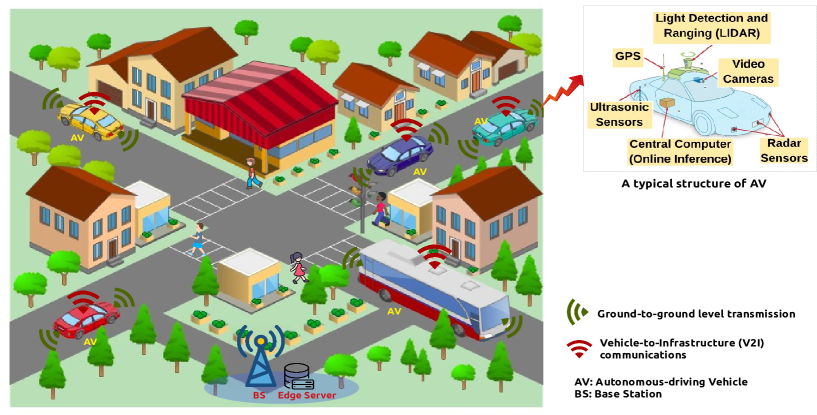
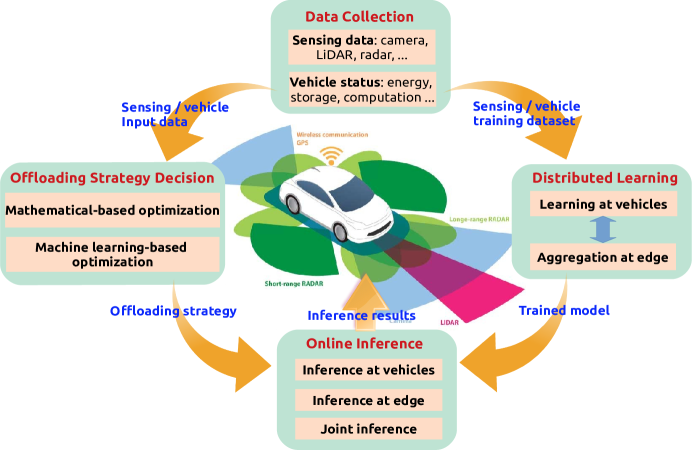
In a level-5 autonomous driving system, the autonomous driving vehicles (AVs) are expected to sense the surroundings via analyzing a large amount of data captured by a variety of onboard sensors in near-real-time. As a result, enormous computing costs will be introduced to the AVs for processing the tasks with the deployed machine learning (ML) model, while the inference accuracy may not be guaranteed. In this context, the advent of edge intelligence (EI) and sixth-generation (6G) wireless networking are expected to pave the way to more reliable and safer autonomous driving by providing multi-access edge computing (MEC) together with ML to AVs in close proximity. To realize this goal, we propose a two-tier EI-empowered autonomous driving framework. In the autonomous-vehicles tier, the autonomous vehicles are deployed with the shallow layers by splitting the trained deep neural network model. In the edge-intelligence tier, an edge server is implemented with the remaining layers (also deep layers) and an appropriately trained multi-task learning (MTL) model. In particular, obtaining the optimal offloading strategy (including the binary offloading decision and the computational resources allocation) can be formulated as a mixed-integer nonlinear programming (MINLP) problem, which is solved via MTL in near-real-time with high accuracy. On another note, an edge-vehicle joint inference is proposed through neural network segmentation to achieve efficient online inference with data privacy-preserving and less communication delay. Experiments demonstrate the effectiveness of the proposed framework, and open research topics are finally listed.
研究动机与目标
- 为解决因车载处理大量传感器数据而导致的高级别自动驾驶系统计算成本高、推理准确性不可靠的问题。
- 通过多接入边缘计算(MEC)将部分深度学习工作负载卸载至边缘服务器,实现在自动驾驶车辆(AVs)中低延迟、高准确率的推理。
- 通过神经网络分割与车辆和边缘服务器之间的联合推理,保护数据隐私并减少通信延迟。
- 利用多任务学习(MTL)高效求解卸载决策与资源分配的混合整数非线性规划(MINLP)问题。
- 在不同数据质量和车辆负载条件下评估框架性能,验证其鲁棒性与可扩展性。
提出的方法
- 该框架将预训练的深度神经网络(DNN)模型分割为浅层部分部署在车辆上,深层部分部署在边缘服务器上。
- 在边缘服务器上部署多任务学习(MTL)模型,以近乎实时的方式联合预测最优卸载决策与计算资源分配。
- 神经网络分割通过在车辆与边缘服务器之间路由中间特征图,实现高效的在线推理,最大限度减少通信开销。
- 将卸载策略问题建模为混合整数非线性规划(MINLP)问题,通过MTL求解,实现亚毫秒级响应时间。
- 通过将原始传感器数据保留在车辆上,仅传输中间特征,支持隐私保护的推理。
- 通过案例研究在不同数据质量(坏数据比例η)和自动驾驶车辆数量(2–8辆)下评估框架性能,对比MTL、sBB和仅车辆推理方法。
实验结果
研究问题
- RQ16G无线系统中的边缘智能如何在实时约束下实现自动驾驶车辆的低延迟、高准确率推理?
- RQ2在多辆自动驾驶车辆的环境中,计算卸载与通信延迟之间最优权衡是什么?
- RQ3如何在实现车辆与边缘服务器协同推理的同时保护数据隐私?
- RQ4与传统优化方法相比,多任务学习在提升卸载决策效率与准确性方面有多大改善?
- RQ5当输入数据质量下降(如图像模糊)且车辆密度变化时,系统性能如何?
主要发现
- 基于MTL的卸载策略将求解时间缩短至sBB算法的千分之一以下,实现了近实时性能。
- 当坏数据比例(η)超过0.3时,边缘推理优于仅车辆推理,因深层DNN层提升了准确性,从而降低了加权成本。
- MTL模型的均方误差(MSE)小于sBB算法的一半,表明其在卸载决策预测方面具有更高的准确性。
- 当η < 0.3时,仅车辆推理更具竞争力,因其延迟更低且准确性更高;但随着数据质量下降,边缘推理变得至关重要。
- 在2至8辆AV的范围内,该框架保持了低通信延迟和高推理准确性,展现出良好的可扩展性。
- 通过神经网络分割实现的联合推理,支持隐私保护、动态且高效的在线推理,显著降低了延迟。
更好的研究,从现在开始
从阅读论文到最终审阅,大幅缩短您的研究时间。
无需绑定信用卡
本解读由 AI 生成,并经人工编辑审核。