
[论文解读] Efficient quantum algorithm for nonlinear reaction-diffusion equations and energy estimation
本文提出了一种高效的量子算法,用于求解非线性反应-扩散方程,采用改进的Carleman线性化技术,利用ℓ∞范数定义了一个更宽松的收敛条件 R_D < 1,该条件与空间网格尺寸无关。该方法实现了高维PDE的量子加速,并允许通过后处理从解态中的导数信息估计动能。
Nonlinear differential equations exhibit rich phenomena in many fields but are notoriously challenging to solve. Recently, Liu et al. [1] demonstrated the first efficient quantum algorithm for dissipative quadratic differential equations under the condition $R < 1$, where $R$ measures the ratio of nonlinearity to dissipation using the $\ell_2$ norm. Here we develop an efficient quantum algorithm based on [1] for reaction-diffusion equations, a class of nonlinear partial differential equations (PDEs). To achieve this, we improve upon the Carleman linearization approach introduced in [1] to obtain a faster convergence rate under the condition $R_D < 1$, where $R_D$ measures the ratio of nonlinearity to dissipation using the $\ell_{\infty}$ norm. Since $R_D$ is independent of the number of spatial grid points $n$ while $R$ increases with $n$, the criterion $R_D<1$ is significantly milder than $R<1$ for high-dimensional systems and can stay convergent under grid refinement for approximating PDEs. As applications of our quantum algorithm we consider the Fisher-KPP and Allen-Cahn equations, which have interpretations in classical physics. In particular, we show how to estimate the mean square kinetic energy in the solution by postprocessing the quantum state that encodes it to extract derivative information.
研究动机与目标
- 开发一种高效的非线性反应-扩散方程量子算法,该类PDE在物理学、生物学和数据科学中具有广泛应用。
- 克服先前量子算法依赖于严格R < 1条件的局限性,该条件基于ℓ2范数,且随网格细化而恶化。
- 通过引入基于ℓ∞范数的收敛准则 R_D < 1,改进Carleman线性化方法,确保在空间网格细化下保持稳定性。
- 通过量子解态的后处理,实现对经典可观测量(如均方动能)的计算。
- 探索通过振幅估计和导数态制备,在非线性PDE中实现经典输出的超多项式量子加速的可行性。
提出的方法
- 将Carleman线性化框架适配为将非线性反应-扩散方程映射为无限维线性系统,同时保持原始PDE的结构。
- 提出一种基于解的ℓ∞范数的新收敛准则 R_D < 1,该准则在空间网格细化下保持有界,与基于ℓ2范数的R < 1条件不同。
- 使用量子相位估计算法和振幅放大,以复杂度 poly(log n, T, 1/ε) 准备编码线性化系统解的量子态。
- 应用振幅估计从量子态中提取经典信息(如均方动能),该量子态通过受控导数制备过程编码了导数信息。
- 利用最大值原理和解的正则性,确保解在ℓ∞意义下的有界性和稳定性,从而支持新收敛条件的成立。
- 设计一种在网格细化下保持效率的量子算法,通过最小化对解的ℓ2范数的依赖(通常随网格点数增长而增大)实现。
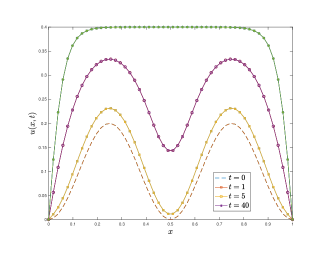
实验结果
研究问题
- RQ1能否将非线性PDE中量子Carleman线性化的收敛条件改进为与空间网格尺寸无关?
- RQ2使用ℓ∞范数而非ℓ2范数来度量非线性性与耗散性的比值,是否能带来更鲁棒、更可扩展的反应-扩散方程量子算法?
- RQ3量子算法能否在不引入指数开销的情况下,高效估计如动能等经典可观测量?
- RQ4能否通过振幅估计和导数态制备,在非线性PDE中实现经典输出的超多项式量子加速?
- RQ5该算法在网格细化下的性能如何变化?能否使其对空间离散化完全不敏感?
主要发现
- 该算法基于ℓ∞范数实现了收敛条件 R_D < 1,该条件与空间网格点数n无关,显著弱于基于ℓ2范数的R < 1条件。
- 复杂度为 O(T²q/(gε) · poly(log T, log n, log 1/ε)),相较于先前用于非线性ODE的量子算法,在时间上实现了二次改进。
- 通过制备编码导数信息的量子态并应用振幅估计,该算法能够高效估计均方动能。
- 由于基于ℓ∞范数的准则,该方法在网格细化下保持稳定性和收敛性,解决了先前方法的关键局限。
- 该方法适用于物理上相关的方程,如Fisher-KPP和Allen-Cahn方程,用于建模种群动力学和相分离等现象。
- 该框架为在求解高维非线性PDE中实现量子优势提供了路径,前提是可通过后处理高效提取经典输出。

更好的研究,从现在开始
从阅读论文到最终审阅,大幅缩短您的研究时间。
无需绑定信用卡
本解读由 AI 生成,并经人工编辑审核。