
[论文解读] Emergency Incident Detection from Crowdsourced Waze Data using Bayesian Information Fusion
本文提出一种贝叶斯信息融合框架,通过建模时空不确定性和报告者可靠性,从嘈杂的众包Waze数据中检测紧急事件。该方法相比基线模型在F1得分上实现了5%以上的相对提升,并平均比官方记录提前5.92分钟检测到事件。
The number of emergencies have increased over the years with the growth in urbanization. This pattern has overwhelmed the emergency services with limited resources and demands the optimization of response processes. It is partly due to traditional `reactive' approach of emergency services to collect data about incidents, where a source initiates a call to the emergency number (e.g., 911 in U.S.), delaying and limiting the potentially optimal response. Crowdsourcing platforms such as Waze provides an opportunity to develop a rapid, `proactive' approach to collect data about incidents through crowd-generated observational reports. However, the reliability of reporting sources and spatio-temporal uncertainty of the reported incidents challenge the design of such a proactive approach. Thus, this paper presents a novel method for emergency incident detection using noisy crowdsourced Waze data. We propose a principled computational framework based on Bayesian theory to model the uncertainty in the reliability of crowd-generated reports and their integration across space and time to detect incidents. Extensive experiments using data collected from Waze and the official reported incidents in Nashville, Tenessee in the U.S. show our method can outperform strong baselines for both F1-score and AUC. The application of this work provides an extensible framework to incorporate different noisy data sources for proactive incident detection to improve and optimize emergency response operations in our communities.
研究动机与目标
- 解决Waze众包事件报告不可靠且不确定的问题,以支持主动应急响应。
- 克服依赖延迟911报警的传统反应式应急系统局限性。
- 提出一种系统化方法,融合时空不确定的嘈杂报告。
- 相比E-TRIMS官方事件记录,利用实时Waze数据提升事件早期检测能力。
- 通过贝叶斯概率更新提供事件预测的可量化置信度度量。
提出的方法
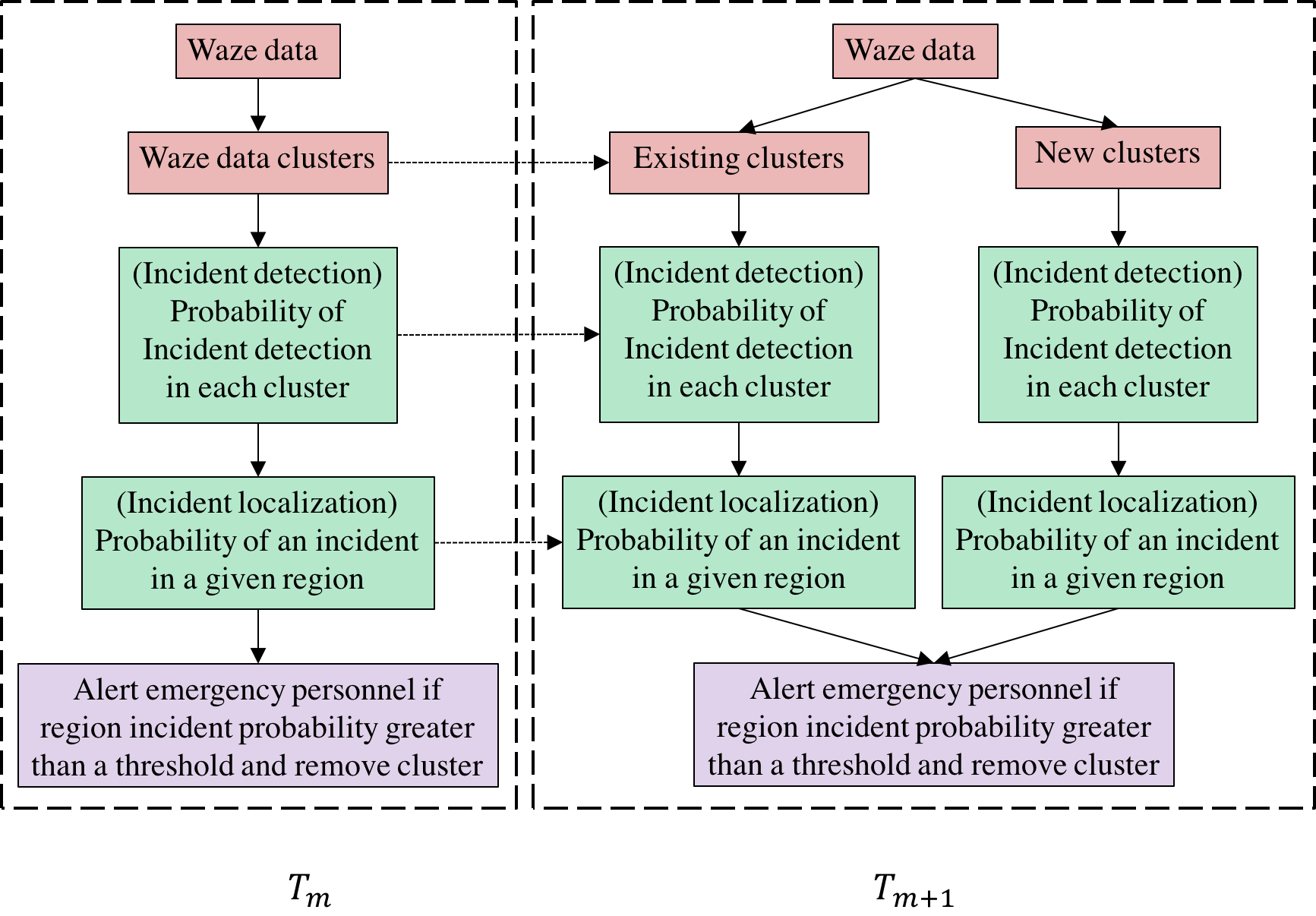
- 将Waze报告建模为噪声传感器读数,并应用贝叶斯推断以随时间估计事件概率。
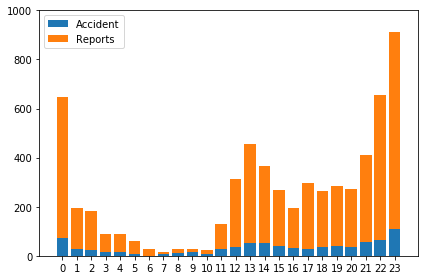
- 采用基于时空网格的方法,在空间和时间窗口内聚合报告。
- 在贝叶斯框架中将报告者可靠性作为可学习参数,动态加权报告。
- 应用序贯贝叶斯更新,随新报告到达不断优化事件概率。
- 通过网格搜索优化超参数(如25分钟时间窗口、100米空间孔径),以最大化F1得分。
- 在贝叶斯框架内使用逻辑回归,基于报告密度和可靠性建模事件发生的可能性。
实验结果
研究问题
- RQ1贝叶斯信息融合能否有效利用嘈杂的Waze数据,在官方报告之前更早检测到事件?
- RQ2与基线方法相比,建模报告者可靠性和时空不确定性如何提升检测性能?
- RQ3哪些超参数设置(如时间窗口、空间孔径)能优化事件检测准确率和F1得分?
- RQ4该系统在多大程度上能够于官方E-TRIMS记录发布前预测事件?
- RQ5性能如何随不同事件间隔、空间网格尺寸和时间步长而变化?
主要发现
- 所提出的贝叶斯融合方法相比强基线方法在F1得分上实现了5%以上的相对提升。
- 表现最佳的模型(M6)平均比官方E-TRIMS记录提前5.92分钟检测到事件。
- 基于逻辑回归的方案在F1得分和AUC上均优于其他分类器,表明其在精确率与召回率之间具有更好的平衡。
- 模型性能对空间孔径大小敏感,最优性能出现在100米处,凸显了空间分辨率调优的重要性。
- 延长事件间隔可略微提升F1得分,表明更长的检测窗口有助于提升稀有事件的可靠性。
- 该方法在处理稀疏且不一致的报告时表现出鲁棒性,通过贝叶斯不确定性量化在预测中保持高置信度。
更好的研究,从现在开始
从阅读论文到最终审阅,大幅缩短您的研究时间。
无需绑定信用卡
本解读由 AI 生成,并经人工编辑审核。