
[论文解读] Emerging Drug Interaction Prediction Enabled by Flow-based Graph Neural Network with Biomedical Network
该论文提出EmerGNN,一种基于流的图神经网络,通过利用HetioNet等生物医学网络,从药物对之间提取并加权相关路径,以预测新兴药物的药物-药物相互作用(DDI)。通过沿加权生物医学关系进行方向性信息流学习成对表示,EmerGNN在冷启动DDI预测中实现了比现有方法更高的准确性,同时提供可解释的、基于路径的解释。
Accurately predicting drug-drug interactions (DDI) for emerging drugs, which offer possibilities for treating and alleviating diseases, with computational methods can improve patient care and contribute to efficient drug development. However, many existing computational methods require large amounts of known DDI information, which is scarce for emerging drugs. In this paper, we propose EmerGNN, a graph neural network (GNN) that can effectively predict interactions for emerging drugs by leveraging the rich information in biomedical networks. EmerGNN learns pairwise representations of drugs by extracting the paths between drug pairs, propagating information from one drug to the other, and incorporating the relevant biomedical concepts on the paths. The different edges on the biomedical network are weighted to indicate the relevance for the target DDI prediction. Overall, EmerGNN has higher accuracy than existing approaches in predicting interactions for emerging drugs and can identify the most relevant information on the biomedical network.
研究动机与目标
- 为解决在临床相互作用数据有限的情况下预测新兴药物药物-药物相互作用(DDI)的挑战。
- 克服现有基于GNN的DDI预测方法严重依赖历史相互作用数据且在冷启动场景下表现不佳的局限性。
- 开发一种有效整合异质生物医学网络(如HetioNet)的模型,以提取并加权药物对之间的相关生物通路。
- 通过识别连接新兴药物对的关键生物概念和关系,实现可解释的DDI预测。
- 通过早期检测新药潜在有害的相互作用,提升患者安全并加速药物研发。
提出的方法
- EmerGNN构建了一个基于流的GNN,沿生物医学网络中连接药物对的子图传播信息,捕捉从一种药物到另一种药物的方向性信息流。
- 利用注意力机制提取并加权新兴药物与现有药物之间的路径,其中边权重反映对目标DDI预测的相关性。
- 通过聚合这些路径上生物医学实体(如基因、疾病)和关系(如CrC、CbG、CtD)的信息,学习药物对的联合表示。
- 将DDI网络和生物医学网络整合到统一框架中,实现跨网络消息传递,以提升表示学习效果。
- 采用基于注意力的路径选择的束搜索方法,为每对药物识别最相关的子路径,增强可解释性。
- 采用在药物对周围局部子图上运行的GNN架构,聚焦于相关拓扑结构,而非全局图传播。

实验结果
研究问题
- RQ1当历史相互作用数据稀缺时,基于GNN的模型能否有效预测新兴药物的药物-药物相互作用?
- RQ2如何利用生物医学网络为冷启动DDI预测提供有意义的归纳偏置?
- RQ3哪些类型的生物医学关系(如基因-疾病、药物-基因)对特定DDI类型最具预测性?
- RQ4与全局图嵌入相比,生物医学网络中的基于路径的信息流在多大程度上提升了预测性能?
- RQ5模型的预测能否通过识别参与预测相互作用的关键生物通路和关系来实现可解释?
主要发现
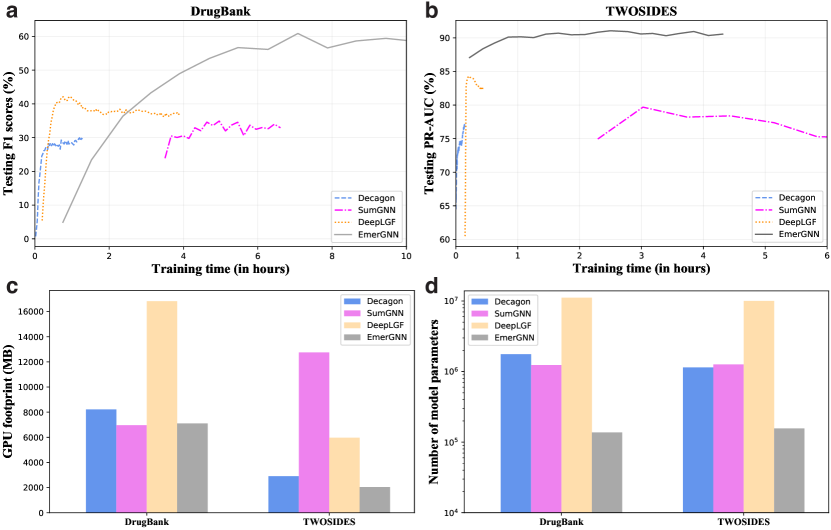
- EmerGNN在预测新兴药物DDI方面优于现有基于GNN的方法,尤其在S1(新兴对现有)和S2(新兴对新兴)设置中表现更优。
- 该模型在宏平均F1分数上优于强基线模型如Decagon、SumGNN和CompGCN,尤其在低频相互作用组中表现更佳。
- 注意力机制成功识别出路径上最相关的生物医学关系,前5位被注意的关系(如CrC、CtD、CsSE)对预测性能有显著贡献。
- 消融实验表明,将测试集中的相互作用边移除并加入训练集可提升性能,证实了模型在冷启动场景下的鲁棒性。
- t-SNE可视化结果表明,与SumGNN和CompGCN等模型相比,EmerGNN学习到的药物对表示更具区分性且语义更合理。
- 通过热图和直方图分析验证了模型的可解释性:预测的相互作用与特定相互作用类型及选定路径上的生物医学关系强相关。
更好的研究,从现在开始
从阅读论文到最终审阅,大幅缩短您的研究时间。
无需绑定信用卡
本解读由 AI 生成,并经人工编辑审核。