
[论文解读] Engineering Software Systems for Quantum Computing as a Service: A Mapping Study
该论文对 QCaaS 研究进行了系统映射研究,确定建模符号、模式、语言、部署平台,以及新兴趋势。
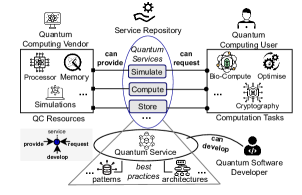
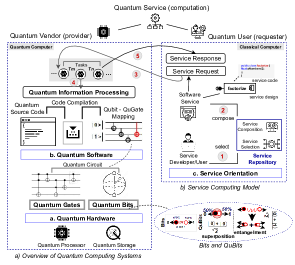
Quantum systems have started to emerge as a disruptive technology and enabling platforms - exploiting the principles of quantum mechanics - to achieve quantum supremacy in computing. Academic research, industrial projects (e.g., Amazon Braket), and consortiums like 'Quantum Flagship' are striving to develop practically capable and commercially viable quantum computing (QC) systems and technologies. Quantum Computing as a Service (QCaaS) is viewed as a solution attuned to the philosophy of service-orientation that can offer QC resources and platforms, as utility computing, to individuals and organisations who do not own quantum computers. To understand the quantum service development life cycle and pinpoint emerging trends, we used evidence-based software engineering approach to conduct a systematic mapping study (SMS) of research that enables or enhances QCaaS. The SMS process retrieved a total of 55 studies, and based on their qualitative assessment we selected 9 of them to investigate (i) the functional aspects, design models, patterns, programming languages, deployment platforms, and (ii) trends of emerging research on QCaaS. The results indicate three modelling notations and a catalogue of five design patterns to architect QCaaS, whereas Python (native code or frameworks) and Amazon Braket are the predominant solutions to implement and deploy QCaaS solutions. From the quantum software engineering (QSE) perspective, this SMS provides empirically grounded findings that could help derive processes, patterns, and reference architectures to engineer software services for QC.
研究动机与目标
- 调查现有可使 Quantum Computing as a Service (QCaaS) 实现或增强的解决方案。
- 描述 QCaaS 的功能方面、设计模型、模式、编程语言、部署平台和运作化。
- 识别新兴趋势和空白,以指导未来的 QCaaS 研究与实践。
- 从量子软件工程视角,为 QC 的软件服务工程提供经经验证据支撑的指导。
提出的方法
- 使用基于证据的软件工程方法执行了系统映射研究(SMS)。
- 在主要电子数据源(IEEE Xplore、ACM DL、SpringerLink、ScienceDirect、Wiley Online Library)以及 Google Scholar 中进行检索;对每个来源定制检索字符串。
- 从种子研究应用前向滚雪球法扩展候选集。
- 使用预定义标准(S1-S4, Q1-Q5)对研究进行筛选和质量评估,以选择 9项研究用于最终分析。
- 数据提取结构化,与改编的 IBM SOA 生命周期(概念、建模、组装、部署)保持一致。
- 以功能方面、建模符号、模式、语言和部署平台等方面报告结果。
实验结果
研究问题
- RQ1RQ1:文献中报告了哪些用于支持量子计算作为服务的发展解决方案?
- RQ2RQ2:关于量子计算作为服务的研究有哪些新兴趋势?
主要发现
- 为 QCaaS 识别了三种建模符号(UML、基于图的模型和过程模型)。
- 报道了五种 QCaaS 的设计模式(API Gateway、Layered Architecture、Classic-Quantum Split、Service Wrapping、Repository)。
- Python(原生或通过框架)和 Amazon Braket 是 QCaaS 解决方案中占主导地位的实现/部署选项。
- 为 QCaaS 识别出四个应用领域:优化、流程自动化、数学和量子仿真,影响工具/语言的选择。
- 强调用于部署的三个量子供应商/平台:Amazon Braket、IBM Quantum 和 Rigetti。
- 新兴趋势包括对非功能性方面、模型驱动工程和低代码方法的重视,量子领域工程(QSRs)、人类角色,以及以过程为中心的 QCaaS 开发。
更好的研究,从现在开始
从阅读论文到最终审阅,大幅缩短您的研究时间。
无需绑定信用卡
本解读由 AI 生成,并经人工编辑审核。