
[论文解读] Enhancing Social Recommendation with Adversarial Graph Convolutional Networks
该论文提出ESRF,一种基于深度对抗图卷积网络的框架,通过联合学习隐式社交关系并建模异构社交影响,提升社交推荐性能。通过使用基于GCN的自编码器增强稀疏社交数据,并引入注意力GCN模块对关系强度进行加权,ESRF在三个真实世界数据集上优于最先进模型,展现出对稀疏性和噪声的鲁棒性。
Social recommender systems are expected to improve recommendation quality by incorporating social information when there is little user-item interaction data. However, recent reports from industry show that social recommender systems consistently fail in practice. According to the negative findings, the failure is attributed to: (1) A majority of users only have a very limited number of neighbors in social networks and can hardly benefit from social relations; (2) Social relations are noisy but they are indiscriminately used; (3) Social relations are assumed to be universally applicable to multiple scenarios while they are actually multi-faceted and show heterogeneous strengths in different scenarios. Most existing social recommendation models only consider the homophily in social networks and neglect these drawbacks. In this paper we propose a deep adversarial framework based on graph convolutional networks (GCN) to address these problems. Concretely, for (1) and (2), a GCN-based autoencoder is developed to augment the relation data by encoding high-order and complex connectivity patterns, and meanwhile is optimized subject to the constraint of reconstructing the social profile to guarantee the validity of the identified neighborhood. After obtaining enough purified social relations for each user, a GCN-based attentive social recommendation module is designed to address (3) by capturing the heterogeneous strengths of social relations. Finally, we adopt adversarial training to unify all the components by playing a Minimax game and ensure a coordinated effort to enhance recommendation performance. Extensive experiments on multiple open datasets demonstrate the superiority of our framework and the ablation study confirms the importance and effectiveness of each component.
研究动机与目标
- 解决社交推荐系统在实际应用中因社交关系稀疏和噪声导致的性能低下问题。
- 克服现有模型将所有社交关系一视同仁的局限,忽略其在不同情境下的异构影响。
- 通过发现显式链接之外的可靠隐式社交连接,在低数据场景下提升推荐质量。
- 构建统一框架,通过对抗训练协调关系增强与推荐过程。
- 通过约束自编码器重建用户社交资料,确保增强关系的有效性。
提出的方法
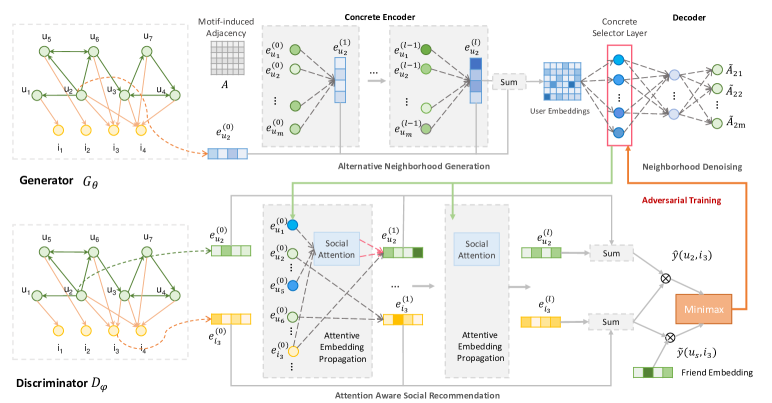
- 使用基于GCN的自编码器学习高阶连接模式,并生成隐式社交邻居,通过重建用户社交资料来约束,确保其有效性。
- 引入具有可学习注意力机制的图卷积网络,以建模社交关系的异构强度,根据相关性为邻居分配不同权重。
- 在生成器(关系增强GCN)与判别器(推荐导向GCN)之间实施对抗训练,通过极小化极大博弈统一并优化两个组件。
- 优化自编码器以重建用户社交资料,确保增强关系具有意义而非随机生成。
- 采用两阶段训练流程:首先预训练自编码器和注意力模块,然后通过对抗损失联合微调所有组件。
- 引入超参数β以控制对抗训练的幅度,平衡关系增强与推荐准确率。
实验结果
研究问题
- RQ1如何在不引入噪声的前提下,有效增强低数据场景下的稀疏社交关系?
- RQ2通过高阶连接模式发现的隐式社交邻居,在多大程度上能提升推荐性能?
- RQ3如何在不同推荐情境下建模社交关系的异构影响?
- RQ4关系增强与推荐模块之间的对抗训练是否优于独立优化?
- RQ5该框架对超参数(如替代邻居数量k、对抗幅度β和GCN深度)的敏感性如何?
主要发现
- ESRF在Last.fm、Douban和Gowalla数据集上显著优于最先进社交推荐模型,RMSE和MAE均取得提升。
- 当k=40、30和50时,ESRF在Last.fm、Douban和Gowalla上的性能达到峰值,表明在噪声主导前存在最优增强水平。
- 对抗训练可提升性能,但过大的幅度(高β)会降低结果,表明关系质量与推荐准确率之间存在权衡。
- 在Last.fm、Douban和Gowalla上,分别使用4、3和4层GCN时模型表现最佳,超过该深度后收益递减。
- 32.44%的识别替代邻居与显式社交关系重叠,表明增强邻居具有实际社交联系的相关性。
- 模型中的注意力权重在不同用户邻居间呈现明显差异,证实框架成功学习到异构社交影响力强度。
更好的研究,从现在开始
从阅读论文到最终审阅,大幅缩短您的研究时间。
无需绑定信用卡
本解读由 AI 生成,并经人工编辑审核。