
[论文解读] Entanglement-magic separation in hybrid quantum circuits
本文展示了在具有可控T门注入和投影测量的混合量子线路中,魔性(magic)——以稳定子熵为度量——存在一种由测量引发的相变。与在不同测量速率下发生体积律到面积律转变的纠缠不同,魔性表现出一种独立的相变,揭示了非 Clifford 资源可免受测量诱导抑制的影响,凸显了在纠缠之外的量子优势资源理论的新层面。
Magic describes the distance of a quantum state to its closest stabilizer state. It is -- like entanglement -- a necessary resource for a potential quantum advantage over classical computing. We study magic, quantified by stabilizer entropy, in a hybrid quantum circuit with projective measurements and a controlled injection of non-Clifford resources. We discover a phase transition between a (sub)-extensive and area law scaling of magic controlled by the rate of measurements. The same circuit also exhibits a phase transition in entanglement that appears, however, at a different critical measurement rate. This mechanism shows how, from the viewpoint of a potential quantum advantage, hybrid circuits can host multiple distinct transitions where not only entanglement, but also other non-linear properties of the density matrix come into play.
研究动机与目标
- 研究魔性是否如同纠缠,在混合量子线路中经历由测量引发的相变。
- 确定魔性相变的临界测量速率是否与纠缠相变的临界速率不同。
- 探讨非 Clifford 资源(通过 T 门实现)在稳定魔性以抵抗测量诱导抑制中的作用。
- 建立魔性标度与测量速率和 T 门密度关系的相图。
- 阐明魔性和纠缠相变独立存在对量子优势和量子误差纠正的含义。
提出的方法
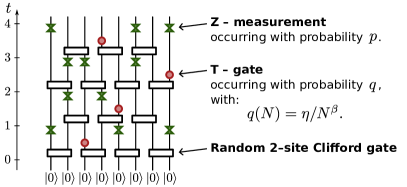
- 本研究采用一维混合量子线路,包含随机 Clifford 门、投影测量以及可调密度的 T 门控制注入。
- 通过稳定子熵来量化魔性,即非稳定子资源含量的度量。
- 通过大量随机轨迹的蒙特卡洛采样模拟系统,以计算稳态下的魔性和纠缠熵。
- 将 T 门密度缩放为 $ \eta/N^\beta $,从而分析不同 $ \beta $ 下的热力学极限,包括 $ \beta = 1 $ 和 $ \beta < 1 $。
- 为提升分析可解性,引入一个单体位点 Clifford 门的可分模型,实现魔性标度的精确推导:$ \bar{\mathcal{M}}_{\mathrm{ss}} \propto N^{1-\beta} $。
- 通过分析标度行为(亚广延与面积律)识别相变:临界速率通过数值与解析方法确定。
实验结果
研究问题
- RQ1在混合量子线路中,魔性是否表现出与纠缠相变不同的测量诱导相变?
- RQ2魔性从(亚)广延标度过渡到面积律标度的测量速率是多少?该速率与纠缠相变速率相比如何?
- RQ3以 $ \eta/N^\beta $ 缩放的 T 门密度如何影响热力学极限下魔性的标度行为?
- RQ4稳定子形式或张量网络方法能否模拟出在高测量速率下魔性仍保持(亚)广延标度的线路?
- RQ5两比特 Clifford 门在保护魔性免受测量诱导退化中起到何种作用?
主要发现
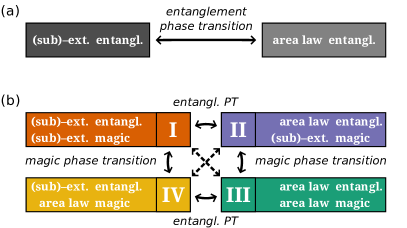
- 本文识别出魔性中存在一种独特的测量诱导相变,其临界测量速率 $ p_c^{\text{magic}} $ 与纠缠相变的临界速率 $ p_c^{\text{ent}} $ 不同,证明魔性和纠缠由不同机制支配。
- 在低测量速率区域,纠缠和魔性均呈(亚)广延标度,表明该相中两类资源均具有鲁棒性。
- 在中等测量速率下,纠缠过渡到面积律,而魔性仍保持(亚)广延标度,定义了一个尽管纠缠减少但量子优势仍可能实现的相。
- 在高测量速率下,纠缠和魔性均过渡到面积律标度,系统进入经典可模拟的范畴。
- 可分模型的解析结果确认,当 $ \beta < 1 $ 时,魔性标度为 $ \bar{\mathcal{M}}_{\mathrm{ss}} \propto N^{1-\beta} $,当 $ \beta = 1 $ 时保持恒定,当 $ \beta > 1 $ 时消失,表明魔性对 T 门密度缩放具有临界依赖性。
- 完整线路中两比特 Clifford 门的存在增强了对魔性的保护,表明纠缠可作为屏障,防止非 Clifford 资源受测量诱导退化。
更好的研究,从现在开始
从阅读论文到最终审阅,大幅缩短您的研究时间。
无需绑定信用卡
本解读由 AI 生成,并经人工编辑审核。