
[论文解读] Entanglement Routing over Networks with Time Multiplexed Repeaters
该论文提出了一种基于时间复用中继的本地多路径路由协议,用于提升量子网络中的纠缠分发速率。通过利用本地链路状态信息并优化时间复用块长度 $k$,该协议在吞吐量提升与存储退相干之间取得平衡,揭示出在现实退相干模型下能最大化速率的最优 $k_{\text{opt}}$。
Quantum networks will be able to service consumers with long-distance entanglement by use of quantum repeaters that generate Bell pairs (or links) with their neighbors, iid with probability $p$ and perform Bell State Measurements (BSMs) on the links that succeed iid with probability $q$. While global link state knowledge is required to maximize the rate of entanglement generation between any two consumers, it increases the protocol latency due to the classical communication requirements and requires long quantum memory coherence times. We propose two entanglement routing protocols that require only local link state knowledge to relax the quantum memory coherence time requirements and reduce the protocol latency. These protocols utilize multi-path routing protocol and time multiplexed repeaters. The time multiplexed repeaters first generate links for $k$-time steps before performing BSMs on any pairs of links. Our two protocols differ in the decision rule used for performing BSMs at the repeater: the first being a static path based routing protocol and second a dynamic distance based routing protocol. The performance of these protocols depends on the quantum network topology and the consumers' location. We observe that the average entanglement rate and the latency increase with the time multiplexing block length, $k$, irrespective of the protocol. When a step function memory decoherence model is introduced such that qubits are held in the quantum memory for an exponentially distributed time with mean $μ$, an optimal $k$ ($k_ ext{opt}$) value appears, such that for increasing $k$ beyond $k_{ m opt}$ hurts the entanglement rate. $k_{ m opt}$ decreases with $p$ and increases with $μ$. $k_{ m opt}$ appears due to the tradeoff between benefits from time multiplexing and the increased likelihood of previously established Bell pairs decohering due to finite memory coherence times.
研究动机与目标
- 解决在长距离量子网络中纠缠分发面临的高延迟与量子存储寿命有限的挑战。
- 减少对全局网络状态知识的依赖,这在大规模、动态的量子网络中不切实际。
- 开发一种可扩展的本地路由协议,利用时间复用中继提升纠缠生成速率。
- 分析在现实存储模型下,时间复用增益与退相干引起的链路损耗之间的权衡。
- 识别出在概率性链路生成与存储退相干条件下,能最大化纠缠速率的最优时间复用块长度 $k_{\text{opt}}$
提出的方法
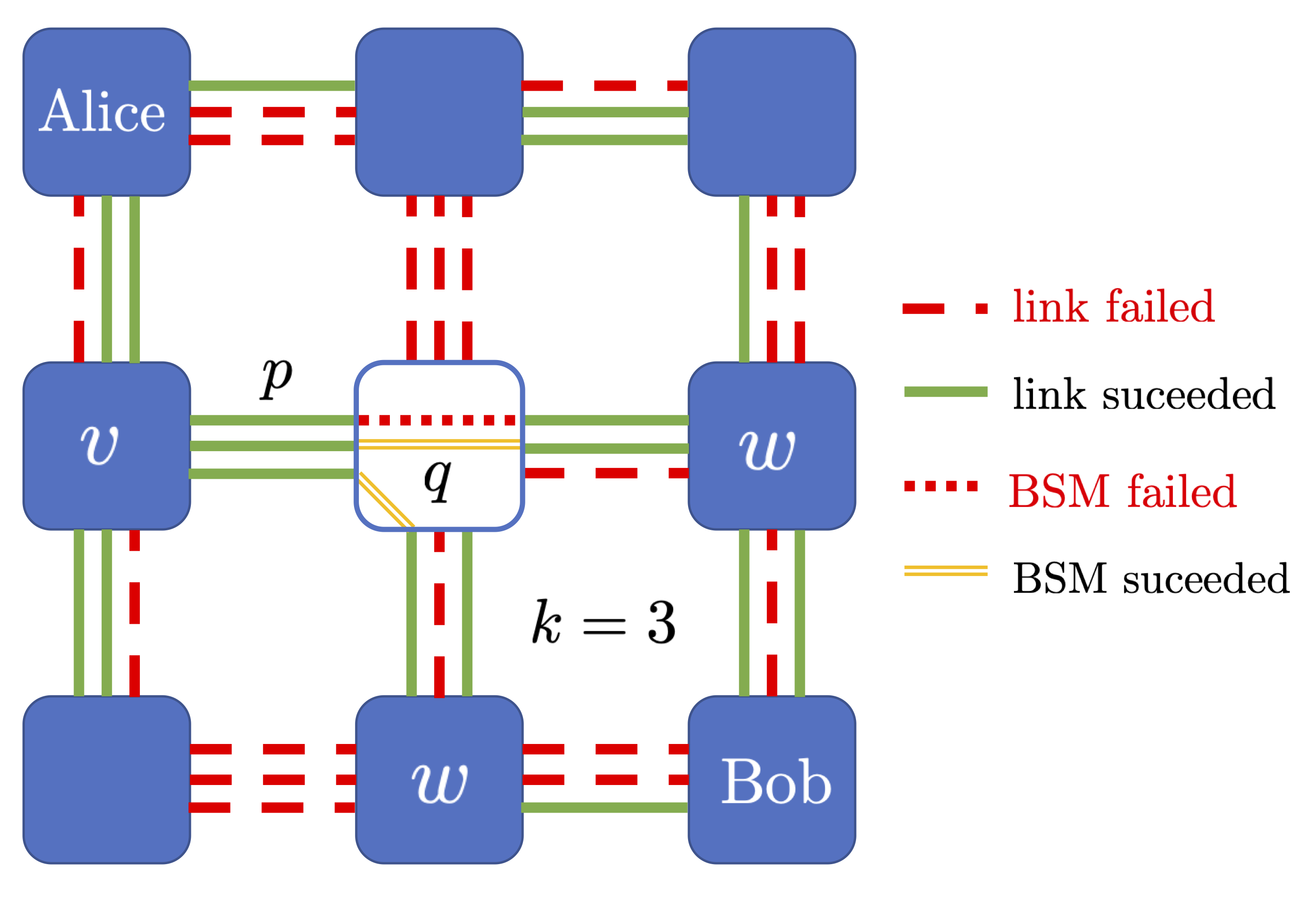
- 采用基于距离的多路径路由协议,仅依赖本地链路状态知识——每个中继根据自身的纠缠尝试和拓扑信息独立做出交换决策。
- 对时间复用中继进行建模,使其可在多个时隙内执行贝尔态测量(BSM),从而提高成功纠缠交换的概率。
- 引入阶跃函数形式的存储退相干模型,其中量子比特以平均值为 $\mu$ 的指数分布时间被存储,影响链路存活概率。
- 使用混合整数二次约束规划(MIQCP)计算网络快照中最大双路纠缠容量。
- 推导出在确定性链路生成($p=1$)情况下的解析速率方程,将链路存活概率建模为 $s(t) = e^{-t/\mu}$。
- 评估平均纠缠速率 $R_k(1,q,\mu)$ 作为 $k$、$q$ 和 $\mu$ 的函数,结合随时间产生多个可用链路的概率。
实验结果
研究问题
- RQ1在具有概率性链路生成的量子网络中,时间复用块长度 $k$ 如何影响平均纠缠分发速率?
- RQ2当存在存储退相干时,能最大化纠缠速率的最优 $k_{\text{opt}}$ 是什么?
- RQ3时间复用增益的提升与退相干损耗风险增加之间的权衡如何影响协议性能?
- RQ4仅依赖最少全局状态知识的本地路由协议能否实现与全局优化方法相当的速率?
- RQ5存储退相干($\mu$)的存在如何影响时间复用中继网络的可扩展性与性能?
主要发现
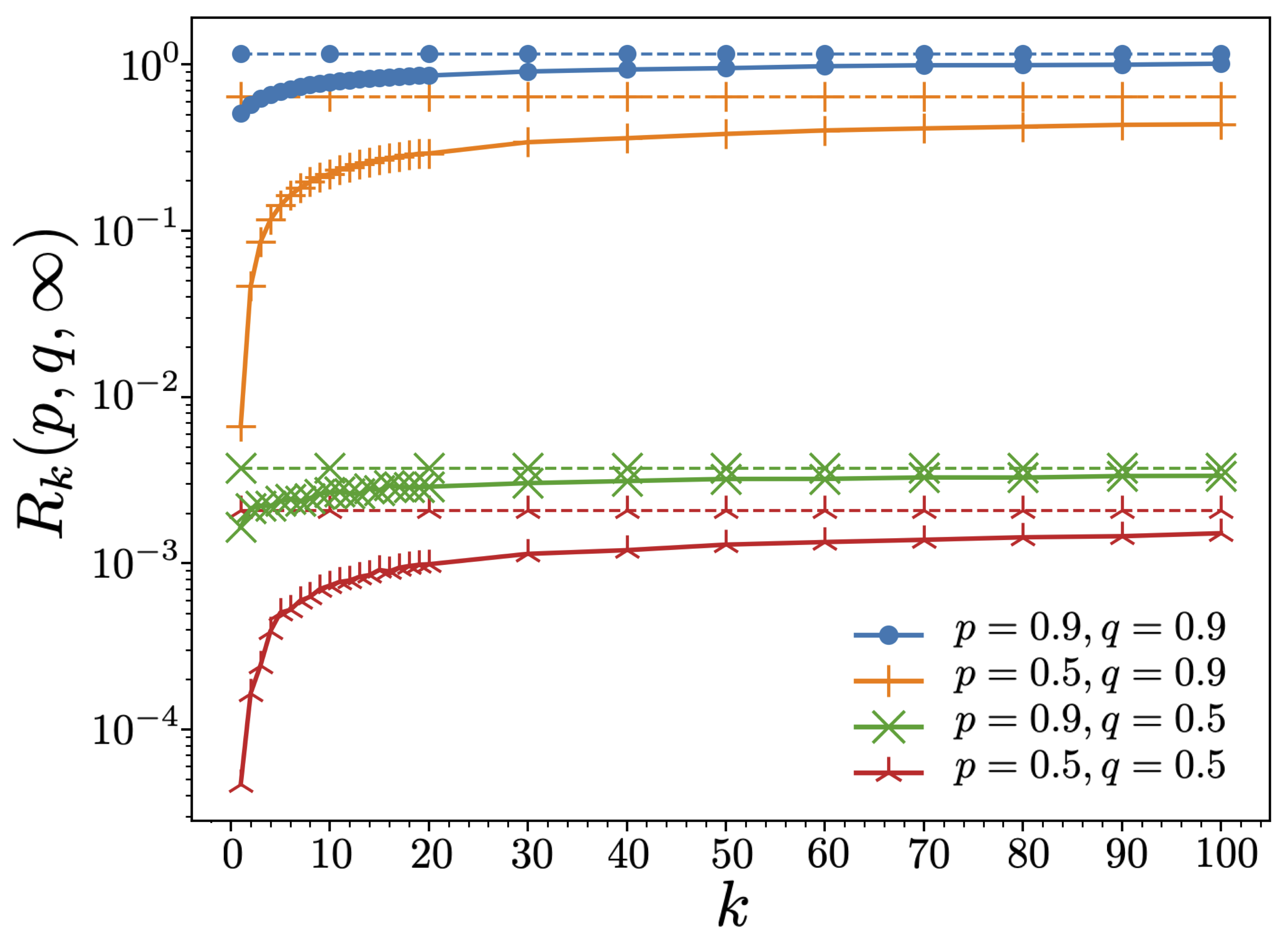
- 平均纠缠分发速率随时间复用块长度 $k$ 增加而提升,但初始延迟也随之增加。
- 当以指数分布平均寿命 $\mu$ 建模存储退相干时,会涌现出一个最优 $k_{\text{opt}}$,在复用增益与退相干损耗之间实现平衡。
- 当链路生成概率 $p$ 降低或存储退相干时间 $\mu$ 增加时,$k_{\text{opt}}$ 也随之增大,以维持最优性能。
- 对于 $p=1$ 的情况,推导出解析速率 $R_k(1,q,\mu)$ 并通过仿真验证,显示基线项 $q^{d-1}/k$ 与 $k$ 呈反比关系。
- 该协议的速率高于单路径路由,并且仅使用本地知识即可接近全局优化方法的性能。
- 基于 MIQCP 的容量计算方法能够准确估计网络快照中最大纠缠流,充分考虑了链路可用性的概率性与 BSM 成功率。
更好的研究,从现在开始
从阅读论文到最终审阅,大幅缩短您的研究时间。
无需绑定信用卡
本解读由 AI 生成,并经人工编辑审核。