
[论文解读] Entanglement Transition due to particle losses in a monitored fermionic chain
本论文通过非厄米有效哈密顿量和高斯态动力学,研究了具有局域粒子损失的监测费米子链中的测量诱导纠缠相变。通过调节配对和损失速率,揭示了从对数律到面积律的纠缠标度转变,且在存在线性跃迁算符时,获得了等待时间分布和纠缠统计的精确结果。
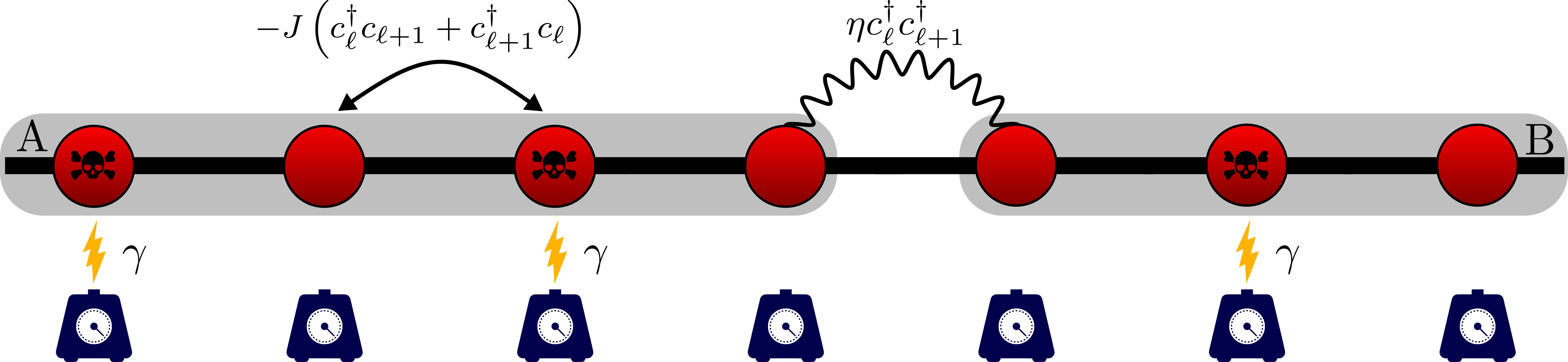
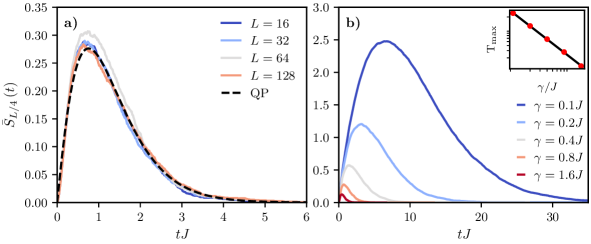
Recently, there has been interest in the dynamics of monitored quantum systems using linear jump operators related to the creation or annihilation of particles. Here, we study the dynamics of the entanglement entropy under quantum jumps that induce local particle losses in a model of free fermions with hopping and $\mathbb{Z}_2$ pairing. We solve the non-unitary dynamics using the recently developed Faber Polynomial method and explore the different steady-state entanglement regimes by tuning the pairing strength, thus interpolating between monitored free fermions coherently driven by a particle number conserving Hamiltonian to a parity conserving one. In the absence of pairing, all quantum trajectories approach the vacuum at long times, with the entanglement entropy showing non-monotonic behavior over time that we capture with a phenomenological quasiparticle \emph{ansatz}. In this regime, quantum jumps play a key role, and we highlight this by exactly computing their waiting-time distribution. On the other hand, the interplay between losses and pairing gives rise to quantum trajectories with entangled steady-states. We show that by tuning the system parameters, a measurement-induced entanglement transition occurs where the entanglement entropy scaling changes from logarithmic to area-law. We compare this transition with the one derived in the no-click limit and observe qualitative agreement in most of the phase diagram. Furthermore, the statistics of entanglement gain and loss are analyzed to better understand the impact of the linear jump operators.
研究动机与目标
- 理解通过局域量子跃迁导致的粒子损失如何影响具有U(1)和Z2对称性的费米子链中的纠缠动力学。
- 研究在具有线性跃迁算符的非相互作用费米子系统中,测量诱导纠缠相变(MIPT)的出现机制。
- 分析配对和损失速率在驱动对数律与面积律纠缠标度转变中的作用。
- 计算量子跃迁的精确等待时间分布,并表征纠缠增益与损失的统计特性。
提出的方法
- 使用Nambu基下的非厄米有效哈密顿量对系统建模,以描述具有粒子损失的相干演化。
- 通过Lindblad主方程的随机展开模拟量子跃迁动力学,跃迁对应于每个位点的局域粒子湮灭。
- 利用态的高斯性质,通过Faber多项式的递推关系高效演化关联矩阵(G和F)。
- 利用Wick定理和跃迁发生在位点ℓ后的G和F的精确公式,计算跃迁后的关联函数更新。
- 通过关联矩阵得到约化密度矩阵,并利用高斯态的标准公式计算纠缠熵。
- 利用存活概率和非厄米演化,精确计算量子跃迁的等待时间分布。
实验结果
研究问题
- RQ1在费米子链中,粒子损失与配对的相互作用如何影响稳态纠缠结构?
- RQ2在监测费米子系统中,调节配对强度和损失速率时,纠缠相变的本质是什么?
- RQ3在具有线性跃迁算符的非相互作用费米子链中,是否可观测到纠缠熵标度从对数律到面积律的转变?
- RQ4在量子轨迹中,纠缠增益与损失的统计特性如何演化,其与跃迁过程有何关联?
- RQ5在此监测费米子链中,量子跃迁的精确等待时间分布是什么,其如何反映粒子损失的动力学?
主要发现
- 在无配对的U(1)对称情况下,系统演化至真空,纠缠熵表现出非单调的时间演化,由一种现象学准粒子近似所捕捉。
- 精确计算了量子跃迁的等待时间分布,揭示了非幺正动力学在塑造纠缠演化中的作用。
- 在Z2配对情况下,发生测量诱导的纠缠相变,随着系统参数的调节,纠缠熵标度从对数律转变为面积律。
- 该相变与无探测极限定性一致,表明临界行为在不同测量协议下具有鲁棒性。
- 分析了纠缠增益与损失的统计特性,表明跃迁诱导的关联变化驱动了纠缠相之间的转变。
- 利用Wick定理精确推导了关联函数的跃迁后更新规则,实现了完整量子轨迹的高效模拟。
更好的研究,从现在开始
从阅读论文到最终审阅,大幅缩短您的研究时间。
无需绑定信用卡
本解读由 AI 生成,并经人工编辑审核。