
[论文解读] Enumeration of spin-space groups: Towards a complete description of symmetries of magnetic orders
本文通过从空间群的不变量子群以及商群的三维实表示出发,系统枚举自旋-空间群(SSGs),形成一个全面的在线数据库并提供在磁性材料中识别SSG的算法。
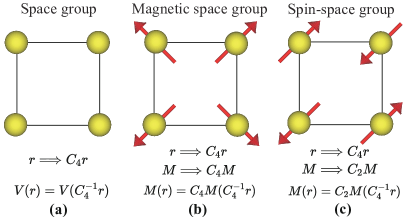
Symmetries of three-dimensional periodic scalar fields are described by 230 space groups (SGs). Symmetries of three-dimensional periodic (pseudo-) vector fields, however, are described by the spin-space groups (SSGs), which were initially used to describe the symmetries of magnetic orders. In SSGs, the real-space and spin degrees of freedom are unlocked in the sense that an operation could have different spacial and spin rotations. SSGs gives a complete symmetry description of magnetic structures, and have natural applications in the band theory of itinerary electrons in magnetically ordered systems with weak spin-orbit coupling. Altermagnetism, a concept raised recently that belongs to the symmetry-compensated collinear magnetic orders but has non-relativistic spin splitting, is well described by SSGs. Due to the vast number and complicated group structures, SSGs have not yet been systematically enumerated. In this work, we exhaust SSGs based on the invariant subgroups of SGs, with spin operations constructed from three-dimensional (3D) real representations of the quotient groups for the invariant subgroups. For collinear and coplanar magnetic orders, the spin operations can be reduced into lower dimensional real representations. As the number of SSGs is infinite, we only consider SSGs that describe magnetic unit cells up to 12 times crystal unit cells. We obtain 157,289 non-coplanar, 24,788 coplanar-non-collinear, and 1,421 collinear SSGs. The enumerated SSGs are stored in an online database at \url{https://cmpdc.iphy.ac.cn/ssg} with a user-friendly interface. We also develop an algorithm to identify SSG for realistic materials and find SSGs for 1,626 magnetic materials. Our results serve as a solid starting point for further studies of symmetry and topology in magnetically ordered materials.
研究动机与目标
- 通过自旋-空间群(SSGs)提供磁序的完整对称描述。
- 通过利用230个空间群的不变量子群和商群表示来枚举SSGs。
- 提供公开数据库和将SSG分配给真实磁性材料的实用算法。
提出的方法
- 将自旋-空间群定义为将晶格操作与自旋旋转的三维实表示结合的扩张。
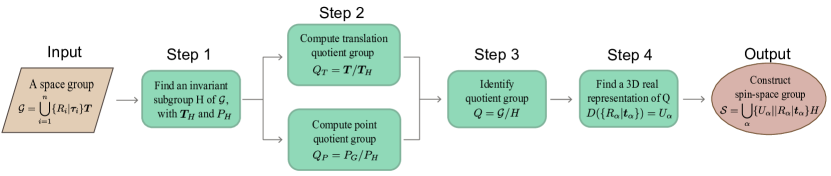
- 枚举每个空间群G的不变量子群H,并计算商群Q=G/H,同构于点群。
- 将Q的三维实表示分配给生成SSGs的G(S)=⊔α{Uα||Rα|tα}H,其中自旋部分Uα属于O(3)。
- 分别使用Q的1D或2D实表示以处理共线和共面-非共线序。
- 将磁晶胞限制为最多为晶胞的12倍,以获得有限目录。
- 提供SSG的在线数据库并开发用于在材料数据库中识别SSG的算法。
实验结果
研究问题
- RQ1如何从230个空间群穷尽性地枚举SSG?
- RQ2对于不同磁序类型(非共面、共面-非共线、共线),SSG的结构是什么?
- RQ3通过将磁晶胞限制在可计算范围(≤12×晶胞)是否能产生一个实用的有限SSG目录?
- RQ4如何使用确定性算法在真实磁性材料中识别SSG?
主要发现
- 确定了157,289个非共平面SSG。
- 确定了24,788个共平面-非共线SSG。
- 确定了1,421个共线SSG。
- 当商群为晶体点群时,在12×限制内得到68,922个非共平面SSG的特例。
- 在ssg(及参考站点)建立了在线数据库以供枚举的SSG使用。
- 应用算法在Bilbao晶体学 Server等数据集中从1,626个可相位比磁性材料中找到SSG。
更好的研究,从现在开始
从论文设计到论文写作,大幅缩短您的研究时间。
无需绑定信用卡
本解读由 AI 生成,并经人工编辑审核。