
[论文解读] EPOCHS VIII. An Insight into MIRI-selected Galaxies in SMACS-0723 and the Benefits of Deep MIRI Photometry in Revealing AGN and the Dusty Universe
本研究利用詹姆斯·韦伯太空望远镜(JWST)MIRI 在 SMACS-0723 区域的深度测光数据,提升了 181 个红移 z = 0–3.5 的星系的光度红移、星族合成建模及活动星系核(AGN)探测的精度。MIRI 数据使光度红移误差降低 20%,将星形成率(SFR)估计值降低 0.1 dex,并通过捕捉多环芳烃(PAH)特征和尘埃发射,显著改善了 AGN 分数的约束。
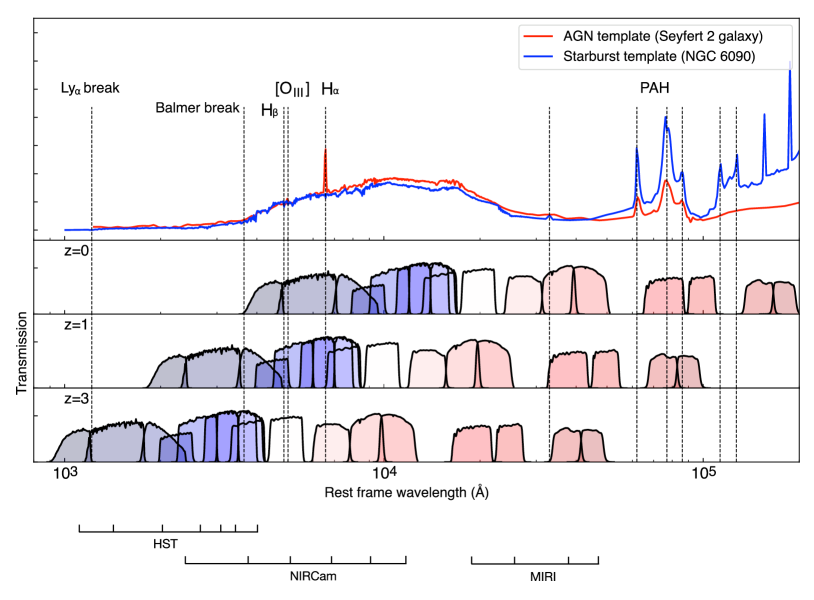
We present the analysis of the stellar population and star formation history of 181 MIRI selected galaxies at redshift 0-3.5 in the massive galaxy cluster field SMACS J0723.3-7327, commonly referred to as SMACS0723, using the James Webb Space Telescope (JWST) Mid-Infrared Instrument (MIRI). We combine the data with the JWST Near Infrared Camera (NIRCam) catalogue, in conjunction with the Hubble Space Telescope (HST) WFC3/IR and ACS imaging. We find that the MIRI bands capture PAH features and dust emission, significantly enhancing the accuracy of photometric redshift and measurements of the physical properties of these galaxies. The median photo-z's of galaxies with MIRI data are found to have a small 0.1% difference from spectroscopic redshifts and reducing the error by 20 percent. With MIRI data included in SED fits, we find that the measured stellar masses are unchanged, while the star formation rate is systematically lower by 0.1 dex. We also fit the median SED of active galactic nuclei (AGN) and star forming galaxies (SFG) separately. MIRI data provides tighter constraints on the AGN contribution, reducing the typical AGN contributions by ~14 percent. In addition, we also compare the median SED obtained with and without MIRI, and we find that including MIRI data yields steeper optical and UV slopes, indicating bluer colours, lower dust attenuation, and younger stellar populations. In the future, MIRI/MRS will enhance our understanding by providing more detailed spectral information and allowing for the study of specific emission features and diagnostics associated with AGN.
研究动机与目标
- 利用 SMACS-0723 区域的深度 MIRI 测光数据,提高星系光度红移的准确性。
- 评估 MIRI 数据对星族合成与星形成率(SFR)测量的影响。
- 评估 MIRI 在约束活动星系核(AGN)贡献与尘埃特性方面的作用。
- 对比包含与不包含 MIRI 数据的 SED,量化 UV/光学斜率、尘埃消光与星族年龄的改进。
- 展示深度 MIRI 观测在揭示此前光学数据中被遮蔽的尘埃主导与 AGN 主导星系方面的优势。
提出的方法
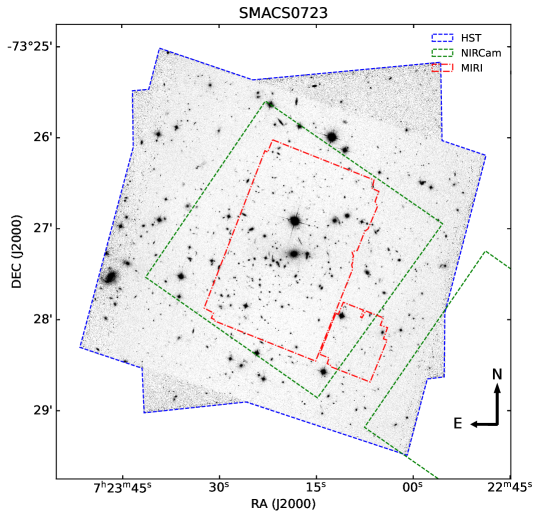
- 结合 MIRI、NIRCam 和 HST WFC3/IR/ACS 成像,在 SMACS-0723 区域的 2.3 平方角分内创建多波段测光星表。
- 使用完整测光数据(HST、NIRCam、MIRI)进行 SED 拟合,以推导光度红移、星族质量、SFR 和 AGN 分数。
- 利用光谱红移对光度红移进行校准,以验证准确性并量化系统性偏移。
- 通过 MIRI 波段中 8–15 μm(本征系)的 PAH 特征检测,识别尘埃发射并约束尘埃消光。
- 对比包含与不包含 MIRI 数据的中值 SED,评估 UV/光学斜率、尘埃含量与星族年龄的变化。
- 应用 χ² 最小化方法识别最佳拟合 SED,并将 AGN 分数 > 0.1 的星系分类为 AGN 主导。
实验结果
研究问题
- RQ1与仅使用 HST 和 NIRCam 相比,MIRI 测光的引入在多大程度上提升了光度红移的准确性?
- RQ2MIRI 数据在多大程度上改进了高红移星系中星族质量与星形成率(SFR)的估计?
- RQ3MIRI 数据如何改善复合 SED 中 AGN 贡献的约束?
- RQ4MIRI 数据对推断的 UV 与光学斜率有何影响,这又对尘埃消光与星族年龄意味着什么?
- RQ5MIRI 波段中的 PAH 特征与尘埃发射如何增强对遮蔽星系与 AGN 的探测与表征?
主要发现
- 引入 MIRI 数据后,中值光度红移误差降低了 20%,且光度红移与光谱红移之间的平均差异减少了 0.1%。
- 包含 MIRI 数据的星系,其光度红移与光谱红移的中值差异仅为 0.1%,而未使用 MIRI 的星系则高出 3%。
- 星族质量在引入 MIRI 后保持不变,但 SFR 估计值系统性降低 0.1 dex。
- 引入 MIRI 后,AGN 分数(frac AGN)的均值降至 0.11 ± 0.15,其不确定性降低 Δμ_err = 0.17,表明约束更加紧密。
- 包含 MIRI 数据后,UV 与光学斜率变得更陡,表明颜色更蓝、尘埃消光更低,且星族年龄更年轻。
- MIRI 捕捉到本征系 8–15 μm 处强烈的 PAH 特征,这对识别尘埃发射与 AGN 活动至关重要,尤其在高红移星系中。
更好的研究,从现在开始
从阅读论文到最终审阅,大幅缩短您的研究时间。
无需绑定信用卡
本解读由 AI 生成,并经人工编辑审核。