
[论文解读] EquiPocket: an E(3)-Equivariant Geometric Graph Neural Network for Ligand Binding Site Prediction
EquiPocket 提出了一种 E(3)-等变的几何图神经网络,用于配体结合位点预测,通过利用表面原子几何结构和等变消息传递,克服了体素化 3D CNN 的局限性。该方法在多个基准测试中实现了最先进性能,尤其在大型和不规则蛋白质上表现优异,通过保持旋转不变性,并以更高的效率和对数据分布偏移更强的鲁棒性,建模多尺度的结构与化学特征。
Predicting the binding sites of target proteins plays a fundamental role in drug discovery. Most existing deep-learning methods consider a protein as a 3D image by spatially clustering its atoms into voxels and then feed the voxelized protein into a 3D CNN for prediction. However, the CNN-based methods encounter several critical issues: 1) defective in representing irregular protein structures; 2) sensitive to rotations; 3) insufficient to characterize the protein surface; 4) unaware of protein size shift. To address the above issues, this work proposes EquiPocket, an E(3)-equivariant Graph Neural Network (GNN) for binding site prediction, which comprises three modules: the first one to extract local geometric information for each surface atom, the second one to model both the chemical and spatial structure of protein and the last one to capture the geometry of the surface via equivariant message passing over the surface atoms. We further propose a dense attention output layer to alleviate the effect incurred by variable protein size. Extensive experiments on several representative benchmarks demonstrate the superiority of our framework to the state-of-the-art methods.
研究动机与目标
- 为解决基于 CNN 的方法在建模不规则蛋白结构时的局限性,特别是由体素化引起的限制。
- 通过在模型架构中强制实施 E(3)-等变性,克服现有 3D CNN 方法对旋转的敏感性。
- 改进对蛋白表面几何结构的表征,这对准确检测结合位点至关重要。
- 通过引入密集注意力输出层,减轻因蛋白尺寸变化引起的数据分布偏移的影响。
- 开发一种更具泛化能力且高效的深度学习框架,用于结合位点预测,超越现有最先进方法。
提出的方法
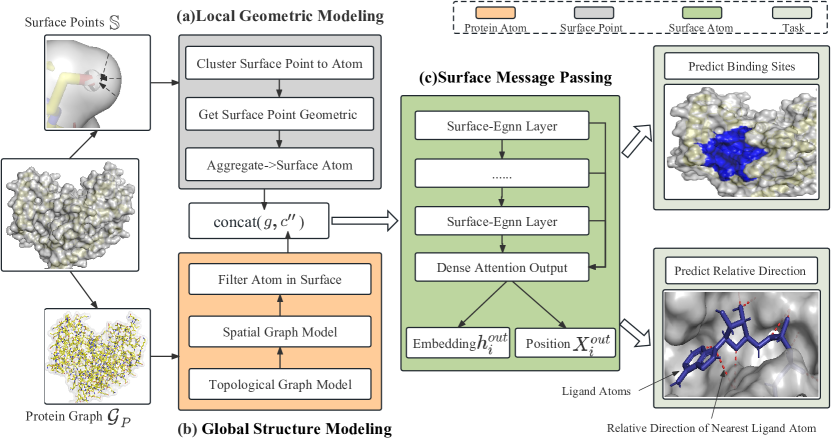
- EquiPocket 采用三模块架构:局部几何特征提取、通过 GAT 和 EGNN 进行全局蛋白结构建模,以及在表面原子上进行的表面特异性等变消息传递。
- 使用 E(3)-等变层,确保预测结果对三维旋转保持不变,从而在变换下保持几何一致性。
- 表面-EGNN 模块通过在表面原子图上的等变消息传递,捕捉蛋白表面上的局部和长程几何关系。
- 在输出层引入密集注意力机制,动态加权特征,减轻因蛋白尺寸变化和分布偏移导致的性能下降。
- 表面原子通过 MSMS 识别,模型将蛋白处理为包含 3D 坐标、原子特征和编码空间与化学关系的边特征的几何图。
- 框架通过二元分类的交叉熵损失进行端到端训练,以分割结合位点残基。
实验结果
研究问题
- RQ1E(3)-等变的几何图网络是否能在结合位点预测中超越体素化 3D CNN,尤其是在形状不规则的蛋白质上?
- RQ2与标准 CNN 相比,E(3)-等变性在多大程度上提升了模型对旋转扰动的鲁棒性?
- RQ3通过等变消息传递对表面几何结构进行建模,在多大程度上提升了预测准确性?
- RQ4密集注意力机制是否能有效减轻因蛋白尺寸变化引起的数据分布偏移的影响?
- RQ5与现有最先进方法相比,该框架在多样化的蛋白尺寸和结构复杂度下是否具有更好的泛化能力?
主要发现
- EquiPocket 在多个基准测试中达到最先进性能,包括 PDBbind 和 CASF-2016,在 PDBbind 上的平均 DCC 达到 0.787,显著优于先前方法。
- 该模型在大型蛋白(如 1f8e,含 12,268 个原子)上仍保持高性能,而基于 CNN 的方法(如 Kalasanty)因固定尺寸的体素化而完全失效。
- 消融实验表明,EquiPocket 对旋转和数据分布偏移具有更强的鲁棒性,表现为在不同蛋白尺寸和测试集上性能一致。
- 消融研究证实,表面-EGNN 模块和密集注意力层对性能至关重要,后者显著减轻了分布偏移的影响。
- 最优超参数为表面-EGNN 的截断半径 6 Å 和深度 4,兼顾性能与 GPU 显存使用(峰值 62GB)。
- 案例研究显示,EquiPocket 即使在复杂或大型蛋白中也能准确预测结合位点,而 Fpocket、Kalasanty 和 DeepSurf 则失败或产生不准确结果。
更好的研究,从现在开始
从阅读论文到最终审阅,大幅缩短您的研究时间。
无需绑定信用卡
本解读由 AI 生成,并经人工编辑审核。