
[论文解读] Ewald-based Long-Range Message Passing for Molecular Graphs
本文提出Ewald消息传递,一种在傅里叶空间进行的消息传递方案,通过频率域滤波替代基于距离的消息传递,以捕捉分子图中的长程相互作用(如静电作用和范德华力)。该方法在不改变网络架构的前提下,使OC20和OE62数据集上的能量预测精度提升10–16%,优于基线模型,有效学习了标准MPNN常忽略的长程物理特性。
Neural architectures that learn potential energy surfaces from molecular data have undergone fast improvement in recent years. A key driver of this success is the Message Passing Neural Network (MPNN) paradigm. Its favorable scaling with system size partly relies upon a spatial distance limit on messages. While this focus on locality is a useful inductive bias, it also impedes the learning of long-range interactions such as electrostatics and van der Waals forces. To address this drawback, we propose Ewald message passing: a nonlocal Fourier space scheme which limits interactions via a cutoff on frequency instead of distance, and is theoretically well-founded in the Ewald summation method. It can serve as an augmentation on top of existing MPNN architectures as it is computationally inexpensive and agnostic to architectural details. We test the approach with four baseline models and two datasets containing diverse periodic (OC20) and aperiodic structures (OE62). We observe robust improvements in energy mean absolute errors across all models and datasets, averaging 10% on OC20 and 16% on OE62. Our analysis shows an outsize impact of these improvements on structures with high long-range contributions to the ground truth energy.
研究动机与目标
- 解决消息传递神经网络(MPNN)因基于距离的消息传递机制,难以捕捉长程物理相互作用(如静电作用和范德华力)的局限性。
- 开发一种计算高效、与架构无关的方法,可无缝集成至现有MPNN中,以改善长程相互作用的学习。
- 证明通过Ewald求和实现的频域消息传递,是基于距离截断的消息传递的理论合理且有效的替代方案。
- 验证该方法在多种分子结构(包括周期性OC20和非周期性OE62系统)中的鲁棒性。
- 证明性能提升源于对长程贡献(如静电作用和色散力)的更好建模,而非泛化偏置或架构改进。
提出的方法
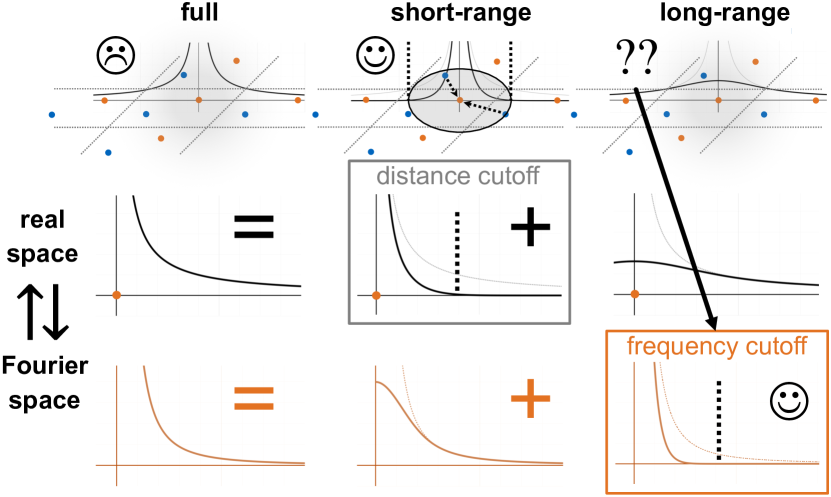
- Ewald消息传递用傅里叶空间方案替代基于距离的消息传递,通过频率截断限制相互作用,而非依赖空间距离。
- 利用Ewald求和方法将长程相互作用分解为短程(实空间)和长程(傅里叶空间)两部分,后者通过截断频率求和计算。
- 该方法以插件模块形式实现,可无缝集成至任意现有MPNN架构中,无需修改其核心设计。
- 消息在傅里叶空间中通过学习的频率分量基底计算,实现对缓慢衰减相互作用(如库仑力)的高效计算。
- 通过使用固定数量的频率分量,保持计算效率,且与系统规模无关。
- 该方法兼容周期性和非周期性分子图,并可与现有GNN消息传递层无缝集成。
实验结果
研究问题
- RQ1基于频率域的消息传递方案是否能有效捕捉在基于距离的MPNN失效的分子图中的长程物理相互作用?
- RQ2Ewald消息传递是否在包括周期性和非周期性结构在内的多样化分子数据集上提升能量预测精度?
- RQ3与基线模型的架构修改或超参数调优相比,Ewald消息传递的性能提升如何?
- RQ4性能提升在多大程度上源于对长程贡献(如静电作用和色散力)的更好建模?
- RQ5该方法是否计算高效且可扩展,具有极低的运行时间和参数开销?
主要发现
- 在OC20数据集上,Ewald消息传递使能量平均绝对误差(MAE)降低10%,在OE62数据集上降低16%,且在所有测试基线模型中均取得一致改进。
- 在四个基线模型(SchNet、PaiNN、DimeNet++、GemNet-dT)中均实现稳定提升,表明其广泛适用性和鲁棒性。
- 在OE62数据集中,Ewald消息传递成功恢复了DFT-D3色散校正的效果,证实其能有效建模范德华力等长程相互作用。
- 在长程能量贡献较高的结构中,性能提升最为显著,表明其精准学习了非局部物理特性。
- 运行时间仅增加约270%(OE62数据集),但该性能增益无法通过任何测试的基线配置(包括更大模型或更长截断距离)复现。
- 成本-性能权衡有利于Ewald消息传递,因其以极小的架构或计算开销实现了显著的精度提升。
更好的研究,从现在开始
从阅读论文到最终审阅,大幅缩短您的研究时间。
无需绑定信用卡
本解读由 AI 生成,并经人工编辑审核。