
[论文解读] Exact power spectrum in a minimal hybrid model of stochastic gene expression oscillations
本文针对一种结合离散基因开关与连续蛋白动力学的最小化混合模型中的随机基因表达振荡,提出了功率谱的精确解析解。通过求解蛋白浓度的福克-普朗克方程,作者推导出自相关函数和功率谱的精确表达式,揭示了在负反馈回路中存在三相随机分岔,解释了持续噪声诱导振荡的产生机制。
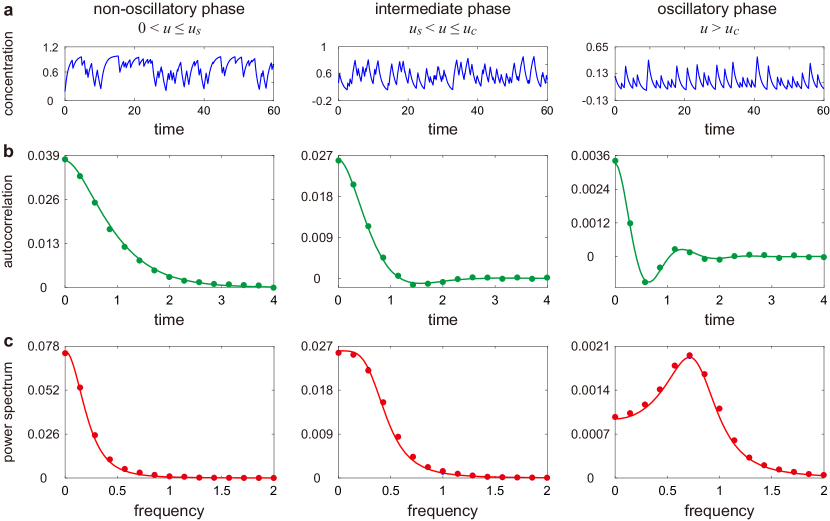
Stochastic oscillations in individual cells are usually characterized by a non-monotonic power spectrum with an oscillatory autocorrelation function. Here we develop an analytical approach of stochastic oscillations in a minimal hybrid model of stochastic gene expression including promoter state switching, protein synthesis and degradation, as well as a genetic feedback loop. The oscillations observed in our model are noise-induced since the deterministic theory predicts stable fixed points. The autocorrelated function, power spectrum, and steady-state distribution of protein concentration fluctuations are computed in closed form without making any approximations. Using the exactly solvable model, we illustrate sustained oscillations as a circular motion along a stochastic hysteresis loop induced by gene state switching. A triphasic stochastic bifurcation upon the increasing strength of negative feedback is observed, which reveals how stochastic bursts evolve into stochastic oscillations. In our model, oscillations tend to occur when the protein is relatively stable and when gene switching is relatively slow. Translational bursting is found to enhance the robustness and broaden the region of stochastic oscillations. These results provide deeper insights into R. Thomas' two conjectures for single-cell gene expression kinetics.
研究动机与目标
- 开发用于基因表达中随机振荡的精确解析框架,克服线性噪声近似等近似方法的局限性。
- 弥合单细胞随机振荡精确理论的长期空白,特别是在存在反馈回路的情况下。
- 利用最小化混合模型,为勒内·托马斯关于反馈与振荡的猜想提供机制性解释。
- 量化噪声如何通过基因状态切换驱动的随机滞后回路诱导持续振荡。
- 将分析扩展至包含翻译爆发,以捕捉基因表达中生物学上相关的特征。
提出的方法
- 构建一个混合随机模型,其中基因状态切换为离散事件,而蛋白浓度通过随机微分方程连续演化。
- 推导出蛋白浓度与基因状态联合概率密度的福克-普朗克方程,从而实现对矩的精确计算。
- 通过求解蛋白浓度一阶与二阶矩的线性常微分方程组,计算自相关函数与功率谱。
- 利用矩阵指数方法与特征值分解,推导出自相关函数的闭式表达式,表示为多个指数函数的和。
- 对自相关函数应用傅里叶变换,获得频率域中的精确解析功率谱。
- 通过在矩方程中引入爆发大小与频率的一般跳跃测度,将框架扩展至包含翻译爆发。

实验结果
研究问题
- RQ1能否为具有反馈的最小化混合模型中的随机基因表达振荡推导出精确的解析功率谱?
- RQ2在内在噪声存在的情况下,负反馈强度如何影响持续振荡的出现?
- RQ3基因状态切换在生成支持振荡的随机滞后回路中起什么作用?
- RQ4翻译爆发如何影响蛋白浓度涨落的自相关函数与功率谱?
- RQ5精确解能否解释托马斯关于反馈与振荡的两个猜想的机制基础?
主要发现
- 精确功率谱被表示为两个洛伦兹峰的和,分别对应于矩动力学矩阵的两个特征值,从而可精确表征振荡行为。
- 在无反馈或正反馈情况下,不会出现持续振荡,证实负反馈是噪声诱导振荡的必要条件。
- 对于负反馈,揭示了三相随机分岔:随着反馈强度增加,噪声首先被抑制,随后诱导振荡,最终被抑制,且在中等强度下功率谱出现峰值。
- 自相关函数在 t=0 处单调递减,表明短时间尺度上涨落呈反相关,这是振荡动力学的特征标志。
- 稳态蛋白浓度方差由一个包含反馈强度、降解率与爆发参数的闭式表达式给出,精确体现了系统规模与噪声强度的依赖关系。
- 引入翻译爆发后,通过在矩方程中引入爆发大小的二阶矩,导致功率谱发生改变,低频分量得到增强。
更好的研究,从现在开始
从阅读论文到最终审阅,大幅缩短您的研究时间。
无需绑定信用卡
本解读由 AI 生成,并经人工编辑审核。