
[论文解读] Expansion-Squeeze-Excitation Fusion Network for Elderly Activity Recognition
本文提出了一种扩展-挤压-激励融合网络(ESE-FN),通过学习模态和通道级注意力机制来融合RGB与骨骼特征,从而提升老年人活动识别性能。该方法在大规模ETRI-Activity3D数据集上实现了96.7%的最先进准确率,通过新颖的多模态损失函数和双注意力融合策略优于现有方法。
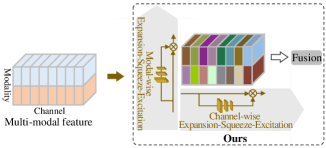
This work focuses on the task of elderly activity recognition, which is a challenging task due to the existence of individual actions and human-object interactions in elderly activities. Thus, we attempt to effectively aggregate the discriminative information of actions and interactions from both RGB videos and skeleton sequences by attentively fusing multi-modal features. Recently, some nonlinear multi-modal fusion approaches are proposed by utilizing nonlinear attention mechanism that is extended from Squeeze-and-Excitation Networks (SENet). Inspired by this, we propose a novel Expansion-Squeeze-Excitation Fusion Network (ESE-FN) to effectively address the problem of elderly activity recognition, which learns modal and channel-wise Expansion-Squeeze-Excitation (ESE) attentions for attentively fusing the multi-modal features in the modal and channel-wise ways. Furthermore, we design a new Multi-modal Loss (ML) to keep the consistency between the single-modal features and the fused multi-modal features by adding the penalty of difference between the minimum prediction losses on single modalities and the prediction loss on the fused modality. Finally, we conduct experiments on a largest-scale elderly activity dataset, i.e., ETRI-Activity3D (including 110,000+ videos, and 50+ categories), to demonstrate that the proposed ESE-FN achieves the best accuracy compared with the state-of-the-art methods. In addition, more extensive experimental results show that the proposed ESE-FN is also comparable to the other methods in terms of normal action recognition task.
研究动机与目标
- 为解决识别涉及人机交互和低幅运动的细微、相似老年人活动的挑战。
- 通过捕捉跨模态的判别性时空模式,提升RGB视频与骨骼序列之间的特征融合效果。
- 设计一种可学习的注意力机制,以建模模态间与通道间依赖关系,增强特征表示能力。
- 通过新颖的多模态损失函数,确保单模态与融合多模态预测之间的一致性。
- 通过在标准正常动作识别基准(NTU RGB+D)上评估性能,验证模型的泛化能力。
提出的方法
- 提出双注意力机制:模态级ESE注意力(M-ESEA),用于融合RGB与骨骼模态的特征。
- 引入通道级ESE注意力(C-ESEA),通过建模融合特征中的通道依赖关系,增强判别能力。
- 采用两阶段融合流程:首先通过M-Net实现模态级融合,再通过C-Net实现通道级融合。
- 设计多模态损失(ML),通过惩罚单模态预测损失最小值与融合模态预测损失之间的差异,以强制保持一致性。
- 使用双分支主干网络分别独立提取RGB与骨骼特征,再进行融合。
- 应用扩展与挤压操作,以建模局部与全局特征交互,扩展SENet家族的上采样与下采样行为。
实验结果
研究问题
- RQ1一种在模态与通道维度上同时运作的双注意力融合机制,能否提升老年人活动识别性能?
- RQ2所提出的多模态损失在保持单模态与融合预测一致性方面效果如何?
- RQ3ESE-FN是否能泛化到老年人特定活动之外的正常动作识别任务?
- RQ4与标准注意力机制相比,扩展与挤压操作在多大程度上增强了特征表示?
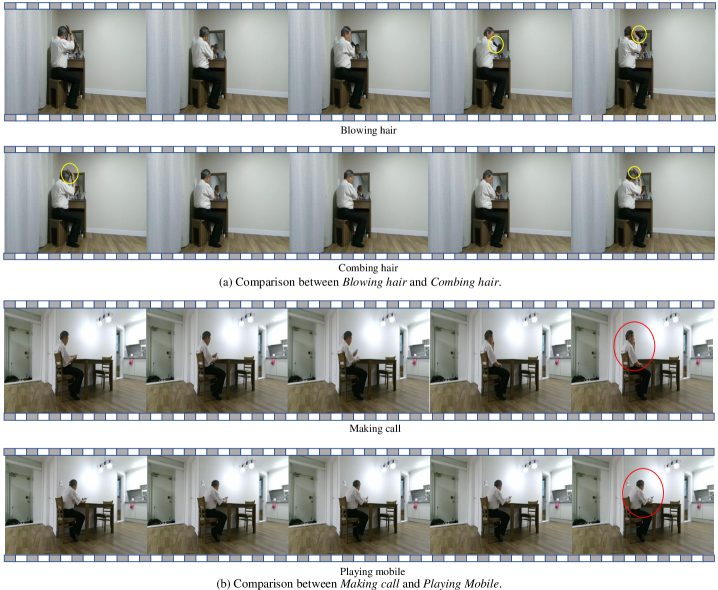
- RQ5该模型在高度具有挑战性、视觉上相似的老年人活动(如“吹头发”与“梳头”)上的表现如何?
主要发现
- ESE-FN在ETRI-Activity3D数据集上实现了96.7%的最先进准确率,优于现有方法。
- 在NTU RGB+D数据集上,分别在Cross-Subject与Cross-View协议下,较SOTA方法提升0.7%与0.2%。
- NTU RGB+D上的混淆矩阵显示优异的类别级识别性能,主对角线始终较浅,表明所有60个动作类别均具有高识别准确率。
- 消融实验证实,M-ESEA与C-ESEA组件均对性能提升有显著贡献,验证了双注意力融合的有效性。
- 所提出的多模态损失有效稳定了训练过程,并通过强制单模态与融合预测之间的一致性,提升了泛化能力。
- 模型在细粒度、相似的老年人活动(如“打电话”与“玩手机”)上表现出鲁棒性,其中仅手部动作或人机交互存在细微差异。
更好的研究,从现在开始
从阅读论文到最终审阅,大幅缩短您的研究时间。
无需绑定信用卡
本解读由 AI 生成,并经人工编辑审核。