
[论文解读] Explaining Tree Model Decisions in Natural Language for Network Intrusion Detection
本文提出大型语言模型决策树解释(LLM-DTE),一种利用大型语言模型(LLM)为基于决策树的网络入侵检测系统生成自然语言解释的方法,使非专家用户也能理解。在人类评估中,LLM-DTE 显著优于基于规则的解释,Quiz 成绩提高 39.5%,且在可读性、质量以及背景知识使用方面评分更优。
Network intrusion detection (NID) systems which leverage machine learning have been shown to have strong performance in practice when used to detect malicious network traffic. Decision trees in particular offer a strong balance between performance and simplicity, but require users of NID systems to have background knowledge in machine learning to interpret. In addition, they are unable to provide additional outside information as to why certain features may be important for classification. In this work, we explore the use of large language models (LLMs) to provide explanations and additional background knowledge for decision tree NID systems. Further, we introduce a new human evaluation framework for decision tree explanations, which leverages automatically generated quiz questions that measure human evaluators' understanding of decision tree inference. Finally, we show LLM generated decision tree explanations correlate highly with human ratings of readability, quality, and use of background knowledge while simultaneously providing better understanding of decision boundaries.
研究动机与目标
- 为解决基于决策树的网络入侵检测(NID)系统对无机器学习专业知识的用户难以解释的问题。
- 生成包含特征重要性与决策边界背景知识的自然语言解释,超越简单的规则提取。
- 开发一种新颖的人工评估框架,通过自动生成的反事实 Quiz 问题评估解释质量。
- 评估 LLM 生成的解释是否相比传统基于规则的解释在 NID 场景中提升用户理解能力。
提出的方法
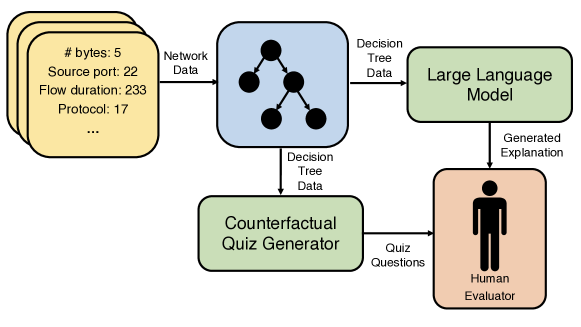
- 在网络流量数据上训练决策树模型,用于将流量分类为良性或恶意。
- 针对给定输入,从决策树中提取路径与结构信息,以追踪决策路径。
- 设计一个大型语言模型(LLM)提示,包含任务描述、特征定义、树结构、节点阈值、类别分布及输入特征值。
- 指示 LLM 使用简单、非技术性语言,生成解释为何决策树将该输入分类为良性或恶意。
- 基于规则模板自动生成反事实 Quiz 问题,以测试人类评估者对解释的理解程度。
- 通过 10 名参与者(一半具有机器学习背景,一半具有安全背景)开展人工评估,比较 LLM-DTE 与基于规则的解释在 Quiz 表现与定性评分上的差异。
实验结果
研究问题
- RQ1LLM 生成的自然语言解释是否能提升用户对基于决策树的网络入侵检测决策的理解,相比基于规则的解释?
- RQ2LLM 生成的解释在多大程度上融入了关于特征相关性与决策边界的背景知识?
- RQ3基于 Quiz 的人工评估框架在衡量决策树解释质量方面有多有效?
- RQ4LLM 生成的解释是否在可读性、质量与背景知识利用方面优于基于规则的解释?
主要发现
- LLM-DTE 解释的平均 Quiz 得分为 17.3(满分为 25),相比基于规则的解释(12.4/25)提高了 39.5%。
- 人类评估者认为 LLM-DTE 解释具有高可读性的比例比基于规则的解释高 15%,其中 42% 的 LLM-DTE 解释被评为高可读性,而基于规则的解释为 30%。
- LLM-DTE 解释在质量评分中被评为“高”的比例为 52%,而基于规则的解释为 30%,表明感知质量接近翻倍。
- LLM-DTE 解释在背景知识使用方面被评为“高”的比例为 52%,而基于规则的解释为 30%,反映出感知上下文相关性提高了 70%。
- 使用自动生成 Quiz 问题的人工评估框架与定性偏好具有强相关性,验证了其在评估解释有效性方面的适用性。
- 尽管性能有所提升,LLM-DTE 的生成速度仍慢于基于规则的方法,且成本更高;同时,随着决策树深度增加,解释质量因提示长度变长而下降。
更好的研究,从现在开始
从阅读论文到最终审阅,大幅缩短您的研究时间。
无需绑定信用卡
本解读由 AI 生成,并经人工编辑审核。