
[论文解读] Exploring chemical enrichment of the intracluster medium with the Line Emission Mapper
线发射映射器(LEM)探测器任务将实现对软X射线波段的高分辨率、空间分辨X射线谱学,以在Mpc尺度上绘制星系团内介质(ICM)的化学富集图。通过观测附近的宁静星系团以及偶然发现的高红移原星系团,LEM将测量十种关键元素的丰度,为宇宙金属富集的时间、来源和普遍性提供前所未有的约束。
Synthesized in the cores of stars and supernovae, most metals disperse over cosmic scales and are ultimately deposited well outside the gravitational potential of their host galaxies. Since their presence is well visible through their X-ray emission lines in the hot gas pervading galaxy clusters, measuring metal abundances in the intracluster medium (ICM) offers us a unique view of chemical enrichment of the Universe as a whole. Despite extraordinary progress in the field thanks to four decades of X-ray spectroscopy using CCD (and gratings) instruments, understanding the precise stellar origins of the bulk of metals, and when the latter were mixed on Mpc scales, requires an X-ray mission capable of spatial, non-dispersive high resolution spectroscopy covering at least the soft X-ray band over a large field of view. In this White Paper, we demonstrate how the Line Emission Mapper (LEM) probe mission concept will revolutionize our current picture of the ICM enrichment. Specifically, we show that LEM will be able to (i) spatially map the distribution of ten key chemical elements out to the virial radius of a nearby relaxed cluster and (ii) measure metal abundances in serendipitously discovered high-redshift protoclusters. Altogether, these key observables will allow us to constrain the chemical history of the largest gravitationally bound structures of the Universe. They will also solve key questions such as the universality of the initial mass function (IMF) and the initial metallicity of the stellar populations producing these metals, as well as the relative contribution of asymptotic giant branch (AGB) stars, core-collapse, and Type Ia supernovae to enrich the cosmic web over Mpc scales. Concrete observing strategies are also briefly discussed.
研究动机与目标
- 解决宇宙大尺度结构中大部分金属何时以及以何种方式被分散到宇宙空间的未解之谜。
- 确定不同恒星族群——AGB星、核心塌缩超新星和Ia型超新星——对宇宙网化学富集的相对贡献。
- 通过在星系团和星系群中进行空间分辨的金属丰度测量,检验初始质量函数(IMF)和恒星族群初始金属丰度的普遍性。
- 通过结合对附近宁静星系团的深空观测与偶然发现的高红移原星系团的观测,研究星系团的化学历史。
- 实现对ICM中金属分布与混合的全面、多尺度视图,包括活动星系核反馈、并合以及气体倾覆的影响。
提出的方法
- 对红移z ≈ 0.07–0.08的宁静星系团进行2 Ms的深空观测,以在软X射线波段中绘制十种关键元素(如Fe、O、Ne、Mg、Si、S、Ar、Ca、Sc、Ti)的空间分辨丰度图。
- 利用LEM的大视场和高能量分辨率,探测并分析热ICM中高度电离离子的X射线发射线,从而实现精确的丰度测量。
- 通过深空星系团观测与偶然发现的高红移原星系团探测之间的协同,追溯早期宇宙时期的金属富集。
- 对大质量星系团与低质量星系群进行对比分析,评估不同质量尺度下金属富集的普遍性。
- 应用先进的谱模型和原子数据,解释线发射强度与丰度分布,同时考虑ICM中温度和密度的变化。
- 使用模拟(如TNG100-1、Magneticum、Simba)来解释预期的LEM观测结果,并验证任务概念的灵敏度与动态范围。
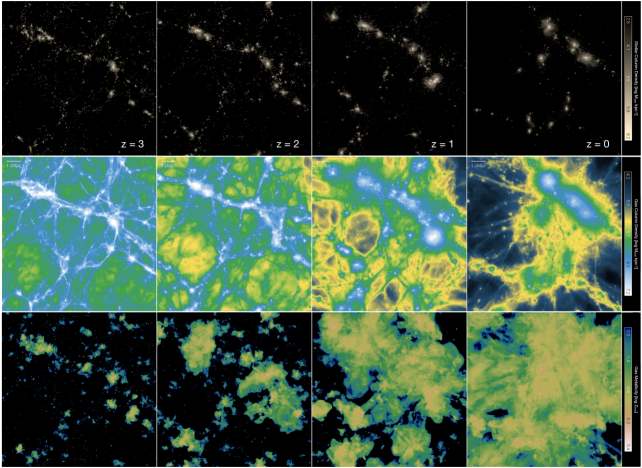
实验结果
研究问题
- RQ1星系在何时开始富集星系团内介质?在附近星系团的外缘以及高红移原星系团中,这些富集过程的特征是什么?
- RQ2在Mpc尺度上,渐近巨星分支(AGB)星、核心塌缩超新星和Ia型超新星对宇宙网金属富集的相对贡献是什么?
- RQ3从星系团和星系群中金属丰度分布推断,初始质量函数(IMF)在不同质量尺度和宇宙时空中是否具有普遍性?
- RQ4ICM中铁的富集历史有多普遍?氧/铁比(O/Fe)比值揭示了早期富集过程的时间与性质的哪些信息?
- RQ5活动星系核喷流、X射线空腔和气体倾覆等反馈机制如何影响ICM中金属的空间分布与混合?
主要发现
- LEM将实现对附近宁静星系团的星系团内介质(ICM)中十种关键化学元素(Fe、O、Ne、Mg、Si、S、Ar、Ca、Sc、Ti)的空间分布测绘,提供首次对大尺度金属分布的全面视图。
- 对红移z ≈ 0.07–0.08星系团进行的2 Ms深空观测,将实现对金属丰度及其径向分布的精确测量,对Fe、O及O/Fe比值的变化具有高灵敏度。
- LEM将探测并表征偶然发现的高红移原星系团中的金属丰度,为早期富集的时期提供直接约束。
- 结合星系团与星系群的观测(包括为四个系统额外分配的两组各1 Ms观测:两组星系群和两组大质量星系团),将实现对不同质量尺度上金属丰度分布的对比研究。
- 在较冷、质量较小的星系群中,更高的线发射强度可补偿其较低的X射线亮度,使其成为LEM进行高分辨率丰度测绘的可行目标。
- LEM的能力将与XRISM(核心谱学)和NewAthena(深空、高能段灵敏度)形成互补,实现对宇宙金属富集的全谱段、多尺度理解。
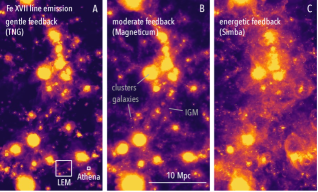
更好的研究,从现在开始
从阅读论文到最终审阅,大幅缩短您的研究时间。
无需绑定信用卡
本解读由 AI 生成,并经人工编辑审核。