
[论文解读] Exploring Lead Free Mixed Halide Double Perovskites Solar Cell
本研究通过SCAPS-1D模拟,探究了无铅混合卤化物双钙钛矿Cs₂TiI₆₋ₓBrₓ作为钙钛矿太阳能电池吸光层的性能。FTO/Cu₂O/Cs₂TiI₅Br₁/WS₂配置效率最高(19.03%),而Cs₂TiI₂Br₄在效率(13.31%)与结构稳定性之间达到最佳平衡,其稳定性通过改进的容忍因子τ得到验证。
The significant surge in energy use and escalating environmental concerns have sparked worldwide interest towards the study and implementation of solar cell technology. Perovskite solar cells (PSCs) have garnered remarkable attention as an emerging third-generation solar cell technology. This paper presents an in-depth analysis of lead-free mixed halide double perovskites in the context of their potential uses in solar cell technology. Through the previous studies of various mixed halide double perovskite materials as potential absorber layer materials, it has been observed that Cs$_2$TiI$_{6-x}$Br$_x$ possesses promising characteristics. In this study, simulations were conducted using SCAPS-1D software to explore all possible combinations for x= 0 to 6. The materials for the Hole Transport Layer (HTL) and Electron Transport Layer (ETL) and absorber layer, along with their optimal thicknesses, are selected to yield the most promising results in terms of open-circuit voltage (V$_{oc}$), short-circuit current density (J$_{sc}$), fill factor (FF), and power conversion efficiency. A novel tolerance factor is employed to assess structural stability of perovskites. FTO/Cu$_2$O/Cs$_2$TiI$_5$Br$_1$/WS$_2$ emerges as the best combination in terms of the efficiency with 19.03% but FTO/Cu$_2$O/Cs$_2$TiI$_2$Br$_4$/WS$_2$ shows good stability with 13.31% efficiency.
研究动机与目标
- 评估无铅混合卤化物双钙钛矿作为第三代太阳能电池可行吸光材料的潜力。
- 识别提升效率与稳定性所需的最优电子传输层(ETL)、空穴传输层(HTL)及吸光层组合。
- 通过改进的容忍因子τ(超越传统Goldschmidt因子)评估结构稳定性。
- 确定Cs₂TiI₆₋ₓBrₓ(x = 0至6)的最佳组成,以实现最大功率转换效率与稳定性。
- 通过分析缺陷密度与各层厚度对器件性能的影响,实现效率与缺陷容忍度的平衡。
提出的方法
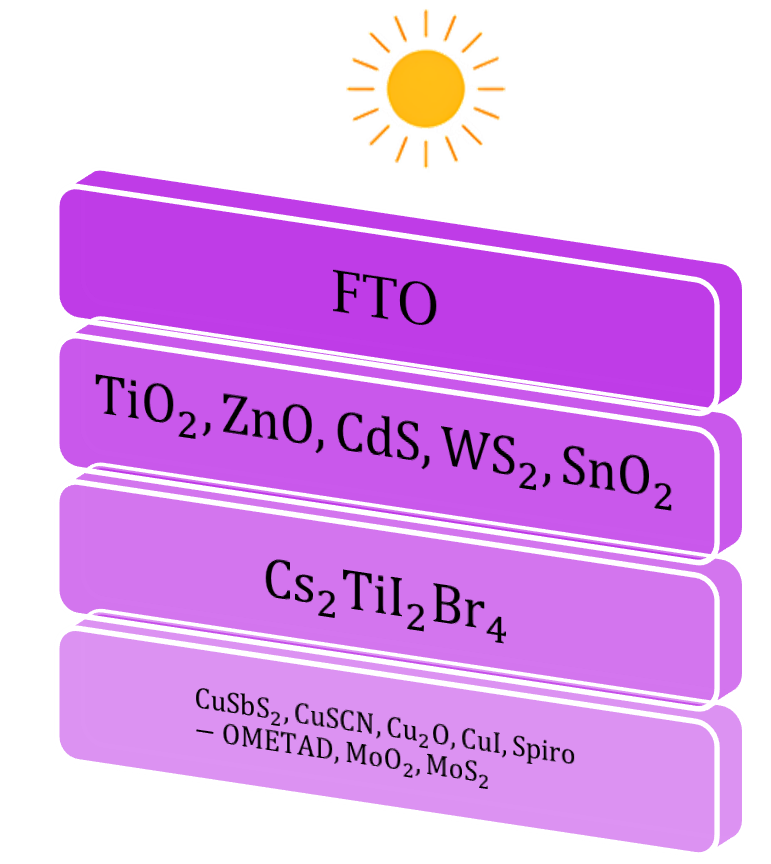
- 采用SCAPS-1D模拟不同ETL、HTL及吸光层配置的PSC器件性能。
- 应用改进的容忍因子τ = (r_X / r_B) - n_A(n_A - (r_A / r_B) / ln(r_A / r_B)),以预测Cs₂TiI₆₋ₓBrₓ的结构稳定性。
- 系统性地调整材料参数,包括带隙、电子亲和能、介电常数、载流子迁移率及缺陷密度(10¹⁵ cm⁻³)。
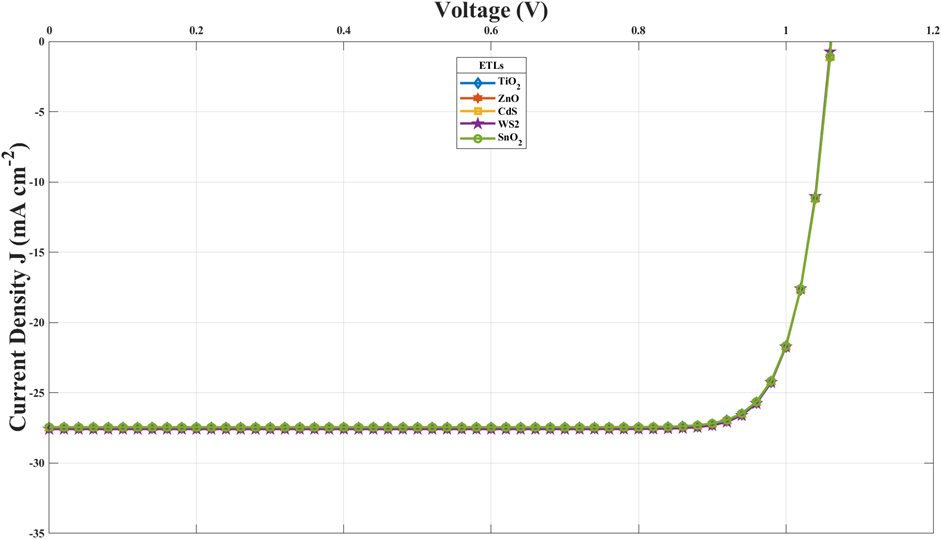
- 分析x = 0至6范围内的J-V特性与光谱响应,评估性能趋势。
- 通过模拟多种厚度值,确定ETL与HTL的最优厚度。
- 调节缺陷密度与载流子浓度,评估其对开路电压(Voc)、短路电流密度(Jsc)、填充因子(FF)及效率的影响。
实验结果
研究问题
- RQ1在无铅双钙钛矿太阳能电池中,ETL、HTL与吸光层的何种组合可实现最高功率转换效率?
- RQ2Cs₂TiI₆₋ₓBrₓ中溴含量(x)的变化如何影响开路电压与电流密度?
- RQ3改进的容忍因子τ在多大程度上可准确预测混合卤化物双钙钛矿的结构稳定性?
- RQ4何种吸光层厚度与缺陷密度可使效率最大化,同时保持稳定性?
- RQ5哪种材料组成在高效率与高结构稳定性之间实现最佳权衡?
主要发现
- FTO/Cu₂O/Cs₂TiI₅Br₁/WS₂配置在所有测试配置中实现了最高的功率转换效率(19.03%)。
- Cs₂TiI₂Br₄在效率(13.31%)与结构稳定性之间达到最佳平衡,其τ值为4.167,稳定性概率P(τ) = 0.540。
- 开路电压(Voc)在x = 1至5范围内保持相对稳定,但在x = 0与x = 6时显著下降,表明其对成分高度敏感。
- 短路电流密度(Jsc)随x从1增至5而降低,表明高溴含量组合的光子吸收效率下降。
- 填充因子(FF)在大多数组成中保持较高水平(80–87%),仅对缺陷密度表现出轻微敏感性,表明对中等缺陷具有强鲁棒性。
- Cu₂O作为HTL表现最优,优于MoO₂与CuSbS₂等其他HTL材料,尤其在最优受主掺杂浓度8.5 × 10¹⁹ cm⁻³时表现突出。
更好的研究,从现在开始
从阅读论文到最终审阅,大幅缩短您的研究时间。
无需绑定信用卡
本解读由 AI 生成,并经人工编辑审核。