
[论文解读] Exploring Separable Attention for Multi-Contrast MR Image Super-Resolution
本文提出SANet,一种用于多对比度磁共振图像超分的新型可分离注意力网络,通过利用辅助对比度提升高、低强度区域的重建质量。通过采用高强度优先和低强度分离注意力机制,SANet改善了解剖细节恢复与边缘保持,在fastMRI和体内数据集上实现了最先进性能,PSNR与SSIM得分均更优。
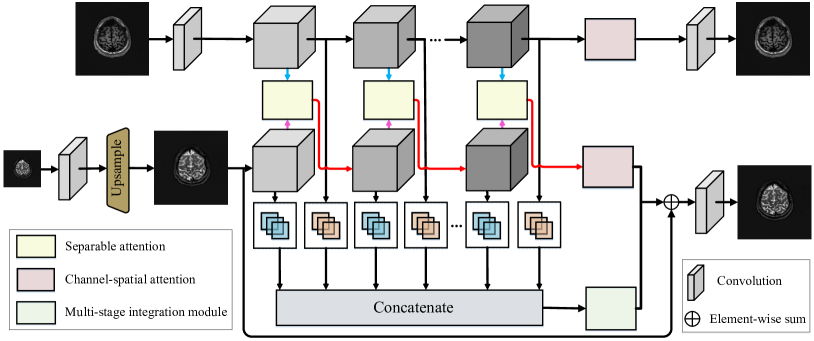
Super-resolving the Magnetic Resonance (MR) image of a target contrast under the guidance of the corresponding auxiliary contrast, which provides additional anatomical information, is a new and effective solution for fast MR imaging. However, current multi-contrast super-resolution (SR) methods tend to concatenate different contrasts directly, ignoring their relationships in different clues, e.g., in the high-intensity and low-intensity regions. In this study, we propose a separable attention network (comprising high-intensity priority attention and low-intensity separation attention), named SANet. Our SANet could explore the areas of high-intensity and low-intensity regions in the "forward" and "reverse" directions with the help of the auxiliary contrast, while learning clearer anatomical structure and edge information for the SR of a target-contrast MR image. SANet provides three appealing benefits: (1) It is the first model to explore a separable attention mechanism that uses the auxiliary contrast to predict the high-intensity and low-intensity regions regions, diverting more attention to refining any uncertain details between these regions and correcting the fine areas in the reconstructed results. (2) A multi-stage integration module is proposed to learn the response of multi-contrast fusion at multiple stages, get the dependency between the fused representations, and boost their representation ability. (3) Extensive experiments with various state-of-the-art multi-contrast SR methods on fastMRI and clinical extit{in vivo} datasets demonstrate the superiority of our model.
研究动机与目标
- 解决现有多对比度SR方法在未建模高、低强度区域间依赖关系的情况下直接拼接对比度的局限性。
- 通过显式建模来自辅助MR对比度的互补解剖信息,提升超分质量。
- 开发一种机制,通过注意力驱动的特征精炼,优化高、低强度区域之间不确定边界的重建。
- 通过多阶段融合模块捕获网络各阶段间的融合依赖关系,增强表征学习能力。
- 实现高性能、参数高效且计算开销极小的超分方法。
提出的方法
- 提出一种可分离注意力机制,将注意力分解为高强度优先与低强度分离路径,以精炼强度区域之间的不确定边界。
- 引入多阶段融合模块,在网络多个深度层次上学习并增强多对比度融合的特征响应。
- 使用可学习的注意力权重比(α)平衡目标对比度与辅助对比度的贡献,最优性能出现在α = 0.7时。
- 采用L1损失函数以实现更快收敛与稳定训练,经消融实验验证其有效性。
- 设计可调节残差组数(2至6组)的残差网络,6组时性能最优,且PSNR与SSIM保持稳定。
- 采用渐进式训练策略,包含共享特征提取分支与对比度特异性精炼分支。
![Figure 1: Comparison between single-contrast method SMORE [ 9 ] ), multi-contrast method Lyu et al. [ 10 ] , and our SANet on in vivo datasets. We effectively reconstruct the target contrast image by exploring the complementary information between the clear anatomical structure and boundary details](https://ar5iv.labs.arxiv.org/html/2109.01664/assets/x1.png)
实验结果
研究问题
- RQ1是否可通过区分高、低强度区域的可分离注意力机制提升多对比度MR超分性能?
- RQ2辅助对比度信息的引入如何影响细微解剖结构与边缘的重建质量?
- RQ3注意力机制中目标与辅助对比度贡献的最优平衡比是多少?
- RQ4多对比度特征的多阶段融合如何增强表征学习与超分性能?
- RQ5与现有EDSR基模型相比,所提方法是否能在更少参数下实现更优性能?
主要发现
- 在SMS数据集上,SANet在2倍放大下实现PSNR 42.10 dB与SSIM 0.997,优于基线方法。
- 最优注意力权重比α = 0.7时PSNR与SSIM达到最高,而α < 0.3时性能显著下降。
- 当残差组数达到6组时性能趋于稳定,PSNR与SSIM不再提升,表明模型容量充足且无过拟合。
- SANet仅需11M参数(6组残差),显著少于EDSR(43M)与SMORE(双EDSR分支),同时性能更优。
- 联合对目标与辅助对比度进行超分,目标图像PSNR达31.72 dB、SSIM达0.700,辅助图像PSNR达32.3 dB、SSIM达0.705,证明了多对比度融合的鲁棒性。
- 消融实验表明,L1损失与L2损失性能相当但收敛更快,支持其在最终模型中的使用。
更好的研究,从现在开始
从阅读论文到最终审阅,大幅缩短您的研究时间。
无需绑定信用卡
本解读由 AI 生成,并经人工编辑审核。