
[论文解读] Exploring the nature of UV-bright $z \gtrsim 10$ galaxies detected by JWST: star formation, black hole accretion, or a non-universal IMF?
该研究使用 Cosmic Archaeology Tool (CAT) 半解析模型来量化 Pop III/II 恒星与 AGN 在从 z ~ 4 到 20 的紫外紫外光函数中的作用,与 JWST 数据进行比较,并检验作为 z>10 矛盾的解决方案的 IMF 演化。
We use the Cosmic Archaeology Tool (CAT) semi-analytical model to explore the contribution of Population (Pop) III/II stars and active galactic nuclei (AGNs) to the galaxy UV luminosity function (LF) evolution at $4 \leq z \leq 20$. We compare in particular with recent JWST data in order to explore the apparent tension between observations and theoretical models in the number density of bright galaxies at $z \gtrsim 10$. The model predicts a star formation history dominated by UV faint ($M_{ m UV} > - 18$) galaxies, with a Pop III contribution of $\lesssim 10\%$ ($\lesssim 0.5\%$) at $z \simeq 20$ ($z \simeq 10$). Stars are the primary sources of cosmic reionization, with $5 - 10 \%$ of ionizing photons escaping into the intergalatic medium at $5 \leq z \leq 10$, while the contribution of unobscured AGNs becomes dominant only at $z \lesssim 5$. The predicted stellar and AGN UV LFs reproduce the observational data at $5 \lesssim z \lesssim 9 - 10$. At higher redshift, CAT predicts a steeper evolution in the faint-end slope ($M_{ m UV} > - 18$), and a number density of bright galaxies ($M_{ m UV} \simeq -20$) consistent with data at $z \sim 10 - 11$, but smaller by 0.8 dex at $z \sim 12 - 13$, and 1.2 dex at $z \sim 14 - 16$, when compared to the values estimated by recent studies. Including the AGN emission does not affect the above findings, as AGNs contribute at most to $\lesssim 10 \%$ of the total UV luminosity at $M_{ m UV} < - 19$ and $z \gtrsim 10$. Interestingly, considering a gradual transition in the stellar IMF, modulated by metallicity and redshift as suggested by recent simulations, the model agrees with JWST data at $z \sim 12 - 13$, and the disagreement at $z \sim 14 - 16$ is reduced to 0.5 dex.
研究动机与目标
- 评估 Pop III/II 恒星与 AGN 对从 z~4 到 20 的 UV LF 演化的贡献。
- 评估 z>10 时 AGN 发射对明亮端 UV 光度的影响。
- 测试以金属丰度与红shift 驱动的逐步 IMF 转换对 UVLF 预测的影响。
- 将 CAT 的预测与 JWST 观测进行比较,以识别矛盾点及可能的解决方案。
提出的方法
- 使用 CAT 产生从 z=4 到 z=24 的大样本 DM merger histories。
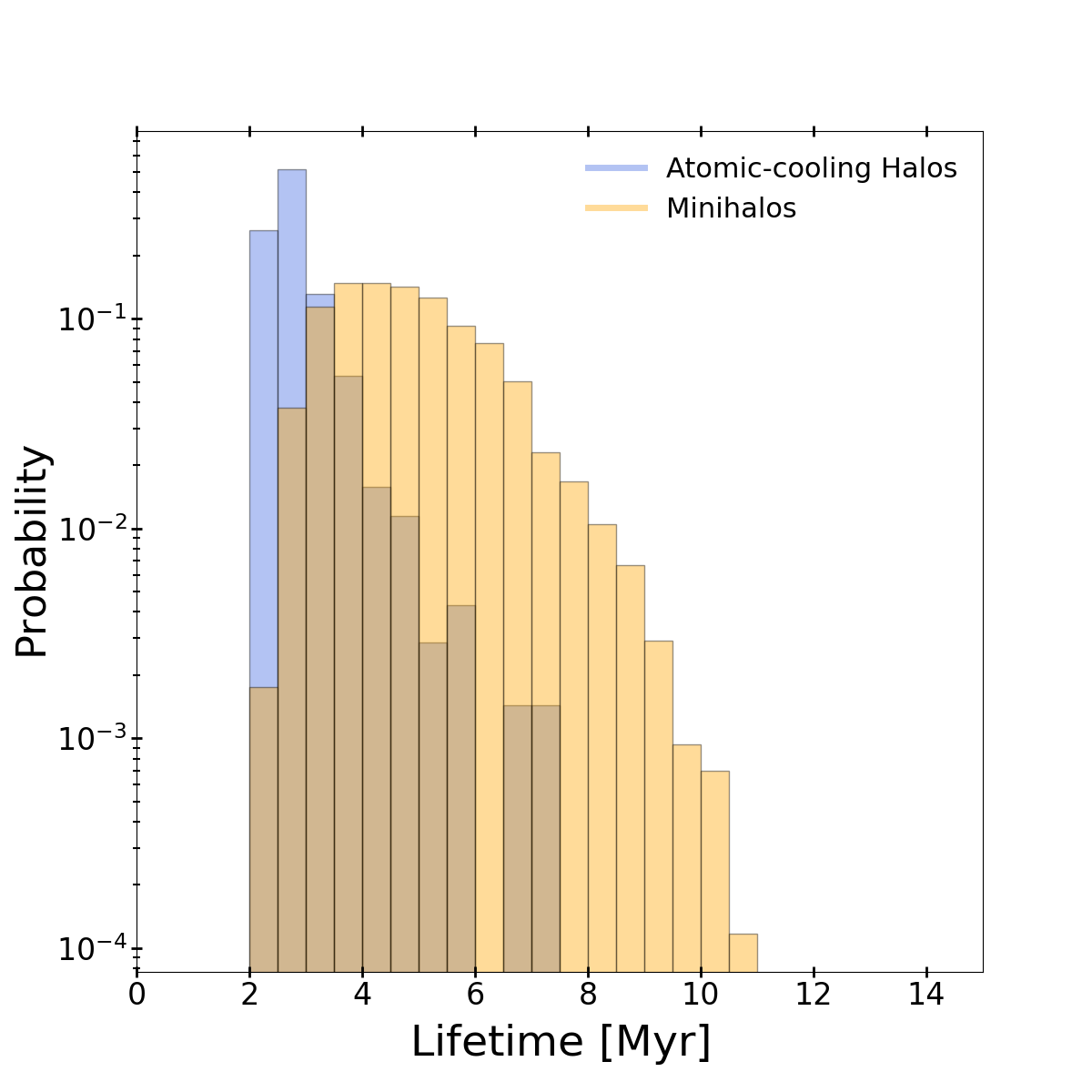
- 用经标定的 SFR 处方对 mini-halo 和 atomic-cooling halos 的恒星形成进行建模。
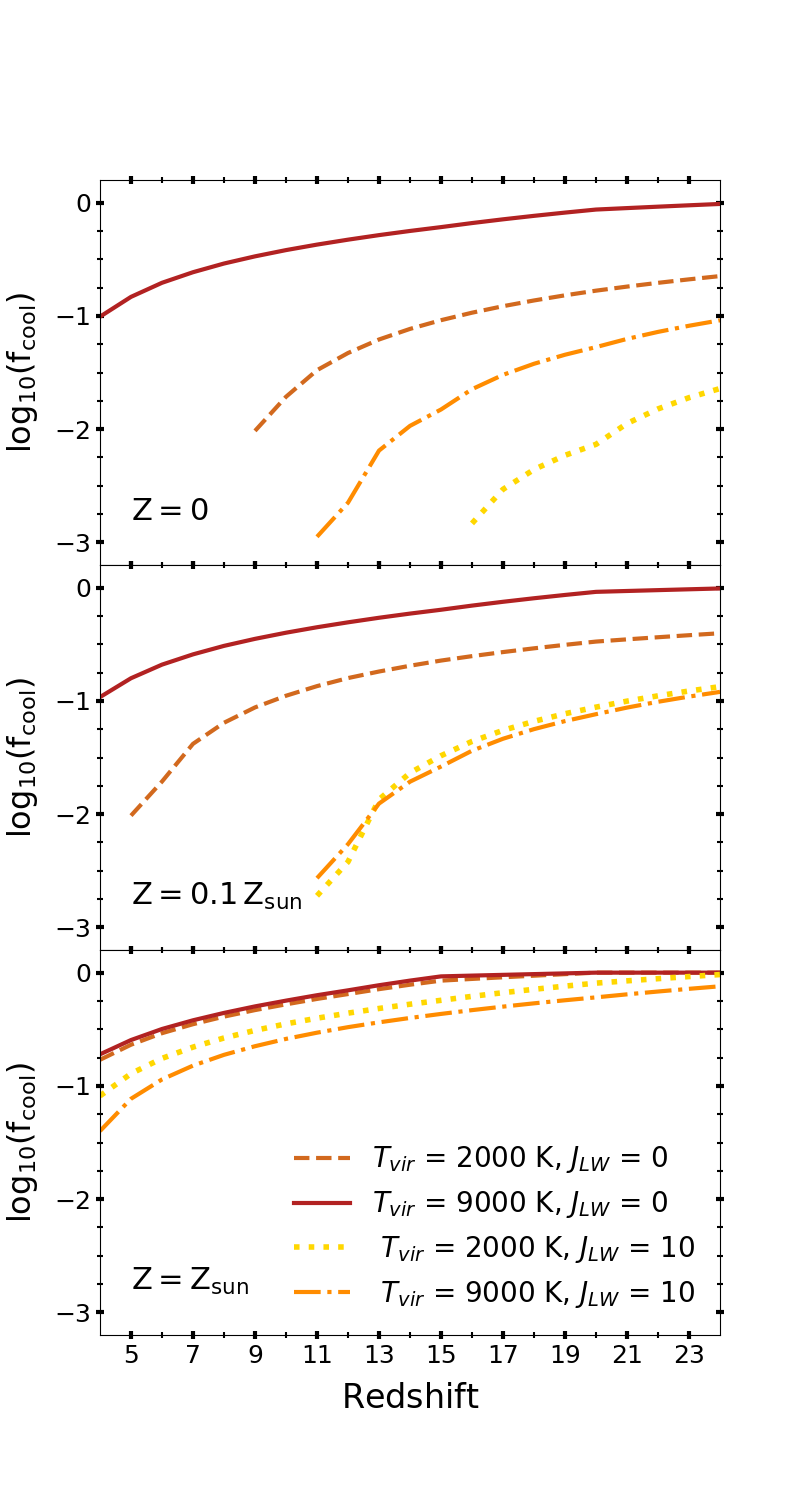
- 实现带随机采样的 Pop III IMF,并在 Zcrit 处过渡到 Pop II,同时增强 Pop III 恒星形成效率。
- 计算 BH 种子形成、通过 Bondi-Hoyle 吸积增长(设定 Eddington 上限)以及合并。
- 包含 SN 与 AGN 的机械反馈,以及 LW/UV 辐射反馈对冷却与星形成的影响。
- 对 Pop II/III 恒星和早期黑洞的光电致辐射输出进行建模,随 redshift 的逃逸分数和 IGM 湿密聚簇度变化,以跟踪再电离(Q_HII)和 tau_e。
实验结果
研究问题
- RQ1Pop III/II 恒星与 AGN 对 4 ≤ z ≤ 20 的 UV LF 相对贡献是多少?
- RQ2在 z ≳ 10 时,是否通过包含 AGN 发射可以使观测的 UV LF 与理论预测趋于一致?
- RQ3具有金属丰度/红移驱动的逐步 IMF 转换是否能改善与 JWST 数据在 z ≈ 12–16 的一致性?
- RQ4模型对 UV LF 的暗端和明端在 JWST 测量中的预测如何,与观测相比有哪些矛盾点仍然存在?
主要发现
- Pop III 对 UV 光度的贡献较小,在 z ≈ 20 时不超过 ≲10%,在 z ≈ 10 时不超过 ≲0.5%。
- 星星仍是宇宙再电离的主要来源,在 z=5 至 z=10 之间有 5–10% 的电离光子逃逸进入 IGM。
- 在 z ≳ 10 时,无遮掩的 AGN 对总 UV 光度的贡献最多仅 ≲10%(对于 M_UV < −19)。
- 从恒星和 AGN 预测的 UV LF 与数据在 5 ≲ z ≲ 9–10 时一致;在更高 redshift 下,暗端演化更陡,而明端密度在 z~10–11 时接近数据但在 z~12–13 约低 0.8 dex,在 z~14–16 约低 1.2 dex,与某些研究相比。
- 加入 AGN 发射并未显著改变高-z 区域 LF 的结论。
- 具有金属丰度/红shift 驱动的逐步 IMF 转换使模型在 z~12–13 与 JWST 数据趋于一致,并将 z~14–16 的差异降至约 0.5 dex。
更好的研究,从现在开始
从论文设计到论文写作,大幅缩短您的研究时间。
无需绑定信用卡
本解读由 AI 生成,并经人工编辑审核。