
[论文解读] Exploring the spectrum of stochastic gravitational-wave anisotropies with pulsar timing arrays
本文提出了一种针对脉冲星时标阵列(PTA)中超大质量双黑洞(SMBHBs)产生的随机引力波背景各向异性的分析模型,表明由于散粒噪声的存在,各向异性具有频率依赖性,并且在恒星散射等动力学过程作用下被增强。关键结果是,各向异性的测量提供了超越各向同性背景的新信息,特别是通过引力波振幅分布的二阶矩;此外,预测了由于双星倾角导致的显著偏振各向异性。
Anisotropies in the nanohertz gravitational-wave background are a compelling next target for pulsar timing arrays (PTAs). Measurements or informative upper limits to the anisotropies are expected in the near future and can offer important clues about the origin of the background and the properties of the sources. Given that each source is expected (in the simplest scenario of circular inspirals) to emit at a fixed frequency, the anisotropy will most generally vary from one frequency to another. The main result presented in this work is an analytical model for the anisotropies produced by a population of inspiralling supermassive black-hole binaries (SMBHBs). This model can be immediately connected with parametrizations of the SMBHB mass function and can be easily expanded to account for new physical processes taking place within the PTA frequency band. We show that a variety of SMBHB models predict significant levels of anistropy at the highest frequencies accessible to PTA observations and that measurements of anisotropies can offer new information regarding this population beyond the isotropic component. We also model the impact of additional dynamical effects driving the binary towards merger and show that, if these processes are relevant within the PTA band, the detectability of anisotropies relative to the isotropic background will be enhanced. Finally, we use the formalism presented in this work to predict the level anisotropy of the circular and linear polarizations of the SGWB due to the distribution of binary orientation angles with respect to the line of sight.
研究动机与目标
- 开发一个用于脉冲星时标阵列(PTA)中由于有限源散粒噪声引起的引力波背景各向异性的预测性分析框架。
- 将各向异性预测直接与超大质量双黑洞质量函数和种群分布等天体物理参数联系起来。
- 研究恒星散射和气体相互作用等动力学过程如何影响各向异性相对于各向同性背景的可探测性。
- 计算由SMBHBs角分布引起的线性与圆偏振各向异性的预期水平。
提出的方法
- 使用针对SMBHB种群的散粒噪声模型推导各向异性功率谱,其中源计数具有频率依赖性。
- 采用SMBHB质量函数的参数化形式计算引力波振幅场的方差,将其与分布的二阶矩联系起来。
- 通过球谐分解建模强度和偏振各向异性,其中取向角呈各向同性分布。
- 通过修改PTA频带内有效源密度,将额外的并合机制(如恒星散射、气体阻力)的影响纳入模型。
- 通过双星倾角的角积分计算偏振各向异性,推导出圆偏振和线性偏振分量的方差。
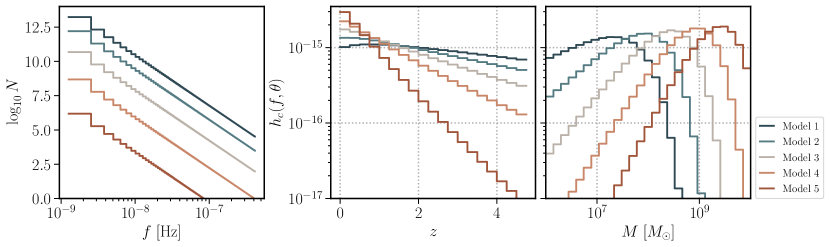
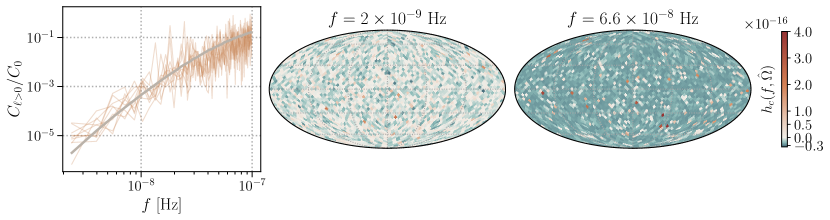
- 利用该形式化方法预测:在引力波主导区域,各向异性水平满足 $ C_{\ell>0}/C_0 \propto f^{11/3} $,在动力学加速作用下可增强可探测性。
实验结果
研究问题
- RQ1在SMBHB数量有限的条件下,随机引力波背景(SGWB)的各向异性如何依赖于频率?
- RQ2各向异性测量在多大程度上能打破仅从各向同性背景中无法分辨的SMBHB种群参数之间的退化?
- RQ3恒星散射或气体阻力等额外动力学过程如何影响各向异性相对于各向同性分量的相对振幅?
- RQ4由于SMBHB倾角分布,SGWB中线性和圆偏振各向异性的预期水平是多少?
- RQ5该形式化方法能否预测在最高PTA频率下可探测的各向异性水平?频率分箱应如何优化以实现最佳探测?
主要发现
- 由于散粒噪声,在高频段,SGWB的各向异性满足 $ C_{\ell>0}/C_0 \propto f^{11/3} $,表明高频段各向异性更强。
- 强度场的方差与 $ \int d\Omega_\iota / 4\pi \, g_I^2(\iota) = 284/315 $ 成正比,表明有限源计数导致显著的强度各向异性。
- 圆偏振各向异性预计约为强度各向异性水平的25%,其方差与 $ 23/105 $ 成正比。
- 线性偏振各向异性预计约为强度各向异性水平的3%,其中 $ Q $ 和 $ U $ 分量的方差各为 $ L $ 的一半。
- 恒星散射或气体阻力等动力学过程会减少可探测双星的数量并削弱引力波谱,但会增强各向异性的相对振幅。
- 该模型能够自洽地预测引力波谱及其各向异性,为突破仅基于各向同性测量的SMBHB种群参数退化提供了框架。
更好的研究,从现在开始
从阅读论文到最终审阅,大幅缩短您的研究时间。
无需绑定信用卡
本解读由 AI 生成,并经人工编辑审核。