
[论文解读] Exponential Quantum Communication Advantage in Distributed Inference and Learning
本文提出了一种用于分布式机器学习的量子通信框架,通过使用参数化量子电路,在训练和推理过程中实现了通信成本的指数级降低。通过将数据编码为量子态并利用量子干涉,该方法在深度非线性模型中实现了通信复杂度的指数级量子优势——而无需依赖特殊的数据访问模型——同时通过量子力学原理提供了内在的隐私保护。
Training and inference with large machine learning models that far exceed the memory capacity of individual devices necessitates the design of distributed architectures, forcing one to contend with communication constraints. We present a framework for distributed computation over a quantum network in which data is encoded into specialized quantum states. We prove that for models within this framework, inference and training using gradient descent can be performed with exponentially less communication compared to their classical analogs, and with relatively modest overhead relative to standard gradient-based methods. We show that certain graph neural networks are particularly amenable to implementation within this framework, and moreover present empirical evidence that they perform well on standard benchmarks. To our knowledge, this is the first example of exponential quantum advantage for a generic class of machine learning problems that hold regardless of the data encoding cost. Moreover, we show that models in this class can encode highly nonlinear features of their inputs, and their expressivity increases exponentially with model depth. We also delineate the space of models for which exponential communication advantages hold by showing that they cannot hold for linear classification. Our results can be combined with natural privacy advantages in the communicated quantum states that limit the amount of information that can be extracted from them about the data and model parameters. Taken as a whole, these findings form a promising foundation for distributed machine learning over quantum networks.
研究动机与目标
- 解决分布式机器学习中的通信瓶颈问题,即经典数据和模型超出单个设备的内存容量。
- 证明量子通信可在广泛类别的机器学习模型中为训练和推理提供指数级通信成本降低。
- 表明该优势不依赖于数据编码成本,并且不局限于稀疏或专用数据访问模型。
- 证明量子优势并非编码方式的产物,通过显示在线性分类器中该优势会消失来验证这一点。
- 探索量子表达能力、模型深度与分布式学习中通信效率之间的相互作用。
提出的方法
- 使用参数化量子电路将数据编码为量子态,实现在量子网络上的分布式推理与训练。
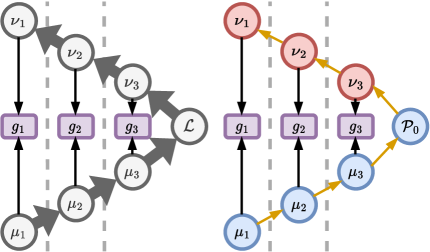
- 通过量子辅助估计损失和梯度来执行梯度下降,利用测量结果更新参数。
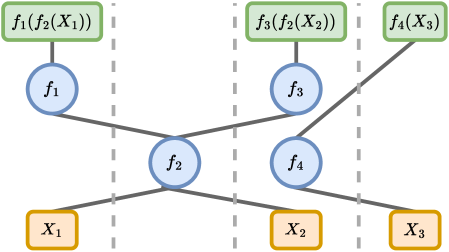
- 该框架利用量子干涉和振幅编码,在量子态的振幅中表示非线性特征。
- 通过信息理论界限分析通信复杂度,表明量子协议与经典协议之间存在指数级分离。
- 该方法使用类似阴影层析的技术进行梯度估计,但论文指出这可能次优,因为迭代之间缺乏相关性的重用。
- 识别出一类电路子集,使得整个训练过程均实现指数级通信优势,而不仅限于梯度估计阶段。
实验结果
研究问题
- RQ1量子通信能否为密集经典数据的分布式机器学习提供指数级通信成本降低?
- RQ2在考虑将数据编码为量子态的成本时,该量子优势是否依然成立?
- RQ3该通信优势是否仅针对非线性模型,还是也适用于线性分类器?
- RQ4能否设计出量子电路,使其表达能力随深度呈指数增长,同时保持低通信开销?
- RQ5在不依赖QRAM等复杂数据访问模型的前提下,能在多大程度上实现通信中的量子优势?
主要发现
- 对于广泛类别的参数化量子电路,与经典协议相比,量子通信在梯度估计和完整训练过程中均实现了指数级通信成本降低。
- 该通信优势并非仅源于数据编码,因为在非线性分类器中该优势不成立,表明其源于非线性表达能力和量子干涉。
- 由于编码非线性特征的酉操作被递归组合,模型表达能力随深度呈指数级增长。
- 该框架通过Holevo定理提供内在隐私保护,限制了从传输的量子态中可提取的经典信息量。
- 该优势无需QRAM或稀疏性假设,且在近场量子设备的现实噪声模型下依然稳健。
- 对于特定电路子集(如使用预训练特征进行微调的场景),在凸性假设下,整个训练过程均可实现指数级通信节省。
更好的研究,从现在开始
从阅读论文到最终审阅,大幅缩短您的研究时间。
无需绑定信用卡
本解读由 AI 生成,并经人工编辑审核。