
[论文解读] Extreme damped Lyman-$α$ absorption in young star-forming galaxies at $z=9-11$
JWST 观测揭示在约 z ≈ 9–11 的三颗星系周围存在极端的 damped Lyα 吸收,log N_HI > 22,指示局部 HI 气体丰富并对早期星系形成与再电离有影响。
The onset of galaxy formation is thought to be initiated by the infall of neutral, pristine gas onto the first protogalactic halos. However, direct constraints on the abundance of neutral atomic hydrogen (HI) in galaxies have been difficult to obtain at early cosmic times. Here we present spectroscopic observations with JWST of three galaxies at redshifts $z=8.8 - 11.4$, about $400-600$ Myr after the Big Bang, that show strong damped Lyman-$α$ absorption ($N_{ m HI} > 10^{22}$ cm$^{-2}$) from HI in their local surroundings, an order of magnitude in excess of the Lyman-$α$ absorption caused by the neutral intergalactic medium at these redshifts. Consequently, these early galaxies cannot be contributing significantly to reionization, at least at their current evolutionary stages. Simulations of galaxy formation show that such massive gas reservoirs surrounding young galaxies so early in the history of the universe is a signature of galaxy formation in progress.
研究动机与目标
- 在再电离时期(z>8)星系环境中研究中性氢 HI 的丰度及分布。
- 表征阻尼翼 Lyα 吸收特征并分辨 IGM 与局部(ISM/halo)HI 的贡献。
- 推导母星系的物理性质(SFR、金属丰度、气体质量、气体分数)并评估对再电离和星系形成的影响。
- 将观测到的 HI 储库与模拟进行比较,以理解早宇宙中的气体吸积历史。
提出的方法
- 获取三组 z>8 星系系统的 JWST/NIRSpec 棱镜光谱,具备稳健的发射线红移。
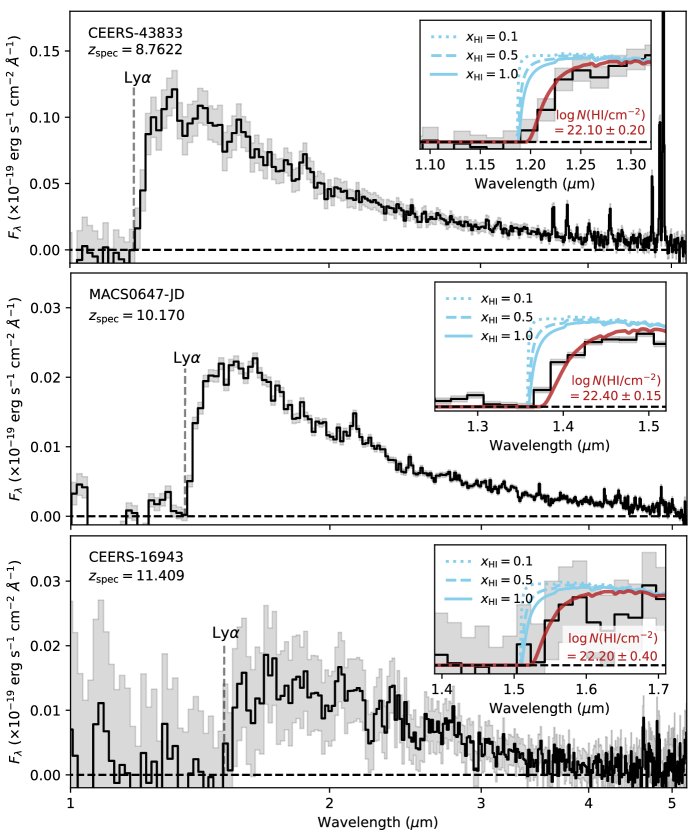
- 通过将 IGM Gunn-Peterson 阻尼与局部 DL A (Voigt) 分布相结合来建模 Lyα 吸收以拟合 N_HI。
- 使用贝叶斯多模态嵌套采样(PyMultiNest)来约束自由参数:A_V、x_HI、N_HI。
- 以 BPASS+Cloudy 模板固定固有连续体,并评估对模板选择的鲁棒性(Δlog N_HI ≲ 0.1 dex)。
- 探索 IGM 情景(x_HI = 0.1、0.5、1.0),并与视线模拟比较以将吸收归因于星系周围的本地 HI。
实验结果
研究问题
- RQ1在形成于 z≈9–11 的星系的近环境中,HI 的柱密度是多少?
- RQ2在这些星系周围的局部 HI(DLA)对 Lyα 阴影相比 IGM 的阻尼翼贡献有多大?
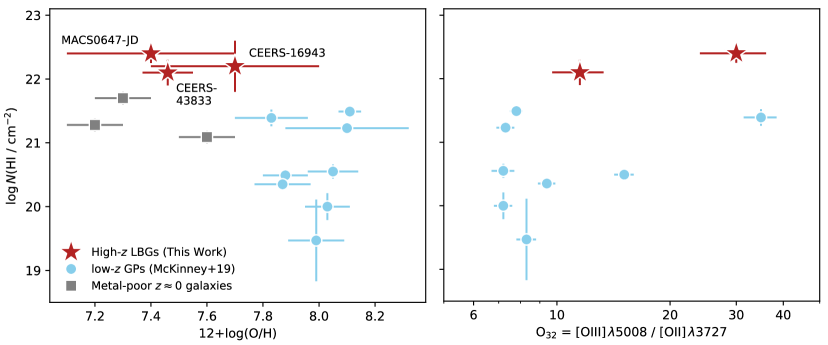
- RQ3这些星系的物理性质(SFR、金属丰度、恒星质量、气体含量)是多少,它们与低红移的类似对象有何差异?
- RQ4观测到的 HI 储库是否与星系形成模拟在气体吸积和气体分数方面的预测一致?
主要发现
- 三者皆呈现极端 DLA,log10(N_HI/cm^-2) = 22.10 ± 0.20 (CEERS-43833),22.20 ± 0.40 (CEERS-16943),与 22.40 ± 0.15 (MACS0647-JD)。
- DLA 主导 Lyα 吸收,超出 IGM 阻尼翼,表明存在于星系近环境中的 HI,而不仅仅是 IGM 中性的结果。
- 推导的 HI 质量表明周围星系气体相当丰富,估计 HI 质量在 ~10^7.5–10^9 M_sun,样本的气体质量分数 M_gas/M_* 约为 5。
- SFR 的范围约为 ~1.4 到 14.5 M_sun/yr(来自肢解线),恒星质量约为 ~10^8–10^9 M_sun,金属丰度低(12+log(O/H) ≈ 7.4–7.7)。
- 从 DLA 推断的气体表面密度较高,提示有可能比仅从 DLA 推断的总气体储量更大,可能需要符合 KS 的总气质量。
- 模拟(Astraeus)预测的气体质量与气体分数与观测到的高-z 系统大致一致,暗示在早期时期存在活跃的气体积累。
更好的研究,从现在开始
从阅读论文到最终审阅,大幅缩短您的研究时间。
无需绑定信用卡
本解读由 AI 生成,并经人工编辑审核。