
[论文解读] Fair coins tend to land on the same side they started: Evidence from 350,757 flips
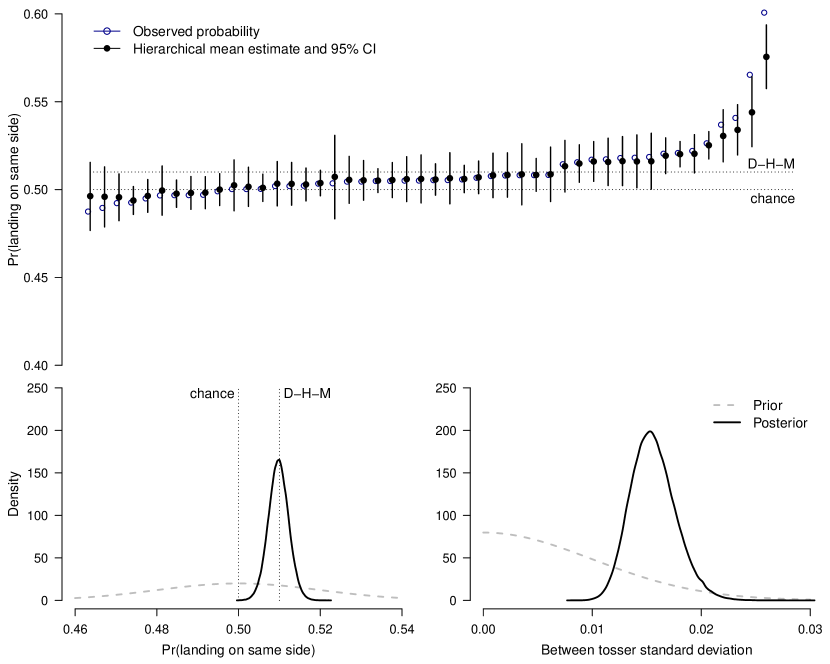
这项对350,757次硬币抛掷的大规模研究为Diaconis、Holmes与Montgomery(2007年)提出的基于物理的模型提供了强有力的实证支持,该模型预测:由于人类抛掷时的微小进动,公平硬币倾向于以起始面落地。数据显示,相同面朝上的偏差具有统计学显著性,比例为50.8%(95%可信区间[0.506, 0.509]),且个体间存在显著差异,证实尽管硬币本身是公平的,但人类抛掷仍会引入可预测的物理偏差。
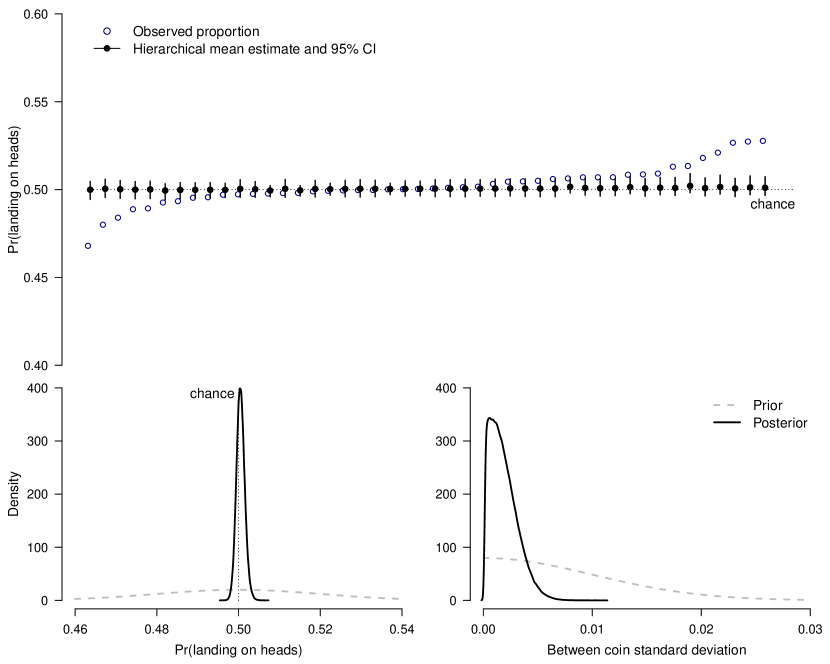
Many people have flipped coins but few have stopped to ponder the statistical and physical intricacies of the process. We collected $350{,}757$ coin flips to test the counterintuitive prediction from a physics model of human coin tossing developed by Diaconis, Holmes, and Montgomery (DHM; 2007). The model asserts that when people flip an ordinary coin, it tends to land on the same side it started -- DHM estimated the probability of a same-side outcome to be about 51\%. Our data lend strong support to this precise prediction: the coins landed on the same side more often than not, $ ext{Pr}( ext{same side}) = 0.508$, 95\% credible interval (CI) [$0.506$, $0.509$], $ ext{BF}_{ ext{same-side bias}} = 2359$. Furthermore, the data revealed considerable between-people variation in the degree of this same-side bias. Our data also confirmed the generic prediction that when people flip an ordinary coin -- with the initial side-up randomly determined -- it is equally likely to land heads or tails: $ ext{Pr}( ext{heads}) = 0.500$, 95\% CI [$0.498$, $0.502$], $ ext{BF}_{ ext{heads-tails bias}} = 0.182$. Furthermore, this lack of heads-tails bias does not appear to vary across coins. Additional analyses revealed that the within-people same-side bias decreased as more coins were flipped, an effect that is consistent with the possibility that practice makes people flip coins in a less wobbly fashion. Our data therefore provide strong evidence that when some (but not all) people flip a fair coin, it tends to land on the same side it started.
研究动机与目标
- 检验D-H-M物理模型所提出的反直觉预测:即人类抛掷的公平硬币倾向于以起始面落地。
- 调查这种相同面朝上的偏差是否在不同个体间保持一致,以及是否存在个体间差异。
- 检查当起始面随机化时,正面或反面朝上的总体概率是否仍为50%,以确认不存在正反面偏差。
- 评估相同面朝上偏差在现实决策场景中的实际影响。
- 使用来自多样化参与者的大型预注册数据集,对D-H-M模型进行验证。
提出的方法
- 一项预注册的、大规模的数据收集工作,包含来自多样化群体的350,757次独立硬币抛掷。
- 参与者使用其偏好的方式抛掷标准的美国和荷兰硬币,起始面(正面或反面朝上)随机分配。
- 每次抛掷均通过视频记录,并经过审核以确保数据质量并防止操纵。
- 统计分析采用贝叶斯推断来估计相同面结果的概率以及正反面偏差,使用贝叶斯因子进行模型比较。
- 分析中纳入了被试内变异,以评估个体在相同面偏差程度上的差异。
- 数据与材料已通过开放科学框架(OSF)公开,以确保透明度和可复现性。
实验结果
研究问题
- RQ1根据D-H-M物理模型的预测,硬币以起始面落地的概率是否超过50%?
- RQ2不同硬币抛掷者之间,相同面朝上的偏差程度是否存在显著的个体差异?
- RQ3当起始面随机化时,硬币落地为正面的总体概率是否等于50%,表明不存在正反面偏差?
- RQ4观察到的相同面朝上偏差在现实决策场景中具有多大程度的实际影响?
- RQ5能否使用大规模、高质量的数据集,实证确认D-H-M模型预测的51%相同面朝上偏差?
主要发现
- 硬币以起始面落地的概率为50.8%,95%可信区间为[0.506, 0.509],为相同面朝上偏差提供了强有力证据。
- 相同面朝上偏差的贝叶斯因子为2364,表明对D-H-M模型预测有极强支持。
- 在相同面朝上偏差的程度上,个体间存在显著差异,表明抛掷手法存在个体差异。
- 正面朝上的总体概率为50.0%,95%可信区间为[0.498, 0.502],贝叶斯因子为0.183,表明有强有力证据否定正反面偏差的存在。
- 相同面朝上偏差在不同类型的硬币中保持一致,表明该偏差并非依赖于硬币的特定属性。
- 模拟显示,若知晓起始面,1,000次投注中可获得19美元利润,表明在重复投注场景中存在策略优势。
更好的研究,从现在开始
从阅读论文到最终审阅,大幅缩短您的研究时间。
无需绑定信用卡
本解读由 AI 生成,并经人工编辑审核。